




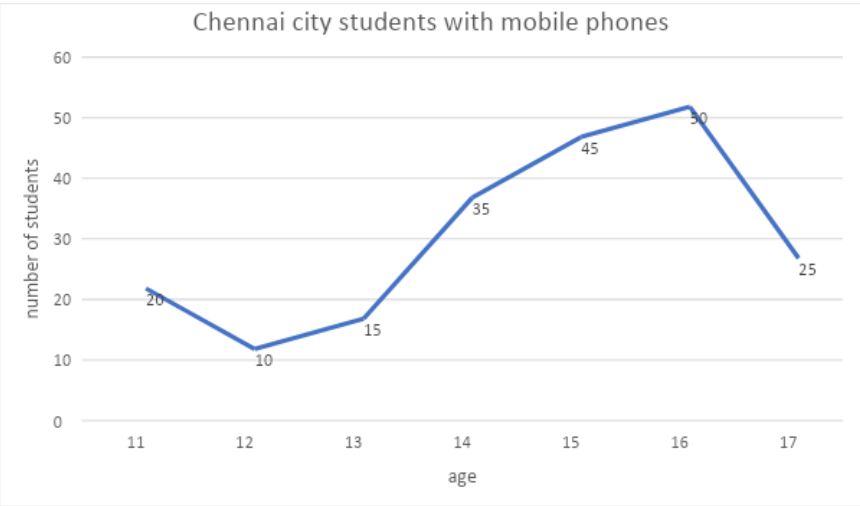
Find out how many students of $14\dfrac{1}{2}$ year olds have mobile phones.
A. 20
B. 30
C. 40
D. 50
Answer
 Verified
577.5k+ views
Hint: We first find the axes and also find out the variables they represent. Then we find the individual value of the number of students of $14\dfrac{1}{2}$ years between 14 and 15. We find the base of the perpendicular drawn from the top of that point.
Complete step-by-step solution:
In the given graphical representation, there are two axes. The X-axis represents the age of students. There are 7 entries, 11 to 17. The Y-axis represents the number of students.
We need to find out the number of students of $14\dfrac{1}{2}$ year old who have mobile phones.
We first find out the position of the point $14\dfrac{1}{2}$ on the X-axis.
From the marking of the individual bar graphs, we can see that the 14 and 15 have their individual points and the point $14\dfrac{1}{2}$ has a point in between them.
So, the point is exactly in the middle of 14 and 15.
We draw a perpendicular line to the X-axis from the point $14\dfrac{1}{2}$ on the Y-axis.
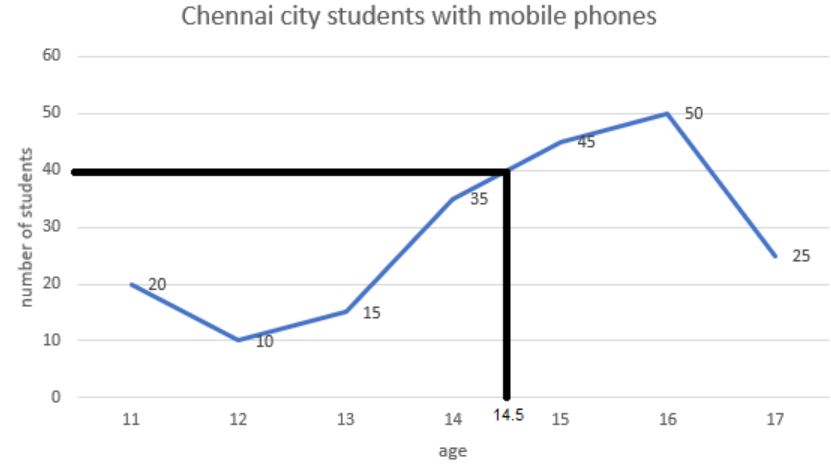
The intersecting point being at the point of 40.
So, 40 students of $14\dfrac{1}{2}$ year olds have mobile phones. The correct option is (C).
Note: If the individual values of those ages are not mentioned then we need to draw a perpendicular line from the top of the points of those individual numbers on the Y-axis to find out the values. The line will touch the axis at a fixed point and that will help to find the exact value. We have a linear line form of the Y-axis from point 35 to 45. The value of the X-axis changes from 14 to 15. So, a unitary change of x gives us a 10-unit change of y in that interval. Being in linear form when we change the value of x from 14 to 14.5, for $\dfrac{1}{2}$ unit change value of y changes 5 units. That’s why the intersecting point is on the point of $35+5=40$.
Complete step-by-step solution:
In the given graphical representation, there are two axes. The X-axis represents the age of students. There are 7 entries, 11 to 17. The Y-axis represents the number of students.
We need to find out the number of students of $14\dfrac{1}{2}$ year old who have mobile phones.
We first find out the position of the point $14\dfrac{1}{2}$ on the X-axis.
From the marking of the individual bar graphs, we can see that the 14 and 15 have their individual points and the point $14\dfrac{1}{2}$ has a point in between them.
So, the point is exactly in the middle of 14 and 15.
We draw a perpendicular line to the X-axis from the point $14\dfrac{1}{2}$ on the Y-axis.
The intersecting point being at the point of 40.
So, 40 students of $14\dfrac{1}{2}$ year olds have mobile phones. The correct option is (C).
Note: If the individual values of those ages are not mentioned then we need to draw a perpendicular line from the top of the points of those individual numbers on the Y-axis to find out the values. The line will touch the axis at a fixed point and that will help to find the exact value. We have a linear line form of the Y-axis from point 35 to 45. The value of the X-axis changes from 14 to 15. So, a unitary change of x gives us a 10-unit change of y in that interval. Being in linear form when we change the value of x from 14 to 14.5, for $\dfrac{1}{2}$ unit change value of y changes 5 units. That’s why the intersecting point is on the point of $35+5=40$.
Recently Updated Pages
Master Class 10 Computer Science: Engaging Questions & Answers for Success

Master Class 10 General Knowledge: Engaging Questions & Answers for Success
Master Class 10 English: Engaging Questions & Answers for Success
Master Class 10 Social Science: Engaging Questions & Answers for Success
Master Class 10 Maths: Engaging Questions & Answers for Success
Master Class 10 Science: Engaging Questions & Answers for Success
Trending doubts
What is the median of the first 10 natural numbers class 10 maths CBSE
Which women's tennis player has 24 Grand Slam singles titles?
Who is the Brand Ambassador of Incredible India?
Why is there a time difference of about 5 hours between class 10 social science CBSE
Write a letter to the principal requesting him to grant class 10 english CBSE
A moving boat is observed from the top of a 150 m high class 10 maths CBSE