




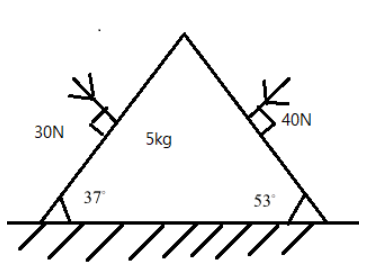
Find normal reaction force exerted by ground on the block
Answer
 Verified
622.5k+ views
Hint: We know that normal force is one of the main components of contact force which acts perpendicular to the surface. This is the force which is responsible for balancing the weight of the object on the surface. This is responsible for the friction between the object and the surface.
Formula:
$F=W+40cos53+30cos37$
Complete answer:
Let us assume the free body diagram of the given diagram.
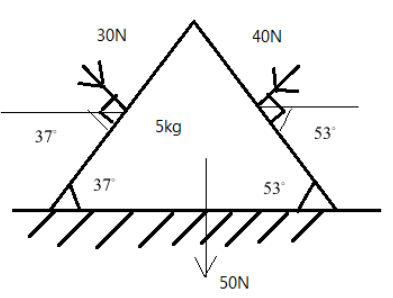
Then clearly, the triangle block exerts an exert weight $W$ due to the force of gravity. Also we can resolve the components of the force which are acting on the sides of the triangle. Then using the base angles, we get
$F=W+40cos53+30cos37$
$\implies F=50+40\times\dfrac{3}{5}+30\times\dfrac{4}{5}$
$\implies F=50+24+24$
$\implies F=98N$
Thus the total force on the block is $98\;N$, this acts vertically in the downward direction.
From Newton's third law of motion, we know that every action has an equal and opposite reaction. Since the block exerts a force of $98\;N$ on the ground, we can also say from Newton's third law that the ground also exerts a force of $98\;N$ on the block.
Thus the required answer is that the ground exerts a force of $98\;N$ on the block.
Note:
The normal force plays an important role in the friction it is used to define the Coefficient of static friction .Also, Coefficient of static friction is a dimensionless quantity, $\mu_{s}$ is the maximum resistive force applied on any given body such that there is no change in state of the motion. It is given as $\mu_{s}=\dfrac{F_{s}}{F_{n}}$, where $F_{s}$ is the applied force and $F_{n}$ is the normal force acting on the given body.
Formula:
$F=W+40cos53+30cos37$
Complete answer:
Let us assume the free body diagram of the given diagram.
Then clearly, the triangle block exerts an exert weight $W$ due to the force of gravity. Also we can resolve the components of the force which are acting on the sides of the triangle. Then using the base angles, we get
$F=W+40cos53+30cos37$
$\implies F=50+40\times\dfrac{3}{5}+30\times\dfrac{4}{5}$
$\implies F=50+24+24$
$\implies F=98N$
Thus the total force on the block is $98\;N$, this acts vertically in the downward direction.
From Newton's third law of motion, we know that every action has an equal and opposite reaction. Since the block exerts a force of $98\;N$ on the ground, we can also say from Newton's third law that the ground also exerts a force of $98\;N$ on the block.
Thus the required answer is that the ground exerts a force of $98\;N$ on the block.
Note:
The normal force plays an important role in the friction it is used to define the Coefficient of static friction .Also, Coefficient of static friction is a dimensionless quantity, $\mu_{s}$ is the maximum resistive force applied on any given body such that there is no change in state of the motion. It is given as $\mu_{s}=\dfrac{F_{s}}{F_{n}}$, where $F_{s}$ is the applied force and $F_{n}$ is the normal force acting on the given body.
Recently Updated Pages
Master Class 11 English: Engaging Questions & Answers for Success

Master Class 11 Social Science: Engaging Questions & Answers for Success
Master Class 11 Maths: Engaging Questions & Answers for Success
Master Class 11 Biology: Engaging Questions & Answers for Success
Master Class 11 Physics: Engaging Questions & Answers for Success
Master Class 11 Chemistry: Engaging Questions & Answers for Success
Trending doubts
One Metric ton is equal to kg A 10000 B 1000 C 100 class 11 physics CBSE
Difference Between Prokaryotic Cells and Eukaryotic Cells
Two of the body parts which do not appear in MRI are class 11 biology CBSE
Find the value of the expression given below sin 30circ class 11 maths CBSE
Draw a diagram of a plant cell and label at least eight class 11 biology CBSE
10 examples of friction in our daily life