



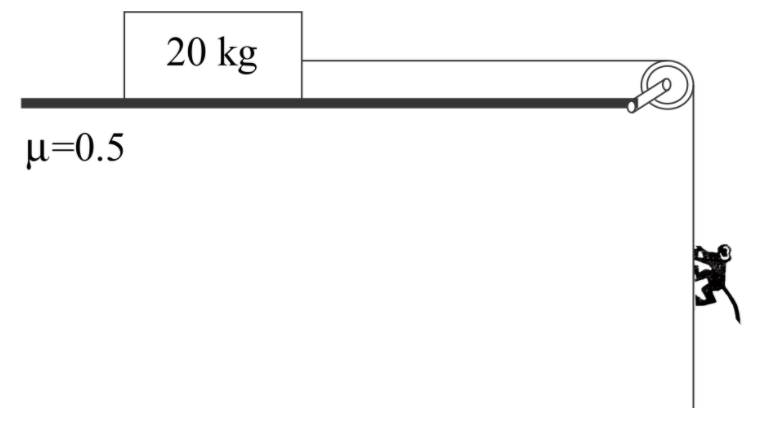
Find maximum acceleration of a monkey of mass $5kg$, so that the block remains stationary.
A) $5m{s^{ - 2}}$
B) $10m{s^{ - 2}}$
C) $20m{s^{ - 2}}$
D) $6.67m{s^{ - 2}}$
Answer
 Verified
596.7k+ views
Hint: The block has to remain stationary, which means the net force on the block will be zero. So, the friction force should be working at its maximum on the block, that will be opposing the motion of the block in forward direction, which is due to the tension created in the string due to the motion of the monkey.
Complete step by step answer:
Maximum friction force $fr$ acting on the block in backward direction is $\mu N$
Where $\mu $ is coefficient of friction and
$N$ is a normal reaction of the block.
And $N = mg$
Where $m$ is mass of block and $g$ is gravity.
So, $fr = \mu mg$
Using values given in question, we get
$fr = 0.5 \times 20 \times 10$
On solving this we get
$fr = 100N$
Now, the force acting on the block in forward direction ( $F$ ) is the force by which the rope is pulling the block in forward direction. And the force by which rope is pulling is the sum of weight of monkey and the force by which monkey is pulling rope, that is, mass of monkeys times it’s upward acceleration.
So, $F = {m_{monkey}}g + {m_{monkey}}a$
Where $a$ is maximum acceleration by which monkey can move upwards so that the block doesn’t move.
Using values given in question we get,
$F = 5 \times 10 + 5 \times a$
On solving, we get,
$F = 50 + 5a$
Now, $F = fr$ So that net force on the block is zero, that is, block doesn’t move.
So, we get
$50 + 5a = 100$
On further solving we get,
$a = 10m{s^{ - 2}}$
So, the maximum acceleration by which monkey can move upward so that the block doesn’t move is $10m{s^{ - 2}}$
Hence the correct answer is option (B)
Note: The force by which rope is pulling is the sum of weight of monkey and the force by which monkey is pulling rope because the weight of monkey and monkey pulling force on the rope will be both in downward direction and this whole force is applied to rope in downward direction.
Complete step by step answer:
Maximum friction force $fr$ acting on the block in backward direction is $\mu N$
Where $\mu $ is coefficient of friction and
$N$ is a normal reaction of the block.
And $N = mg$
Where $m$ is mass of block and $g$ is gravity.
So, $fr = \mu mg$
Using values given in question, we get
$fr = 0.5 \times 20 \times 10$
On solving this we get
$fr = 100N$
Now, the force acting on the block in forward direction ( $F$ ) is the force by which the rope is pulling the block in forward direction. And the force by which rope is pulling is the sum of weight of monkey and the force by which monkey is pulling rope, that is, mass of monkeys times it’s upward acceleration.
So, $F = {m_{monkey}}g + {m_{monkey}}a$
Where $a$ is maximum acceleration by which monkey can move upwards so that the block doesn’t move.
Using values given in question we get,
$F = 5 \times 10 + 5 \times a$
On solving, we get,
$F = 50 + 5a$
Now, $F = fr$ So that net force on the block is zero, that is, block doesn’t move.
So, we get
$50 + 5a = 100$
On further solving we get,
$a = 10m{s^{ - 2}}$
So, the maximum acceleration by which monkey can move upward so that the block doesn’t move is $10m{s^{ - 2}}$
Hence the correct answer is option (B)
Note: The force by which rope is pulling is the sum of weight of monkey and the force by which monkey is pulling rope because the weight of monkey and monkey pulling force on the rope will be both in downward direction and this whole force is applied to rope in downward direction.
Recently Updated Pages
Master Class 11 Social Science: Engaging Questions & Answers for Success

Master Class 11 Physics: Engaging Questions & Answers for Success
Master Class 11 Maths: Engaging Questions & Answers for Success
Master Class 11 Economics: Engaging Questions & Answers for Success
Master Class 11 Computer Science: Engaging Questions & Answers for Success
Master Class 11 Chemistry: Engaging Questions & Answers for Success
Trending doubts
One Metric ton is equal to kg A 10000 B 1000 C 100 class 11 physics CBSE
There are 720 permutations of the digits 1 2 3 4 5 class 11 maths CBSE
1 Quintal is equal to a 110 kg b 10 kg c 100kg d 1000 class 11 physics CBSE
State and prove Bernoullis theorem class 11 physics CBSE
Difference Between Prokaryotic Cells and Eukaryotic Cells
Discuss the various forms of bacteria class 11 biology CBSE