




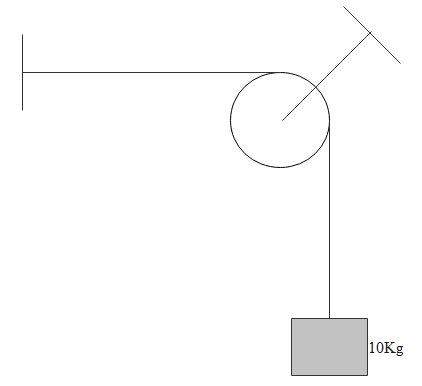
Find magnitude of force exerted by string on the pulley.
A. $100{\text{ N}}$
B. $100\sqrt 2 {\text{ N}}$
C. $200{\text{ N}}$
D. $\sqrt {100} {\text{ N}}$
Answer
 Verified
585.3k+ views
Hint: When a block is connected to the string and when it was given that the system is in equilibrium then here must be some force that balances the weight of the block and that force will be the tension and that will be equal to weight and tension is always a pulling force.
Formula used:
$\eqalign{
& {\text{T = mg}} \cr
& \cr} $
Complete answer:
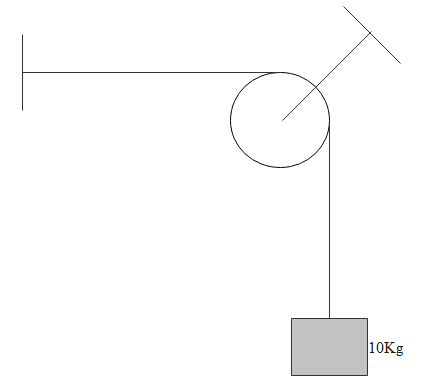
The string used here is the same i.e the vertical portion of the string which connects the block and pulley and the horizontal portion of the string which connects the support and the pulley is the same. As long as the string is the same and massless the tension will be the same for both the portions. Since the system is in equilibrium the weight of the block is compensated by the tension in the string. So the weight of the block is a product of mass and acceleration due to gravity. Let the weight be W and mass be ‘m’ and acceleration due to gravity be ‘g’.
So the weight will be
${\text{W = mg}}$
Mass is given as 10Kg and acceleration due to gravity is $10kg/{m^2}$
${\text{W = mg}}$
$\eqalign{
& \Rightarrow W{\text{ }} = {\text{ }}10 \times 10 \cr
& \Rightarrow W{\text{ }} = {\text{ }}100N \cr} $
And the tension is ‘T’ is equal to the weight.
$\eqalign{
& {\text{T = mg}} \cr
& \cr} $
$\eqalign{
& \Rightarrow {\text{T = 100N}} \cr
& \cr} $
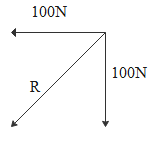
Since the angle between the two tensions is ninety degrees. The resultant will be
$\sqrt {{{100}^2} + {{100}^2}} = 100\sqrt 2 $
So, the correct answer is “Option B”.
Note:
The resultant of the tension forces will be the force acting on the pulley. That force will pass through the center of the pulley hence the torque produced by that force about the pulley center will be zero. Even though if we take the torques produced by the two forces individually the net torque will be zero.
Formula used:
$\eqalign{
& {\text{T = mg}} \cr
& \cr} $
Complete answer:
The string used here is the same i.e the vertical portion of the string which connects the block and pulley and the horizontal portion of the string which connects the support and the pulley is the same. As long as the string is the same and massless the tension will be the same for both the portions. Since the system is in equilibrium the weight of the block is compensated by the tension in the string. So the weight of the block is a product of mass and acceleration due to gravity. Let the weight be W and mass be ‘m’ and acceleration due to gravity be ‘g’.
So the weight will be
${\text{W = mg}}$
Mass is given as 10Kg and acceleration due to gravity is $10kg/{m^2}$
${\text{W = mg}}$
$\eqalign{
& \Rightarrow W{\text{ }} = {\text{ }}10 \times 10 \cr
& \Rightarrow W{\text{ }} = {\text{ }}100N \cr} $
And the tension is ‘T’ is equal to the weight.
$\eqalign{
& {\text{T = mg}} \cr
& \cr} $
$\eqalign{
& \Rightarrow {\text{T = 100N}} \cr
& \cr} $
Since the angle between the two tensions is ninety degrees. The resultant will be
$\sqrt {{{100}^2} + {{100}^2}} = 100\sqrt 2 $
So, the correct answer is “Option B”.
Note:
The resultant of the tension forces will be the force acting on the pulley. That force will pass through the center of the pulley hence the torque produced by that force about the pulley center will be zero. Even though if we take the torques produced by the two forces individually the net torque will be zero.
Recently Updated Pages
Master Class 11 Computer Science: Engaging Questions & Answers for Success

Master Class 11 Business Studies: Engaging Questions & Answers for Success
Master Class 11 Economics: Engaging Questions & Answers for Success
Master Class 11 English: Engaging Questions & Answers for Success
Master Class 11 Maths: Engaging Questions & Answers for Success
Master Class 11 Biology: Engaging Questions & Answers for Success
Trending doubts
There are 720 permutations of the digits 1 2 3 4 5 class 11 maths CBSE
Discuss the various forms of bacteria class 11 biology CBSE
Explain zero factorial class 11 maths CBSE
What organs are located on the left side of your body class 11 biology CBSE
Draw a diagram of nephron and explain its structur class 11 biology CBSE
How do I convert ms to kmh Give an example class 11 physics CBSE