



How do you find legs in a 45-45-90 triangle when its hypotenuse is 11?
Answer
 Verified
590.7k+ views
Hint: As per the given data, two angles of the triangle are equal and the third angle is ${90^ \circ }$. Thus this is an isosceles right angled triangle with the length of its hypotenuse is given as 11 units. Assume the other two sides of a variable and then use Pythagoras theorem to find its value.
Complete step-by-step solution:
According to the question, specifications of a triangle are given to us. We have to obtain the length of its base.
The angles of the triangle are given as ${45^ \circ }$, ${45^ \circ }$ and ${90^ \circ }$. Since two of its angles are the same and the third one is a right angle, the triangle is a right angled triangle.
The length of its hypotenuse is also given and it is 11 units. Let the lengths of its base and height are both $x$ units. These conditions are shown in the below figure:
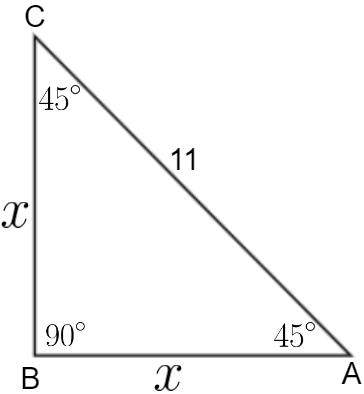
Now, we know that according to the Pythagoras theorem:
\[ \Rightarrow {\left( {{\text{Hypotenuse}}} \right)^2} = {\left( {{\text{Base}}} \right)^2} + {\left( {{\text{Height}}} \right)^2}\]
Putting all the values from the figure in this formula, we’ll get:
\[ \Rightarrow {\left( {11} \right)^2} = {\left( x \right)^2} + {\left( x \right)^2}\]
Simplifying it further, we’ll get:
$
\Rightarrow {x^2} + {x^2} = 121 \\
\Rightarrow 2{x^2} = 121 \\
\Rightarrow {x^2} = \dfrac{{121}}{2}
$
Taking square root both sides, this will give us:
\[
\Rightarrow x = \sqrt {\dfrac{{121}}{2}} = \dfrac{{11}}{{\sqrt 2 }} \\
\Rightarrow x = \dfrac{{11\sqrt 2 }}{2}
\]
Taking its approximate decimal value, this will be:
$
\Rightarrow x = \dfrac{{11 \times 1.414}}{2} = \dfrac{{15.554}}{2} \\
\Rightarrow x = 7.77
$
Thus the lengths of both base and height of the triangle is \[\dfrac{{11\sqrt 2 }}{2}\] or 7.77 units.
Note: (1) If two angles of a triangle are equal then it is called isosceles triangle and if the third angle measures ${90^ \circ }$ then the triangle is called isosceles right angled triangle.
(2) If one of the angles of a triangle measures more than ${90^ \circ }$ then the triangle is called an obtuse angled triangle.
(3) And if all of the angles of a triangle measure less than ${90^ \circ }$ then the triangle is called an acute angled triangle.
Complete step-by-step solution:
According to the question, specifications of a triangle are given to us. We have to obtain the length of its base.
The angles of the triangle are given as ${45^ \circ }$, ${45^ \circ }$ and ${90^ \circ }$. Since two of its angles are the same and the third one is a right angle, the triangle is a right angled triangle.
The length of its hypotenuse is also given and it is 11 units. Let the lengths of its base and height are both $x$ units. These conditions are shown in the below figure:
Now, we know that according to the Pythagoras theorem:
\[ \Rightarrow {\left( {{\text{Hypotenuse}}} \right)^2} = {\left( {{\text{Base}}} \right)^2} + {\left( {{\text{Height}}} \right)^2}\]
Putting all the values from the figure in this formula, we’ll get:
\[ \Rightarrow {\left( {11} \right)^2} = {\left( x \right)^2} + {\left( x \right)^2}\]
Simplifying it further, we’ll get:
$
\Rightarrow {x^2} + {x^2} = 121 \\
\Rightarrow 2{x^2} = 121 \\
\Rightarrow {x^2} = \dfrac{{121}}{2}
$
Taking square root both sides, this will give us:
\[
\Rightarrow x = \sqrt {\dfrac{{121}}{2}} = \dfrac{{11}}{{\sqrt 2 }} \\
\Rightarrow x = \dfrac{{11\sqrt 2 }}{2}
\]
Taking its approximate decimal value, this will be:
$
\Rightarrow x = \dfrac{{11 \times 1.414}}{2} = \dfrac{{15.554}}{2} \\
\Rightarrow x = 7.77
$
Thus the lengths of both base and height of the triangle is \[\dfrac{{11\sqrt 2 }}{2}\] or 7.77 units.
Note: (1) If two angles of a triangle are equal then it is called isosceles triangle and if the third angle measures ${90^ \circ }$ then the triangle is called isosceles right angled triangle.
(2) If one of the angles of a triangle measures more than ${90^ \circ }$ then the triangle is called an obtuse angled triangle.
(3) And if all of the angles of a triangle measure less than ${90^ \circ }$ then the triangle is called an acute angled triangle.

Recently Updated Pages
Master Class 12 Economics: Engaging Questions & Answers for Success

Master Class 12 English: Engaging Questions & Answers for Success
Master Class 12 Social Science: Engaging Questions & Answers for Success
Master Class 12 Maths: Engaging Questions & Answers for Success
Master Class 12 Physics: Engaging Questions & Answers for Success
Master Class 9 General Knowledge: Engaging Questions & Answers for Success
Trending doubts
Find the sum of series 1 + 2 + 3 + 4 + 5 + + 100 class 9 maths CBSE
Difference Between Plant Cell and Animal Cell
Fill the blanks with the suitable prepositions 1 The class 9 english CBSE
What is pollution? How many types of pollution? Define it
Name 10 Living and Non living things class 9 biology CBSE
What is the full form of pH?