



How do you find horizontal asymptotes for \[f\left( x \right)={{\tan }^{-1}}\left( x \right)\] ?
Answer
 Verified
574.8k+ views
Hint: To solve these types of problems efficiently, one has to have a fair knowledge of graph theory and asymptotes of a graph. Knowledge of inverse functions is also necessary. Asymptotes are defined as the lines, which meet a curve at infinity. In these types of questions, we first plot the graph for the original trigonometric function, here which is \[\tan \left( x \right)\] and then take its reflection about the line \[y=x\] to draw the graph of its inverse function. This is pretty much the straight forward rule to draw the graph for inverse functions.
Complete step by step answer:
Now starting off with the problem, we know that, when we try to calculate the value of \[\tan \left( \dfrac{\pi }{2} \right)\] or \[\tan \left( -\dfrac{\pi }{2} \right)\] or \[\tan \left( \dfrac{n\pi }{2} \right)\] (where ‘n’ is any integer, positive or negative), it comes out to be undefined, which means that the vertical line \[x=n\dfrac{\pi }{2}\] is an asymptote of the curve \[\tan \left( x \right)\] . Now since the reflection of the curve \[y=\tan \left( x \right)\] about the line \[y=x\] gives the graph for the inverse curve that is \[y={{\tan }^{-1}}\left( x \right)\], reflection of \[x=n\dfrac{\pi }{2}\] about the line \[y=x\] will also give the required equation of the horizontal asymptote. Thus we can safely say that \[y={{\tan }^{-1}}\left( \infty \right)\] and \[y={{\tan }^{-1}}\left( -\infty \right)\] will be the equations of the horizontal asymptotes of the equation \[y={{\tan }^{-1}}\left( x \right)\] . We can further write that \[y={{\tan }^{-1}}\left( \tan \left( \dfrac{n\pi }{2} \right) \right)\] is the general equation for the asymptote. Thus,
\[y=\dfrac{n\pi }{2}\] , is the equation of the horizontal asymptote, where ‘n’ is any integer, positive or negative.
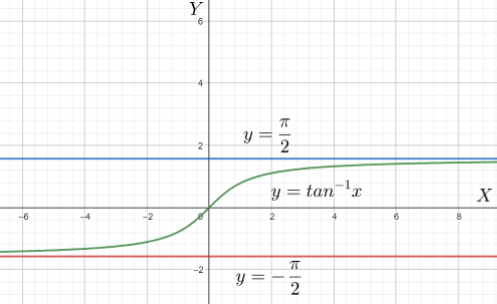
Note: We have to be very careful regarding the domain and range of the problem. In this question since no domain and range is given, the method done here is a more generalized one. After plotting the graph, we need to closely analyse for the lines which may meet the graph at infinity.
Complete step by step answer:
Now starting off with the problem, we know that, when we try to calculate the value of \[\tan \left( \dfrac{\pi }{2} \right)\] or \[\tan \left( -\dfrac{\pi }{2} \right)\] or \[\tan \left( \dfrac{n\pi }{2} \right)\] (where ‘n’ is any integer, positive or negative), it comes out to be undefined, which means that the vertical line \[x=n\dfrac{\pi }{2}\] is an asymptote of the curve \[\tan \left( x \right)\] . Now since the reflection of the curve \[y=\tan \left( x \right)\] about the line \[y=x\] gives the graph for the inverse curve that is \[y={{\tan }^{-1}}\left( x \right)\], reflection of \[x=n\dfrac{\pi }{2}\] about the line \[y=x\] will also give the required equation of the horizontal asymptote. Thus we can safely say that \[y={{\tan }^{-1}}\left( \infty \right)\] and \[y={{\tan }^{-1}}\left( -\infty \right)\] will be the equations of the horizontal asymptotes of the equation \[y={{\tan }^{-1}}\left( x \right)\] . We can further write that \[y={{\tan }^{-1}}\left( \tan \left( \dfrac{n\pi }{2} \right) \right)\] is the general equation for the asymptote. Thus,
\[y=\dfrac{n\pi }{2}\] , is the equation of the horizontal asymptote, where ‘n’ is any integer, positive or negative.
Note: We have to be very careful regarding the domain and range of the problem. In this question since no domain and range is given, the method done here is a more generalized one. After plotting the graph, we need to closely analyse for the lines which may meet the graph at infinity.
Recently Updated Pages
Master Class 12 Social Science: Engaging Questions & Answers for Success

Master Class 12 Physics: Engaging Questions & Answers for Success
Master Class 12 Maths: Engaging Questions & Answers for Success
Master Class 12 Economics: Engaging Questions & Answers for Success
Master Class 12 Chemistry: Engaging Questions & Answers for Success
Master Class 12 Business Studies: Engaging Questions & Answers for Success
Trending doubts
Which are the Top 10 Largest Countries of the World?
Draw a labelled sketch of the human eye class 12 physics CBSE
What are the major means of transport Explain each class 12 social science CBSE
Differentiate between homogeneous and heterogeneous class 12 chemistry CBSE
Sulphuric acid is known as the king of acids State class 12 chemistry CBSE
How many 176Omega resistors in parallel are required class 12 physics CBSE