




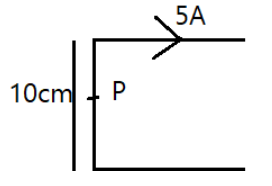
Find force per unit length at P
\[\begin{align}
& A{{.10}^{-4}}m \\
& B{{.10}^{-4}}N/m \\
& C.3\times {{10}^{-4}}N/m \\
& D.0.3N/m \\
\end{align}\]
Answer
 Verified
634.2k+ views
Hint: Here, the dimensions of the rectangular wire and the current in the wire is given, then we can find the force experienced due to the wire. Here, we need to find the force per unit length, and then we can substitute the values.
Formula: $\vec F=I\vec l\times \vec B$
Complete answer:
We know that electricity and magnetism are interrelated. We know that a current carrying conductor can produce a magnetic field around itself. And similarly, a varying magnetic field induces a current in the wire which is kept in the near surrounding. We know that a current carrying conductor when placed in a magnetic field experiences a force.
The force $\vec F$ experienced by a current $I$ carrying wire of length $\vec l$ which is placed in a magnetic field $\vec B$ is given as $\vec F=I\vec l\times \vec B=Ilbsin\theta$, where $\theta$ is the angle made by the length vector to the magnetic field.
The direction of the force is given by the right hand rule, where the thumb, index and the middle finger are extended outwards, and are perpendicular to each other. If the thumb points towards the direction of current, the index finger points towards the direction of the magnetic field, then the middle finger points to the direction of the force.
Let us assume that the P is the midpoint of the given wire. If the current flows through the wire, then from the right hand thumb rule, we can say that the magnetic field is into the paper, inside the ring.
We also know that the magnetic field $B$ for a straight wire is given as, $B=\dfrac{\mu_{0}i}{4\pi r}$. Clearly, the magnetic field at P is only due to the current in the wires above and below the point P. As the magnetic field is parallel to the point P, we can say that it is $0$.
Thus, we have, $B_{P}=2\times \dfrac{\mu_{0}i}{4\pi r}$.
$\implies B_{P}=\dfrac{2\mu_{0}\times 5}{4\pi \times 5\times 10^{-2}}$
$\implies B_{P}=\dfrac{2\mu_{0}}{4\pi\times 10^{-2}}$
Then, the $\dfrac{F}{dl}=iB$
$\implies \dfrac{F}{dl}=5\times\dfrac{2\mu_{0}}{4\pi\times 10^{-2}}$
$\implies \dfrac{F}{dl}=10\times 10^{-5}$
$\therefore \dfrac{F}{dl}=10^{-4}N/m$
Thus, the correct option is \[B{{.10}^{-4}}N/m\] .
Note:
We know that Force is a vector quantity, which has both magnitude and direction. Since the force is a cross product of both the line vector and the magnetic field, we can clearly say that the force is perpendicular to both the line vector and the magnetic field.
Formula: $\vec F=I\vec l\times \vec B$
Complete answer:
We know that electricity and magnetism are interrelated. We know that a current carrying conductor can produce a magnetic field around itself. And similarly, a varying magnetic field induces a current in the wire which is kept in the near surrounding. We know that a current carrying conductor when placed in a magnetic field experiences a force.
The force $\vec F$ experienced by a current $I$ carrying wire of length $\vec l$ which is placed in a magnetic field $\vec B$ is given as $\vec F=I\vec l\times \vec B=Ilbsin\theta$, where $\theta$ is the angle made by the length vector to the magnetic field.
The direction of the force is given by the right hand rule, where the thumb, index and the middle finger are extended outwards, and are perpendicular to each other. If the thumb points towards the direction of current, the index finger points towards the direction of the magnetic field, then the middle finger points to the direction of the force.
Let us assume that the P is the midpoint of the given wire. If the current flows through the wire, then from the right hand thumb rule, we can say that the magnetic field is into the paper, inside the ring.
We also know that the magnetic field $B$ for a straight wire is given as, $B=\dfrac{\mu_{0}i}{4\pi r}$. Clearly, the magnetic field at P is only due to the current in the wires above and below the point P. As the magnetic field is parallel to the point P, we can say that it is $0$.
Thus, we have, $B_{P}=2\times \dfrac{\mu_{0}i}{4\pi r}$.
$\implies B_{P}=\dfrac{2\mu_{0}\times 5}{4\pi \times 5\times 10^{-2}}$
$\implies B_{P}=\dfrac{2\mu_{0}}{4\pi\times 10^{-2}}$
Then, the $\dfrac{F}{dl}=iB$
$\implies \dfrac{F}{dl}=5\times\dfrac{2\mu_{0}}{4\pi\times 10^{-2}}$
$\implies \dfrac{F}{dl}=10\times 10^{-5}$
$\therefore \dfrac{F}{dl}=10^{-4}N/m$
Thus, the correct option is \[B{{.10}^{-4}}N/m\] .
Note:
We know that Force is a vector quantity, which has both magnitude and direction. Since the force is a cross product of both the line vector and the magnetic field, we can clearly say that the force is perpendicular to both the line vector and the magnetic field.
Recently Updated Pages
Master Class 11 Social Science: Engaging Questions & Answers for Success

Master Class 11 English: Engaging Questions & Answers for Success
Master Class 11 Accountancy: Engaging Questions & Answers for Success
Master Class 11 Physics: Engaging Questions & Answers for Success
Master Class 11 Computer Science: Engaging Questions & Answers for Success
Master Class 11 Business Studies: Engaging Questions & Answers for Success
Trending doubts
Find the value of the expression given below sin 30circ class 11 maths CBSE
One Metric ton is equal to kg A 10000 B 1000 C 100 class 11 physics CBSE
Draw a diagram of nephron and explain its structur class 11 biology CBSE
10 examples of friction in our daily life
Proton was discovered by A Thomson B Rutherford C Chadwick class 11 chemistry CBSE
The teeth used for biting and cutting food are called class 11 biology CBSE