




Find C and D in the given reaction.
\[\underset{(A)}{\mathop{Cyclopentadiene}}\,+\underset{(B)}{\mathop{Hexachlorocyclopentadiene}}\,\xrightarrow{\Delta }(C)\xrightarrow{C{{l}_{2}}/CC{{l}_{4}}}(D)\]
Answer
 Verified
665.1k+ views
Hint: Cyclopentadiene and Hexachlorocyclopentadiene give Diels alder reaction when heated. Chlorine in presence of Carbon tetrachloride will add chlorine gas to alkene double bonds.
Complete answer:
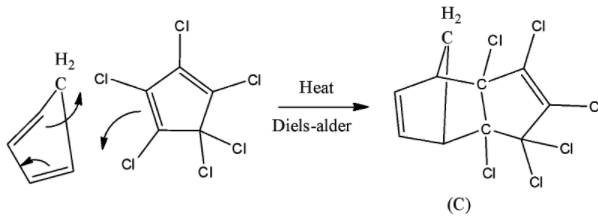
Two Cyclopentadiene rings react in presence of temperature to give Diels alder reaction. Let’s see how Cyclopentadiene will react with Hexachlorocyclopentadiene in presence of high temperature.
So, both compounds will undergo Diels-alder reaction.
- Here the double bonds in Hexachlorocyclopentadiene will be less nucleophilic because of chlorine atoms in comparison with Cyclopentadiene. So, two double bonds in Cyclopentadiene will act as a diene and one double bond of Hexachorocyclopentadiene will act as a dienophile which is less nucleophilic.
Now, Chlorine in Carbon tetrachloride is a reagent that will do addition reaction on alkene and will form two new C-Cl bonds. Let’s see this reaction also.
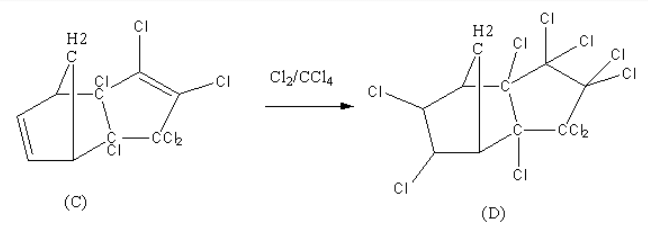
Thus we can say that (C) will be produced by Diels-alder reaction between Cyclopentadiene and Hexachlorocyclopentadiene . (D) is produced by an additional reaction where chlorine gas is added to two Carbon-Carbon double bonds.
Additional Information:
- Diels alder reaction is a kind of a (4 + 2) cycloaddition reaction. In this reaction, a conjugated diene reacts with a Dienophile and forms a cyclic structure. That’s why this reaction is called a cycloaddition reaction.
- Remember that in cycloaddition reactions, Diene donates electrons first, so it needs to be more nucleophilic than the Dienophile.
Note:
Remember that 4+4 cycloaddition reactions between Cyclopentadiene and Hexachlorocyclopentadiene do not occur. Chlorine in Carbon tetrachloride do not substitute chlorine atoms with H-atoms which are bonded to carbon.
Complete answer:
Two Cyclopentadiene rings react in presence of temperature to give Diels alder reaction. Let’s see how Cyclopentadiene will react with Hexachlorocyclopentadiene in presence of high temperature.
So, both compounds will undergo Diels-alder reaction.
- Here the double bonds in Hexachlorocyclopentadiene will be less nucleophilic because of chlorine atoms in comparison with Cyclopentadiene. So, two double bonds in Cyclopentadiene will act as a diene and one double bond of Hexachorocyclopentadiene will act as a dienophile which is less nucleophilic.
Now, Chlorine in Carbon tetrachloride is a reagent that will do addition reaction on alkene and will form two new C-Cl bonds. Let’s see this reaction also.
Thus we can say that (C) will be produced by Diels-alder reaction between Cyclopentadiene and Hexachlorocyclopentadiene . (D) is produced by an additional reaction where chlorine gas is added to two Carbon-Carbon double bonds.
Additional Information:
- Diels alder reaction is a kind of a (4 + 2) cycloaddition reaction. In this reaction, a conjugated diene reacts with a Dienophile and forms a cyclic structure. That’s why this reaction is called a cycloaddition reaction.
- Remember that in cycloaddition reactions, Diene donates electrons first, so it needs to be more nucleophilic than the Dienophile.
Note:
Remember that 4+4 cycloaddition reactions between Cyclopentadiene and Hexachlorocyclopentadiene do not occur. Chlorine in Carbon tetrachloride do not substitute chlorine atoms with H-atoms which are bonded to carbon.
Recently Updated Pages
Which will be the least stable resonating structure class 11 chemistry CBSE

How many 5 digit telephone numbers can be construc-class-11-maths-CBSE
How do you find the angle of the resultant vector class 11 physics CBSE
Draw labelled diagram of the following i Gram seed class 11 biology CBSE
1 Quintal is equal to a 110 kg b 10 kg c 100kg d 1000 class 11 physics CBSE
What is the need and importance of classification class 11 biology CBSE
Trending doubts
Find the value of the expression given below sin 30circ class 11 maths CBSE
One Metric ton is equal to kg A 10000 B 1000 C 100 class 11 physics CBSE
10 examples of friction in our daily life
Draw a diagram of a plant cell and label at least eight class 11 biology CBSE
Difference between physical and chemical change class 11 chemistry CBSE
Proton was discovered by A Thomson B Rutherford C Chadwick class 11 chemistry CBSE