



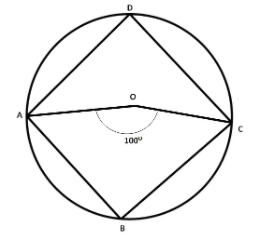
Find angle $\angle ADC$ and $\angle ABC$ in the following figure.
Answer
 Verified
592.8k+ views
Hint:
Here we have to find two angles $\angle ADC$ and $\angle ABC$. First we will find the angle $\angle ADC$ using the property of an arc which states that the angle subtended by an arc at the centre is twice the angle subtended by the same arc at any point on the circumference of the circumference of the circle. Here the angle subtended by an arc ABC at the centre is given, so will find the angle subtended by the same arc at point D using this property. Then to find $\angle ABC$, we will use the property of a quadrilateral ABCD which states that the sum of the opposite angles of a quadrilateral is equal to ${{180}^{\circ}}$, from there we will calculate $\angle ABC$.
Complete step by step solution:
It is given that:
$\angle AOC={{100}^{\circ }}$
We have to find $\angle ADC$ and $\angle ABC$ according to the question.
First we will find $\angle ADC$.
We know one property of arc which states that the angle subtended by an arc at the centre is twice the angle subtended by the same arc at any point on the circumference of the circle.
Here the arc is arc ABC and the angle subtended by it at the centre is given i.e. $\angle AOC={{100}^{\circ }}$
So we can calculate $\angle ADC$ using the property of an arc.
Therefore,
$\Rightarrow \angle AOC=2\angle ADC$
Putting the value of $\angle ADC$, we get
$\Rightarrow {{100}^{\circ }}=2\angle ADC$
Now, we will divide $100^{\circ}$ by 2.
$\begin{align}
& \Rightarrow \dfrac{{{100}^{\circ }}}{2}=\angle ADC \\
& \Rightarrow {{50}^{\circ }}=\angle ADC \\
\end{align}$
Therefore,
$\angle ADC={{50}^{\circ }}$
Now, we have to calculate $\angle ABC$.
To calculate $\angle ABC$, we will use the property of a quadrilateral which states that the sum of the opposite angles of a quadrilateral is equal to ${{180}^{\circ}}$. Here the opposite angles are $\angle ADC$ and $\angle ABC$. Their sum would be equal to. We will write it mathematically.
$\Rightarrow \angle ADC+\angle ABC={{180}^{\circ }}$
Now, we will put the value of $\angle ADC$ here.
$\Rightarrow {{100}^{\circ }}+\angle ABC={{180}^{\circ }}$
Subtracting $100^{\circ}$ from $180^{\circ}$, we get
$\begin{align}
& \angle ABC={{180}^{\circ }}-{{100}^{\circ }}={{80}^{\circ }} \\
& \\
\end{align}$
$\therefore \angle ABC={{80}^{\circ }}$
Hence, $\angle ABC={{80}^{\circ }}\And \angle ADC={{50}^{\circ }}$
Note:
We have considered quadrilateral in this question. So let’s discuss it here to get more idea of it.
A quadrilateral is a two dimensional figure which has four sides and four vertices and whose sum of its internal angles is $360^{\circ}$. There are many types of quadrilaterals, some of them are:-
1) Trapezium
2) Rhombus
3) Square
4) Rectangle
5) parallelogram
Here we have to find two angles $\angle ADC$ and $\angle ABC$. First we will find the angle $\angle ADC$ using the property of an arc which states that the angle subtended by an arc at the centre is twice the angle subtended by the same arc at any point on the circumference of the circumference of the circle. Here the angle subtended by an arc ABC at the centre is given, so will find the angle subtended by the same arc at point D using this property. Then to find $\angle ABC$, we will use the property of a quadrilateral ABCD which states that the sum of the opposite angles of a quadrilateral is equal to ${{180}^{\circ}}$, from there we will calculate $\angle ABC$.
Complete step by step solution:
It is given that:
$\angle AOC={{100}^{\circ }}$
We have to find $\angle ADC$ and $\angle ABC$ according to the question.
First we will find $\angle ADC$.
We know one property of arc which states that the angle subtended by an arc at the centre is twice the angle subtended by the same arc at any point on the circumference of the circle.
Here the arc is arc ABC and the angle subtended by it at the centre is given i.e. $\angle AOC={{100}^{\circ }}$
So we can calculate $\angle ADC$ using the property of an arc.
Therefore,
$\Rightarrow \angle AOC=2\angle ADC$
Putting the value of $\angle ADC$, we get
$\Rightarrow {{100}^{\circ }}=2\angle ADC$
Now, we will divide $100^{\circ}$ by 2.
$\begin{align}
& \Rightarrow \dfrac{{{100}^{\circ }}}{2}=\angle ADC \\
& \Rightarrow {{50}^{\circ }}=\angle ADC \\
\end{align}$
Therefore,
$\angle ADC={{50}^{\circ }}$
Now, we have to calculate $\angle ABC$.
To calculate $\angle ABC$, we will use the property of a quadrilateral which states that the sum of the opposite angles of a quadrilateral is equal to ${{180}^{\circ}}$. Here the opposite angles are $\angle ADC$ and $\angle ABC$. Their sum would be equal to. We will write it mathematically.
$\Rightarrow \angle ADC+\angle ABC={{180}^{\circ }}$
Now, we will put the value of $\angle ADC$ here.
$\Rightarrow {{100}^{\circ }}+\angle ABC={{180}^{\circ }}$
Subtracting $100^{\circ}$ from $180^{\circ}$, we get
$\begin{align}
& \angle ABC={{180}^{\circ }}-{{100}^{\circ }}={{80}^{\circ }} \\
& \\
\end{align}$
$\therefore \angle ABC={{80}^{\circ }}$
Hence, $\angle ABC={{80}^{\circ }}\And \angle ADC={{50}^{\circ }}$
Note:
We have considered quadrilateral in this question. So let’s discuss it here to get more idea of it.
A quadrilateral is a two dimensional figure which has four sides and four vertices and whose sum of its internal angles is $360^{\circ}$. There are many types of quadrilaterals, some of them are:-
1) Trapezium
2) Rhombus
3) Square
4) Rectangle
5) parallelogram
Recently Updated Pages
Master Class 12 Business Studies: Engaging Questions & Answers for Success

Master Class 12 Biology: Engaging Questions & Answers for Success
Master Class 12 Chemistry: Engaging Questions & Answers for Success
Class 12 Question and Answer - Your Ultimate Solutions Guide
Master Class 11 Social Science: Engaging Questions & Answers for Success
Master Class 11 English: Engaging Questions & Answers for Success
Trending doubts
Find the sum of series 1 + 2 + 3 + 4 + 5 + + 100 class 9 maths CBSE
Fill the blanks with the suitable prepositions 1 The class 9 english CBSE
Difference Between Plant Cell and Animal Cell
How many hours before the closure of election must class 9 social science CBSE
What is pollution? How many types of pollution? Define it
What is the Full Form of ICSE / ISC ?