




Find an equation of a line passing through the point representing the solution of the pair of linear equations \[x + y = 2\] and \[2x - y = 1\]. How many such lines can we find?
Answer
 Verified
602.4k+ views
Hint:
Here, we will solve the linear equations to get the required point through which the line will pass. We will find the equation of any line passing through the obtained point by using the formula of two-point form of a line. According to the equation of line, we will then find the number of lines.
Formula Used: Here, we have used the formula for two-point form of a line, \[\dfrac{{y - {y_1}}}{{x - {x_1}}} = \dfrac{{{y_1} - {y_2}}}{{{x_1} - {x_2}}}\], where \[\left( {{x_1},{y_1}} \right)\] and \[\left( {{x_2},{y_2}} \right)\] are the coordinates of the two points.
Complete step by step solution:
First, we will find the point which represents the solution of the given pair of linear equations.
Let us name the required point as P.
Let us name \[x + y = 2\] as equation 1 and \[2x - y = 1\] as equation 2.
To solve the equations, let us add equation 1 and equation 2.
\[\begin{array}{l}\begin{array}{*{20}{c}}{{\rm{ }}x}& + &y& = &2\end{array}\\ + \underline {\begin{array}{*{20}{c}}{{\rm{ }}2x}& - &y& = &1\end{array}} \\\begin{array}{*{20}{c}}{{\rm{ }}3x}& + &{0y}& = &3\end{array}\end{array}\]
Let us name the equation obtained from adding equation 1 and equation 2 as equation 3.
Now, we will solve equation 3 to find the value of \[x\].
\[\begin{array}{c}3x + 0y = 3\\3x = 3\end{array}\]
We will divide both the sides of the equation by 3.
\[\begin{array}{c}\dfrac{{3x}}{3} = \dfrac{3}{3}\\x = 1\end{array}\]
We have obtained the value of \[x\] as 1. So, the \[x\] coordinate of the point P is 1.
Now, we will substitute 1 for \[x\] in equation 1 to find the value of \[y\].
\[\begin{array}{c}x + y = 2\\1 + y = 2\end{array}\]
We will subtract 1 from both sides of the equation and find the value of \[y\].
\[\begin{array}{c}1 + y - 1 = 2 - 1\\y = 1\end{array}\]
We have obtained the value of \[y\] as 1. So, the \[y\] coordinate of the point P is also 1.
The point P is given by \[\left( {1,1} \right)\].
Now, we need to find the equation of a line passing through P. We can use any formula for this. Let us find the equation by using the two-point formula of a line.
According to the two-point formula of a line, if a line passes through 2 points say \[\left( {{x_1},{y_1}} \right)\] and \[\left( {{x_2},{y_2}} \right)\], its equation is given by \[\dfrac{{y - {y_1}}}{{x - {x_1}}} = \dfrac{{{y_1} - {y_2}}}{{{x_1} - {x_2}}}\] .
One of our points is \[P\left( {1,1} \right)\]. We can choose any arbitrary point as the second point. Let us choose the second point as \[\left( {0,0} \right)\].
Now, let us substitute 1 for \[{x_1}\] and \[{y_1}\] and 0 for \[{x_2}\] and \[{y_2}\] in the two-point formula and simplify.
\[\dfrac{{y - {y_1}}}{{x - {x_1}}} = \dfrac{{{y_1} - {y_2}}}{{{x_1} - {x_2}}}\\\dfrac{{y - 1}}{{x - 1}} = \dfrac{{1 - 0}}{{1 - 0}}\\\left( {y - 1} \right)\left( {1 - 0} \right) = \left( {x - 1} \right)\left( {1 - 0} \right)\\y - 1 = x - 1\]
We add 1 on both sides of the equation.
\[y - 1 + 1 = x - 1 + 1\\
\Rightarrow y = x\]
We have obtained the equation of a line passing through point P. It is \[x = y\].
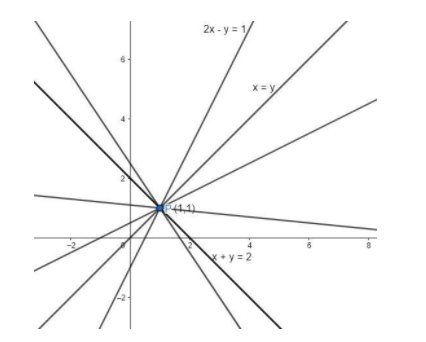
The number of such lines that we can find is infinite. This is because infinitely many lines can pass through a single point. This property is represented in the figure given below.
Note:
We can use an alternate method to find the equation of a line passing through the point \[\left( {1,1} \right)\]as well. We can choose any arbitrary slope of the line or any arbitrary point lying on the line as no other condition has been given.
For example, let’s use the slope intercept form of the line. According to the slope intercept form, the equation of a line is given by \[y = mx + c\] where \[m\] is the slope of the line and \[c\] is the \[y\]- intercept of the line [that is the height at which the line cuts the \[y\]axis.]
We can choose any arbitrary slope for the line. Let us choose the slope as 0.5. Let us substitute 0.5 for \[m\]in the slope-intercept form:
\[\begin{array}{l}y = mx + c\\y = \left( {0.5} \right)x + c\end{array}\]
The line passes through \[\left( {1,1} \right)\], so the equation of the line will be satisfied if we substitute 1 for \[x\] and \[y\]. Substitute 1 for \[x\] and \[y\]in the equation:
\[\begin{array}{l}1 = 0.5 \cdot 1 + c\\1 = 0.5 + c\end{array}\]
Subtract 0.5 from both sides of the equation.
\[\begin{array}{c}1 - 0.5 = 0.5 + c - 0.5\\0.5 = c\end{array}\]
We have obtained the value of the \[y\]- intercept \[\left( c \right)\] as 0.5.
Substitute \[0.5\] for \[m\] and \[c\] in the slope-intercept form:
\[y = 0.5x + 0.5\]
Multiply both sides of the equation by 2 to obtain whole numbers for coefficients of the variables.
\[\begin{array}{c}2\left( y \right) = 2\left( {0.5x + 0.5} \right)\\2y = x + 1\end{array}\]
We have obtained the equation of a line passing through point P. It is \[2y = x + 1\].
The number of such lines we can find is infinite. This is because infinitely many lines can pass through a single point.
Here, we will solve the linear equations to get the required point through which the line will pass. We will find the equation of any line passing through the obtained point by using the formula of two-point form of a line. According to the equation of line, we will then find the number of lines.
Formula Used: Here, we have used the formula for two-point form of a line, \[\dfrac{{y - {y_1}}}{{x - {x_1}}} = \dfrac{{{y_1} - {y_2}}}{{{x_1} - {x_2}}}\], where \[\left( {{x_1},{y_1}} \right)\] and \[\left( {{x_2},{y_2}} \right)\] are the coordinates of the two points.
Complete step by step solution:
First, we will find the point which represents the solution of the given pair of linear equations.
Let us name the required point as P.
Let us name \[x + y = 2\] as equation 1 and \[2x - y = 1\] as equation 2.
To solve the equations, let us add equation 1 and equation 2.
\[\begin{array}{l}\begin{array}{*{20}{c}}{{\rm{ }}x}& + &y& = &2\end{array}\\ + \underline {\begin{array}{*{20}{c}}{{\rm{ }}2x}& - &y& = &1\end{array}} \\\begin{array}{*{20}{c}}{{\rm{ }}3x}& + &{0y}& = &3\end{array}\end{array}\]
Let us name the equation obtained from adding equation 1 and equation 2 as equation 3.
Now, we will solve equation 3 to find the value of \[x\].
\[\begin{array}{c}3x + 0y = 3\\3x = 3\end{array}\]
We will divide both the sides of the equation by 3.
\[\begin{array}{c}\dfrac{{3x}}{3} = \dfrac{3}{3}\\x = 1\end{array}\]
We have obtained the value of \[x\] as 1. So, the \[x\] coordinate of the point P is 1.
Now, we will substitute 1 for \[x\] in equation 1 to find the value of \[y\].
\[\begin{array}{c}x + y = 2\\1 + y = 2\end{array}\]
We will subtract 1 from both sides of the equation and find the value of \[y\].
\[\begin{array}{c}1 + y - 1 = 2 - 1\\y = 1\end{array}\]
We have obtained the value of \[y\] as 1. So, the \[y\] coordinate of the point P is also 1.
The point P is given by \[\left( {1,1} \right)\].
Now, we need to find the equation of a line passing through P. We can use any formula for this. Let us find the equation by using the two-point formula of a line.
According to the two-point formula of a line, if a line passes through 2 points say \[\left( {{x_1},{y_1}} \right)\] and \[\left( {{x_2},{y_2}} \right)\], its equation is given by \[\dfrac{{y - {y_1}}}{{x - {x_1}}} = \dfrac{{{y_1} - {y_2}}}{{{x_1} - {x_2}}}\] .
One of our points is \[P\left( {1,1} \right)\]. We can choose any arbitrary point as the second point. Let us choose the second point as \[\left( {0,0} \right)\].
Now, let us substitute 1 for \[{x_1}\] and \[{y_1}\] and 0 for \[{x_2}\] and \[{y_2}\] in the two-point formula and simplify.
\[\dfrac{{y - {y_1}}}{{x - {x_1}}} = \dfrac{{{y_1} - {y_2}}}{{{x_1} - {x_2}}}\\\dfrac{{y - 1}}{{x - 1}} = \dfrac{{1 - 0}}{{1 - 0}}\\\left( {y - 1} \right)\left( {1 - 0} \right) = \left( {x - 1} \right)\left( {1 - 0} \right)\\y - 1 = x - 1\]
We add 1 on both sides of the equation.
\[y - 1 + 1 = x - 1 + 1\\
\Rightarrow y = x\]
We have obtained the equation of a line passing through point P. It is \[x = y\].
The number of such lines that we can find is infinite. This is because infinitely many lines can pass through a single point. This property is represented in the figure given below.
Note:
We can use an alternate method to find the equation of a line passing through the point \[\left( {1,1} \right)\]as well. We can choose any arbitrary slope of the line or any arbitrary point lying on the line as no other condition has been given.
For example, let’s use the slope intercept form of the line. According to the slope intercept form, the equation of a line is given by \[y = mx + c\] where \[m\] is the slope of the line and \[c\] is the \[y\]- intercept of the line [that is the height at which the line cuts the \[y\]axis.]
We can choose any arbitrary slope for the line. Let us choose the slope as 0.5. Let us substitute 0.5 for \[m\]in the slope-intercept form:
\[\begin{array}{l}y = mx + c\\y = \left( {0.5} \right)x + c\end{array}\]
The line passes through \[\left( {1,1} \right)\], so the equation of the line will be satisfied if we substitute 1 for \[x\] and \[y\]. Substitute 1 for \[x\] and \[y\]in the equation:
\[\begin{array}{l}1 = 0.5 \cdot 1 + c\\1 = 0.5 + c\end{array}\]
Subtract 0.5 from both sides of the equation.
\[\begin{array}{c}1 - 0.5 = 0.5 + c - 0.5\\0.5 = c\end{array}\]
We have obtained the value of the \[y\]- intercept \[\left( c \right)\] as 0.5.
Substitute \[0.5\] for \[m\] and \[c\] in the slope-intercept form:
\[y = 0.5x + 0.5\]
Multiply both sides of the equation by 2 to obtain whole numbers for coefficients of the variables.
\[\begin{array}{c}2\left( y \right) = 2\left( {0.5x + 0.5} \right)\\2y = x + 1\end{array}\]
We have obtained the equation of a line passing through point P. It is \[2y = x + 1\].
The number of such lines we can find is infinite. This is because infinitely many lines can pass through a single point.
Recently Updated Pages
Master Class 11 Social Science: Engaging Questions & Answers for Success

Master Class 11 Physics: Engaging Questions & Answers for Success
Master Class 11 Maths: Engaging Questions & Answers for Success
Master Class 11 Economics: Engaging Questions & Answers for Success
Master Class 11 Computer Science: Engaging Questions & Answers for Success
Master Class 11 Chemistry: Engaging Questions & Answers for Success
Trending doubts
One Metric ton is equal to kg A 10000 B 1000 C 100 class 11 physics CBSE
There are 720 permutations of the digits 1 2 3 4 5 class 11 maths CBSE
1 Quintal is equal to a 110 kg b 10 kg c 100kg d 1000 class 11 physics CBSE
State and prove Bernoullis theorem class 11 physics CBSE
Difference Between Prokaryotic Cells and Eukaryotic Cells
Which among the following are examples of coming together class 11 social science CBSE