




How do you find an equation of a line containing the point $\left( 3,2 \right)$ and parallel to the line $y-2=\dfrac{2}{3}x$?
Answer
 Verified
612.9k+ views
Hint: Change of form of the given equation $y-2=\dfrac{2}{3}x$ will give the slope of the line. We change it to the form of $y=mx+k$ to find the slope m. Then, we get into the form of its parallel line to find the equation. We put the point value of $\left( 3,2 \right)$ to find the value of the constant. We get the equation of the parallel line.
Complete step by step answer:
The given equation of the line $y-2=\dfrac{2}{3}x$ can be changed to $y=\dfrac{2}{3}x+2$.
The given equation $y=\dfrac{2}{3}x+2$ is of the form $y=mx+k$. m is the slope of the line.
This gives that the slope of the line $y-2=\dfrac{2}{3}x$ is $\dfrac{2}{3}$.
We know that any line parallel to the given line will be of the same slope.
This means any line parallel to $y-2=\dfrac{2}{3}x$ will have a slope of $\dfrac{2}{3}$.
We take the equation of any parallel line to $y=mx+k$ as $y=mx+c$.
Let’s assume that the parallel line to $y=\dfrac{2}{3}x+2$ as $y=\dfrac{2}{3}x+p$. Here $p$ is a constant value which we have to find out.
The parallel line goes through the point $\left( 3,2 \right)$. We place the point in the equation $y=\dfrac{2}{3}x+p$.
$\begin{align}
& 2=\dfrac{2}{3}\times 3+p \\
& \Rightarrow p=2-2=0 \\
\end{align}$
Value of $p$ is 0.
The equation of the line is $y=\dfrac{2}{3}x$. Simplified form is $3y=2x$.
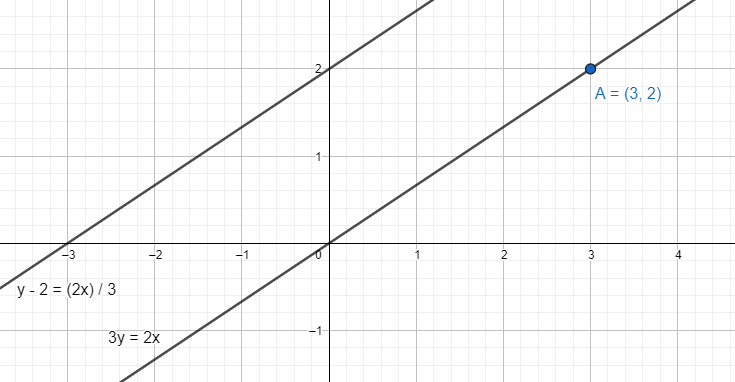
Note: A line parallel to the X-axis does not intersect the X-axis at any finite distance and hence we cannot get any finite x-intercept of such a line. Same goes for lines parallel to the Y-axis. In case of slope of a line the range of the slope is 0 to $\infty $.
Complete step by step answer:
The given equation of the line $y-2=\dfrac{2}{3}x$ can be changed to $y=\dfrac{2}{3}x+2$.
The given equation $y=\dfrac{2}{3}x+2$ is of the form $y=mx+k$. m is the slope of the line.
This gives that the slope of the line $y-2=\dfrac{2}{3}x$ is $\dfrac{2}{3}$.
We know that any line parallel to the given line will be of the same slope.
This means any line parallel to $y-2=\dfrac{2}{3}x$ will have a slope of $\dfrac{2}{3}$.
We take the equation of any parallel line to $y=mx+k$ as $y=mx+c$.
Let’s assume that the parallel line to $y=\dfrac{2}{3}x+2$ as $y=\dfrac{2}{3}x+p$. Here $p$ is a constant value which we have to find out.
The parallel line goes through the point $\left( 3,2 \right)$. We place the point in the equation $y=\dfrac{2}{3}x+p$.
$\begin{align}
& 2=\dfrac{2}{3}\times 3+p \\
& \Rightarrow p=2-2=0 \\
\end{align}$
Value of $p$ is 0.
The equation of the line is $y=\dfrac{2}{3}x$. Simplified form is $3y=2x$.
Note: A line parallel to the X-axis does not intersect the X-axis at any finite distance and hence we cannot get any finite x-intercept of such a line. Same goes for lines parallel to the Y-axis. In case of slope of a line the range of the slope is 0 to $\infty $.
Recently Updated Pages
Master Class 11 Social Science: Engaging Questions & Answers for Success

Master Class 11 English: Engaging Questions & Answers for Success
Master Class 11 Accountancy: Engaging Questions & Answers for Success
Master Class 11 Physics: Engaging Questions & Answers for Success
Master Class 11 Computer Science: Engaging Questions & Answers for Success
Master Class 11 Business Studies: Engaging Questions & Answers for Success
Trending doubts
Find the value of the expression given below sin 30circ class 11 maths CBSE
One Metric ton is equal to kg A 10000 B 1000 C 100 class 11 physics CBSE
Draw a diagram of nephron and explain its structur class 11 biology CBSE
10 examples of friction in our daily life
Proton was discovered by A Thomson B Rutherford C Chadwick class 11 chemistry CBSE
The teeth used for biting and cutting food are called class 11 biology CBSE