




How do you find all the zeros of \[f\left( x \right)={{x}^{3}}-4{{x}^{2}}+16x-64\]?
Answer
 Verified
524.7k+ views
Hint: Zero of the function is also known as the root of the function. The zero of a function is any replacement for the variable that will produce an answer of zero. Graphically, the real zero of a function is where the graph of the function crosses the x‐axis; that is, the real zero of a function is the x‐intercept(s) of the graph of the function.
Complete step-by-step solution:
From the question it is clear we have to find all the zeros of of \[f\left( x \right)={{x}^{3}}-4{{x}^{2}}+16x-64\].
zeros of the function is also known as the root of the function.
Since the highest degree is \[3\], we have to get \[3\] roots.
Now consider the given equation
\[\Rightarrow f\left( x \right)={{x}^{3}}-4{{x}^{2}}+16x-64\]……………..(1)
Now let us re-group the equation in the simpler form.
\[\Rightarrow f\left( x \right)=\left( {{x}^{3}}-4{{x}^{2}} \right)+\left( 16x-64 \right)\]……………..(2)
we can write \[64\]as the product of \[16\] and \[4\].
\[\Rightarrow f\left( x \right)=\left( {{x}^{3}}-4{{x}^{2}} \right)+\left( 16x-16\times 4 \right)\]………………(3)
Now take \[{{x}^{2}}\]common from \[\left( {{x}^{3}}-4{{x}^{2}} \right)\] and \[16\] common from \[\left( 16x-16\times 4 \right)\]
Now equation (3) becomes
\[\Rightarrow f\left( x \right)={{x}^{2}}\left( x-4 \right)+16\left( x-4 \right)\]………………(4)
Now take \[\left( x-4 \right)\] common from \[{{x}^{2}}\left( x-4 \right)\] and \[16\left( x-4 \right)\]
So, equation (4) becomes
\[\Rightarrow f\left( x \right)=\left( x-4 \right)\left( {{x}^{2}}+16 \right)\]
To the values of roots, we have to equate the equation to zero. So \[f\left( x \right)=0\]
\[\Rightarrow \left( x-4 \right)\left( {{x}^{2}}+16 \right)=0\]
CASE 1:
\[\Rightarrow \left( x-4 \right)=0\]
Now add 4 on both sides
\[\Rightarrow \left( x-4+4 \right)=0+4\]
After simplification we get
\[\Rightarrow x=4\]
\[x=4\] is one of the roots of \[f\left( x \right)={{x}^{3}}-4{{x}^{2}}+16x-64\]
CASE 2:
\[\left( {{x}^{2}}+16 \right)=0\]
Now subtract 16 from both sides
\[\Rightarrow \left( {{x}^{2}}+16-16 \right)=0-16\]
After simplification we get
\[\Rightarrow {{x}^{2}}=-16\]
\[\Rightarrow x=\sqrt{-16}\]
\[\Rightarrow x=\sqrt{-1\times 16}\]
We know that \[{{i}^{2}}=-1\] and \[16={{4}^{2}}\]
Now we can write\[{{i}^{2}}=-1\] and \[16={{4}^{2}}\]
\[\Rightarrow x=\sqrt{{{i}^{2}}\times {{4}^{2}}}\]
\[\Rightarrow x=\pm 4i\]
\[x=+4i\] and \[x=-4i\] are the other two roots of \[f\left( x \right)={{x}^{3}}-4{{x}^{2}}+16x-64\].
\[x=+4i\] and \[x=-4i\] are imaginary roots.
\[4,+4i,-4i\] are the three roots of \[f\left( x \right)={{x}^{3}}-4{{x}^{2}}+16x-64\].
Now let us try to graph \[f\left( x \right)={{x}^{3}}-4{{x}^{2}}+16x-64\]
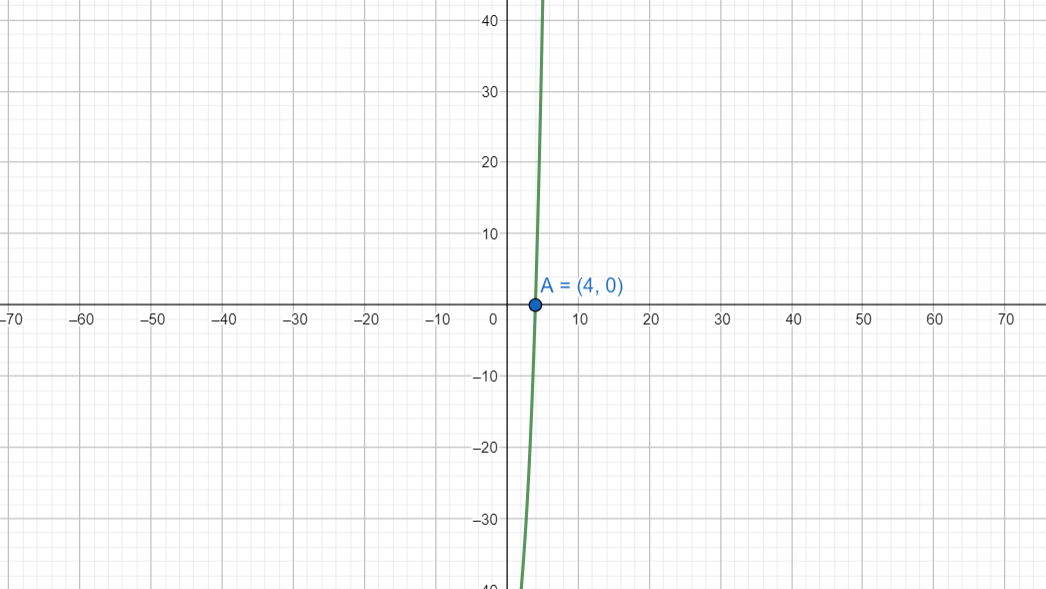
Here \[x=4\] is the only root that can be represented on the graph because it is the real root.
Note: Students may have misconception that \[{{x}^{2}}+16=0\] is not possible so, \[x=4\] is the only root of \[f\left( x \right)={{x}^{3}}-4{{x}^{2}}+16x-64\]. But actually, it is possible by taking \[{{i}^{2}}=-1\] which gives us imaginary and complex roots.
Complete step-by-step solution:
From the question it is clear we have to find all the zeros of of \[f\left( x \right)={{x}^{3}}-4{{x}^{2}}+16x-64\].
zeros of the function is also known as the root of the function.
Since the highest degree is \[3\], we have to get \[3\] roots.
Now consider the given equation
\[\Rightarrow f\left( x \right)={{x}^{3}}-4{{x}^{2}}+16x-64\]……………..(1)
Now let us re-group the equation in the simpler form.
\[\Rightarrow f\left( x \right)=\left( {{x}^{3}}-4{{x}^{2}} \right)+\left( 16x-64 \right)\]……………..(2)
we can write \[64\]as the product of \[16\] and \[4\].
\[\Rightarrow f\left( x \right)=\left( {{x}^{3}}-4{{x}^{2}} \right)+\left( 16x-16\times 4 \right)\]………………(3)
Now take \[{{x}^{2}}\]common from \[\left( {{x}^{3}}-4{{x}^{2}} \right)\] and \[16\] common from \[\left( 16x-16\times 4 \right)\]
Now equation (3) becomes
\[\Rightarrow f\left( x \right)={{x}^{2}}\left( x-4 \right)+16\left( x-4 \right)\]………………(4)
Now take \[\left( x-4 \right)\] common from \[{{x}^{2}}\left( x-4 \right)\] and \[16\left( x-4 \right)\]
So, equation (4) becomes
\[\Rightarrow f\left( x \right)=\left( x-4 \right)\left( {{x}^{2}}+16 \right)\]
To the values of roots, we have to equate the equation to zero. So \[f\left( x \right)=0\]
\[\Rightarrow \left( x-4 \right)\left( {{x}^{2}}+16 \right)=0\]
CASE 1:
\[\Rightarrow \left( x-4 \right)=0\]
Now add 4 on both sides
\[\Rightarrow \left( x-4+4 \right)=0+4\]
After simplification we get
\[\Rightarrow x=4\]
\[x=4\] is one of the roots of \[f\left( x \right)={{x}^{3}}-4{{x}^{2}}+16x-64\]
CASE 2:
\[\left( {{x}^{2}}+16 \right)=0\]
Now subtract 16 from both sides
\[\Rightarrow \left( {{x}^{2}}+16-16 \right)=0-16\]
After simplification we get
\[\Rightarrow {{x}^{2}}=-16\]
\[\Rightarrow x=\sqrt{-16}\]
\[\Rightarrow x=\sqrt{-1\times 16}\]
We know that \[{{i}^{2}}=-1\] and \[16={{4}^{2}}\]
Now we can write\[{{i}^{2}}=-1\] and \[16={{4}^{2}}\]
\[\Rightarrow x=\sqrt{{{i}^{2}}\times {{4}^{2}}}\]
\[\Rightarrow x=\pm 4i\]
\[x=+4i\] and \[x=-4i\] are the other two roots of \[f\left( x \right)={{x}^{3}}-4{{x}^{2}}+16x-64\].
\[x=+4i\] and \[x=-4i\] are imaginary roots.
\[4,+4i,-4i\] are the three roots of \[f\left( x \right)={{x}^{3}}-4{{x}^{2}}+16x-64\].
Now let us try to graph \[f\left( x \right)={{x}^{3}}-4{{x}^{2}}+16x-64\]
Here \[x=4\] is the only root that can be represented on the graph because it is the real root.
Note: Students may have misconception that \[{{x}^{2}}+16=0\] is not possible so, \[x=4\] is the only root of \[f\left( x \right)={{x}^{3}}-4{{x}^{2}}+16x-64\]. But actually, it is possible by taking \[{{i}^{2}}=-1\] which gives us imaginary and complex roots.
Recently Updated Pages
Master Class 10 Computer Science: Engaging Questions & Answers for Success

Master Class 10 General Knowledge: Engaging Questions & Answers for Success
Master Class 10 English: Engaging Questions & Answers for Success
Master Class 10 Social Science: Engaging Questions & Answers for Success
Master Class 10 Maths: Engaging Questions & Answers for Success
Master Class 10 Science: Engaging Questions & Answers for Success
Trending doubts
What is the median of the first 10 natural numbers class 10 maths CBSE
Which women's tennis player has 24 Grand Slam singles titles?
Who is the Brand Ambassador of Incredible India?
Why is there a time difference of about 5 hours between class 10 social science CBSE
Write a letter to the principal requesting him to grant class 10 english CBSE
A moving boat is observed from the top of a 150 m high class 10 maths CBSE