




How do you find all the critical points to graph $9{{x}^{2}}-4{{y}^{2}}-90x-32y+125=0$ including vertices, foci and asymptotes?
Answer
 Verified
580.8k+ views
Hint: Firstly, we need to use the completing the square method to obtain the given equation in the form of standard equation of a hyperbola which is given by $\dfrac{{{\left( x-h \right)}^{2}}}{{{a}^{2}}}-\dfrac{{{\left( y-k \right)}^{2}}}{{{b}^{2}}}=1$. The coordinates of the centre are given as $\left( h,k \right)$. Since the hyperbola is horizontal, the coordinates of the vertices and the foci can be given as $\left( h\pm a \right)$ and $\left( h\pm c \right)$, where ${{c}^{2}}={{a}^{2}}+{{b}^{2}}$. Finally, the slopes of the asymptotes are given by $m=\pm \dfrac{b}{a}$ and the equations for the asymptotes can be determined using the point slope form.
Complete step by step solution:
The equation of the curve given in the question is
\[\Rightarrow 9{{x}^{2}}-4{{y}^{2}}-90x-32y+125=0\]
Arranging the x and the y terms together, we get
\[\Rightarrow 9{{x}^{2}}-90x-4{{y}^{2}}-32y+125=0\]
Now, we can take $9$ common from the first two terms and $-4$ from the next two terms to get
\[\Rightarrow 9\left( {{x}^{2}}-10x \right)-4\left( {{y}^{2}}+8y \right)+125=0\]
Multiplying and dividing the coefficients of x and y by $2$, we get
\[\begin{align}
& \Rightarrow 9\left( {{x}^{2}}-10\times \dfrac{2}{2}x \right)-4\left( {{y}^{2}}+8\times \dfrac{2}{2}y \right)+125=0 \\
& \Rightarrow 9\left( {{x}^{2}}-2\times 5\times x \right)-4\left( {{y}^{2}}+2\times 4\times y \right)+125=0 \\
\end{align}\]
Adding and subtracting \[{{5}^{2}}\] and \[{{4}^{2}}\] in the first and the second bracket respectively, we get
\[\begin{align}
& \Rightarrow 9\left( {{x}^{2}}-2\times 5\times x+{{5}^{2}}-{{5}^{2}} \right)-4\left( {{y}^{2}}+2\times 4\times y+{{4}^{2}}-{{4}^{2}} \right)+125=0 \\
& \Rightarrow 9\left( {{x}^{2}}-2\times 5\times x+{{5}^{2}}-25 \right)-4\left( {{y}^{2}}+2\times 4\times y+{{4}^{2}}-16 \right)+125=0 \\
& \Rightarrow 9\left( {{x}^{2}}-2\times 5\times x+{{5}^{2}} \right)-9\left( 25 \right)-4\left( {{y}^{2}}+2\times 4\times y+{{4}^{2}} \right)-4\left( -16 \right)+125=0 \\
& \Rightarrow 9\left( {{x}^{2}}-2\times 5\times x+{{5}^{2}} \right)-4\left( {{y}^{2}}+2\times 4\times y+{{4}^{2}} \right)-36=0 \\
\end{align}\]
Now, we can contract the first and the second brackets as
\[\begin{align}
& \Rightarrow 9{{\left( x-5 \right)}^{2}}-4{{\left( y+4 \right)}^{2}}-36=0 \\
& \Rightarrow 9{{\left( x-5 \right)}^{2}}-4{{\left( y+4 \right)}^{2}}=36 \\
\end{align}\]
Dividing both sides by \[36\], we get
\[\begin{align}
& \Rightarrow \dfrac{9}{36}{{\left( x-5 \right)}^{2}}-\dfrac{4}{36}{{\left( y+4 \right)}^{2}}=1 \\
& \Rightarrow \dfrac{{{\left( x-5 \right)}^{2}}}{4}-\dfrac{{{\left( y+4 \right)}^{2}}}{9}=1 \\
\end{align}\]
From the above equation, we can say that it is the equation of a hyperbola. Comparing it with the standard equation $\dfrac{{{\left( x-h \right)}^{2}}}{{{a}^{2}}}-\dfrac{{{\left( y-k \right)}^{2}}}{{{b}^{2}}}=1$, we get
\[\begin{align}
& \Rightarrow a=2 \\
& \Rightarrow b=3 \\
\end{align}\]
Also,
$\begin{align}
& \Rightarrow h=5 \\
& \Rightarrow k=-4 \\
\end{align}$
This means that the centre of the hyperbola is at $\left( 5,-4 \right)$.
We know that c is related to a and b by
$\Rightarrow {{c}^{2}}={{a}^{2}}+{{b}^{2}}$
On substituting the values of a and b from above, we get
$\begin{align}
& \Rightarrow {{c}^{2}}={{\left( 2 \right)}^{2}}+{{\left( 3 \right)}^{2}} \\
& \Rightarrow {{c}^{2}}=4+9 \\
& \Rightarrow {{c}^{2}}=13 \\
& \Rightarrow c=\sqrt{13} \\
\end{align}$
Now, since the coefficient of ${{x}^{2}}$ is positive in the given equation, the axis of the hyperbola must be horizontal. This means that the y-coordinate of both the vertices and the foci must be equal to that of the center, that is $-4$.
Now, the x-coordinates of the vertices can be given by $\left( h\pm a \right)$. On substituting the above values, we get $\left( 5\pm 2 \right)$ and on solving we get $3$ and $7$. Therefore, the coordinates of the vertices are $\left( 3,-4 \right)$ and $\left( 7,-4 \right)$.
Also, the x-coordinates of the focus can be given by $\left( h\pm c \right)$. On substituting $h=5$ and $c=\sqrt{13}$, we get $\left( 5\pm \sqrt{13} \right)$. Therefore the coordinates of the foci are $\left( 5+\sqrt{13} \right)$ and $\left( 5-\sqrt{13} \right)$.
Finally, we know that the slopes of the asymptotes are given by
$\Rightarrow m=\pm \dfrac{b}{a}$
On substituting $a=2$ and $b=3$ we get
$\Rightarrow m=\pm \dfrac{3}{2}$
Since the asymptotes of a hyperbola pass through the centre, which in this case is at $\left( 5,-4 \right)$, from the point slope form we can write the equation of the asymptotes as
$\begin{align}
& \Rightarrow \left( y-k \right)=m\left( x-h \right) \\
& \Rightarrow \left( y+4 \right)=m\left( x-5 \right) \\
\end{align}$
On substituting $m=\dfrac{3}{2}$ we get
\[\Rightarrow y+4=\dfrac{3}{2}\left( x-5 \right)\]
Now, substituting $m=-\dfrac{3}{2}$ we get
\[\Rightarrow y+4=-\dfrac{3}{2}\left( x-5 \right)\]
We can observe these in the figure given below.
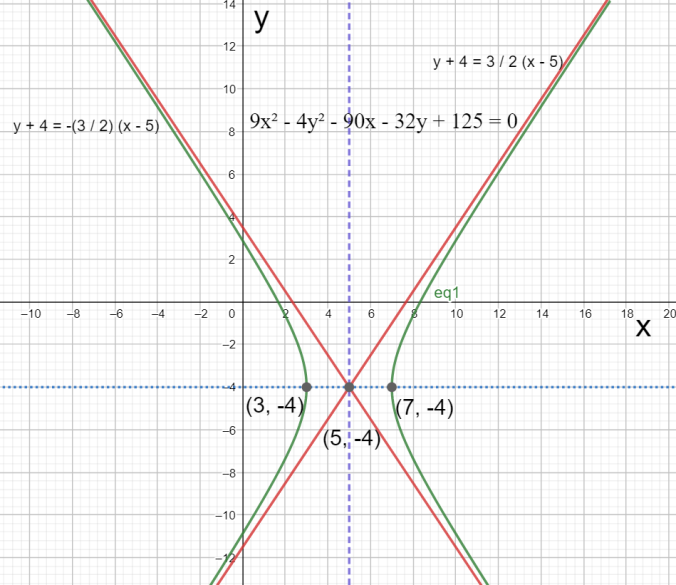
Hence, we have determined the centre, foci, vertices and the equations for the asymptotes for the given hyperbola.
Note: We must remember all of the important results for the hyperbola $\dfrac{{{\left( x-h \right)}^{2}}}{{{a}^{2}}}-\dfrac{{{\left( y-k \right)}^{2}}}{{{b}^{2}}}=1$, which are used in the above solution. We must not get confused between the relations ${{c}^{2}}={{a}^{2}}+{{b}^{2}}$ and ${{c}^{2}}={{a}^{2}}-{{b}^{2}}$. The former is valid for a hyperbola while the latter is valid for an ellipse.
Complete step by step solution:
The equation of the curve given in the question is
\[\Rightarrow 9{{x}^{2}}-4{{y}^{2}}-90x-32y+125=0\]
Arranging the x and the y terms together, we get
\[\Rightarrow 9{{x}^{2}}-90x-4{{y}^{2}}-32y+125=0\]
Now, we can take $9$ common from the first two terms and $-4$ from the next two terms to get
\[\Rightarrow 9\left( {{x}^{2}}-10x \right)-4\left( {{y}^{2}}+8y \right)+125=0\]
Multiplying and dividing the coefficients of x and y by $2$, we get
\[\begin{align}
& \Rightarrow 9\left( {{x}^{2}}-10\times \dfrac{2}{2}x \right)-4\left( {{y}^{2}}+8\times \dfrac{2}{2}y \right)+125=0 \\
& \Rightarrow 9\left( {{x}^{2}}-2\times 5\times x \right)-4\left( {{y}^{2}}+2\times 4\times y \right)+125=0 \\
\end{align}\]
Adding and subtracting \[{{5}^{2}}\] and \[{{4}^{2}}\] in the first and the second bracket respectively, we get
\[\begin{align}
& \Rightarrow 9\left( {{x}^{2}}-2\times 5\times x+{{5}^{2}}-{{5}^{2}} \right)-4\left( {{y}^{2}}+2\times 4\times y+{{4}^{2}}-{{4}^{2}} \right)+125=0 \\
& \Rightarrow 9\left( {{x}^{2}}-2\times 5\times x+{{5}^{2}}-25 \right)-4\left( {{y}^{2}}+2\times 4\times y+{{4}^{2}}-16 \right)+125=0 \\
& \Rightarrow 9\left( {{x}^{2}}-2\times 5\times x+{{5}^{2}} \right)-9\left( 25 \right)-4\left( {{y}^{2}}+2\times 4\times y+{{4}^{2}} \right)-4\left( -16 \right)+125=0 \\
& \Rightarrow 9\left( {{x}^{2}}-2\times 5\times x+{{5}^{2}} \right)-4\left( {{y}^{2}}+2\times 4\times y+{{4}^{2}} \right)-36=0 \\
\end{align}\]
Now, we can contract the first and the second brackets as
\[\begin{align}
& \Rightarrow 9{{\left( x-5 \right)}^{2}}-4{{\left( y+4 \right)}^{2}}-36=0 \\
& \Rightarrow 9{{\left( x-5 \right)}^{2}}-4{{\left( y+4 \right)}^{2}}=36 \\
\end{align}\]
Dividing both sides by \[36\], we get
\[\begin{align}
& \Rightarrow \dfrac{9}{36}{{\left( x-5 \right)}^{2}}-\dfrac{4}{36}{{\left( y+4 \right)}^{2}}=1 \\
& \Rightarrow \dfrac{{{\left( x-5 \right)}^{2}}}{4}-\dfrac{{{\left( y+4 \right)}^{2}}}{9}=1 \\
\end{align}\]
From the above equation, we can say that it is the equation of a hyperbola. Comparing it with the standard equation $\dfrac{{{\left( x-h \right)}^{2}}}{{{a}^{2}}}-\dfrac{{{\left( y-k \right)}^{2}}}{{{b}^{2}}}=1$, we get
\[\begin{align}
& \Rightarrow a=2 \\
& \Rightarrow b=3 \\
\end{align}\]
Also,
$\begin{align}
& \Rightarrow h=5 \\
& \Rightarrow k=-4 \\
\end{align}$
This means that the centre of the hyperbola is at $\left( 5,-4 \right)$.
We know that c is related to a and b by
$\Rightarrow {{c}^{2}}={{a}^{2}}+{{b}^{2}}$
On substituting the values of a and b from above, we get
$\begin{align}
& \Rightarrow {{c}^{2}}={{\left( 2 \right)}^{2}}+{{\left( 3 \right)}^{2}} \\
& \Rightarrow {{c}^{2}}=4+9 \\
& \Rightarrow {{c}^{2}}=13 \\
& \Rightarrow c=\sqrt{13} \\
\end{align}$
Now, since the coefficient of ${{x}^{2}}$ is positive in the given equation, the axis of the hyperbola must be horizontal. This means that the y-coordinate of both the vertices and the foci must be equal to that of the center, that is $-4$.
Now, the x-coordinates of the vertices can be given by $\left( h\pm a \right)$. On substituting the above values, we get $\left( 5\pm 2 \right)$ and on solving we get $3$ and $7$. Therefore, the coordinates of the vertices are $\left( 3,-4 \right)$ and $\left( 7,-4 \right)$.
Also, the x-coordinates of the focus can be given by $\left( h\pm c \right)$. On substituting $h=5$ and $c=\sqrt{13}$, we get $\left( 5\pm \sqrt{13} \right)$. Therefore the coordinates of the foci are $\left( 5+\sqrt{13} \right)$ and $\left( 5-\sqrt{13} \right)$.
Finally, we know that the slopes of the asymptotes are given by
$\Rightarrow m=\pm \dfrac{b}{a}$
On substituting $a=2$ and $b=3$ we get
$\Rightarrow m=\pm \dfrac{3}{2}$
Since the asymptotes of a hyperbola pass through the centre, which in this case is at $\left( 5,-4 \right)$, from the point slope form we can write the equation of the asymptotes as
$\begin{align}
& \Rightarrow \left( y-k \right)=m\left( x-h \right) \\
& \Rightarrow \left( y+4 \right)=m\left( x-5 \right) \\
\end{align}$
On substituting $m=\dfrac{3}{2}$ we get
\[\Rightarrow y+4=\dfrac{3}{2}\left( x-5 \right)\]
Now, substituting $m=-\dfrac{3}{2}$ we get
\[\Rightarrow y+4=-\dfrac{3}{2}\left( x-5 \right)\]
We can observe these in the figure given below.
Hence, we have determined the centre, foci, vertices and the equations for the asymptotes for the given hyperbola.
Note: We must remember all of the important results for the hyperbola $\dfrac{{{\left( x-h \right)}^{2}}}{{{a}^{2}}}-\dfrac{{{\left( y-k \right)}^{2}}}{{{b}^{2}}}=1$, which are used in the above solution. We must not get confused between the relations ${{c}^{2}}={{a}^{2}}+{{b}^{2}}$ and ${{c}^{2}}={{a}^{2}}-{{b}^{2}}$. The former is valid for a hyperbola while the latter is valid for an ellipse.
Recently Updated Pages
Master Class 11 English: Engaging Questions & Answers for Success

Master Class 11 Social Science: Engaging Questions & Answers for Success
Master Class 11 Maths: Engaging Questions & Answers for Success
Master Class 11 Biology: Engaging Questions & Answers for Success
Master Class 11 Physics: Engaging Questions & Answers for Success
Master Class 11 Chemistry: Engaging Questions & Answers for Success
Trending doubts
One Metric ton is equal to kg A 10000 B 1000 C 100 class 11 physics CBSE
What is cell theory Who formulated it class 11 biology CBSE
Phyllotaxy is the arrangement of ALeaflets BLeaves class 11 biology CBSE
Difference Between Prokaryotic Cells and Eukaryotic Cells
The symbiotic association of fungi and algae is called class 11 biology CBSE
Cell theory was formulated by A Schleiden and Schwann class 11 biology CBSE