




How do you find all the critical points to graph $4{{x}^{2}}-9{{y}^{2}}=36$ including vertices, foci and asymptotes?
(a) By comparing the equation with the standard form
(b) Randomly guessing
(c) Drawing the graph
(d) All of the above
Answer
 Verified
615.6k+ views
Hint: We can see that the equation $4{{x}^{2}}-9{{y}^{2}}=36$ given is a equation of a conic which is said to be a hyperbola. So, to get through this problem we are going to write down the standard form of the hyperbola and compare it with our given equation. Thus by analyzing we can get to our needed result quite comfortably.
Complete step-by-step answer:
The standard form of a hyperbola is presented by,
$\dfrac{{{(x-h)}^{2}}}{{{a}^{2}}}-\dfrac{{{(y-k)}^{2}}}{{{b}^{2}}}=1$ …..(1)
According to the question, from the given equation,
$4{{x}^{2}}-9{{y}^{2}}=36$
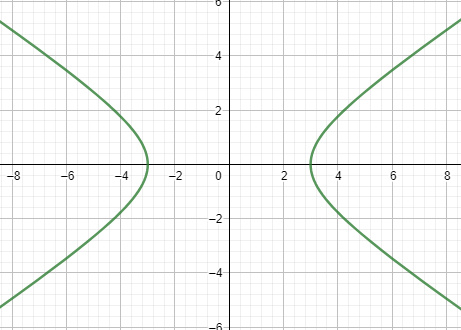
By dividing both sides with 36, we get,
$\dfrac{{{x}^{2}}}{9}-\dfrac{{{y}^{2}}}{4}=1$
This follows,
$\dfrac{{{(x-0)}^{2}}}{{{3}^{2}}}-\dfrac{{{(y-0)}^{2}}}{{{2}^{2}}}=1$
Now, comparing from the above equation (1), we get,
$a=3,b=2,c=\sqrt{{{a}^{2}}+{{b}^{2}}}=\sqrt{9+4}=\sqrt{13}$
And our centre at, $(h,k)=(0,0)$ and vertices at, $(h+a,k)=(3,0),(h-a,k)=(-3,0)$
Also, our foci at, $(h+c,k)=(\sqrt{13},0),(h-c,k)=(-\sqrt{13},0)$
Now, an asymptote is said to be, An asymptote to a curve is a straight line, to which the tangent to the curve tends as the point of contact goes to infinity.
If this sounds confusing, you can think of an asymptote as follows: an asymptote to a curve is a straight line such that the perpendicular distance of a point P(x,y) on the curve from this line tends to zero as the point P goes to infinity (along some branch of the curve).
And the equation of the asymptotes is said to be,
$y=\pm \dfrac{b}{a}(x-h)+k$
Putting the values, a=3, b=2, h=0 and k=0,
$y=\dfrac{2}{3}x,y=-\dfrac{2}{3}x$
Thus, we have the equation of the asymptotes.
Hence, the correct option is, (a) By comparing the equation with the standard form.
Note: Like this hyperbola, $\dfrac{{{x}^{2}}}{9}-\dfrac{{{y}^{2}}}{4}=1$, all hyperbolas share common features. A hyperbola consists of two curves, each with a vertex and a focus. The transverse axis is the axis that crosses through both vertices and foci, and the conjugate axis is perpendicular to it. A hyperbola also has asymptotes which cross in an “x”. The two branches of the hyperbola are on opposite sides of the asymptotes’ cross. The vertices and asymptotes can be used to form a rectangle, with the vertices at the centers of two opposite sides and the corners on the asymptotes. The centers of the other two sides, along the conjugate axis, are called the co-vertices. Where the asymptotes of the hyperbola cross is called the center.
Complete step-by-step answer:
The standard form of a hyperbola is presented by,
$\dfrac{{{(x-h)}^{2}}}{{{a}^{2}}}-\dfrac{{{(y-k)}^{2}}}{{{b}^{2}}}=1$ …..(1)
According to the question, from the given equation,
$4{{x}^{2}}-9{{y}^{2}}=36$
By dividing both sides with 36, we get,
$\dfrac{{{x}^{2}}}{9}-\dfrac{{{y}^{2}}}{4}=1$
This follows,
$\dfrac{{{(x-0)}^{2}}}{{{3}^{2}}}-\dfrac{{{(y-0)}^{2}}}{{{2}^{2}}}=1$
Now, comparing from the above equation (1), we get,
$a=3,b=2,c=\sqrt{{{a}^{2}}+{{b}^{2}}}=\sqrt{9+4}=\sqrt{13}$
And our centre at, $(h,k)=(0,0)$ and vertices at, $(h+a,k)=(3,0),(h-a,k)=(-3,0)$
Also, our foci at, $(h+c,k)=(\sqrt{13},0),(h-c,k)=(-\sqrt{13},0)$
Now, an asymptote is said to be, An asymptote to a curve is a straight line, to which the tangent to the curve tends as the point of contact goes to infinity.
If this sounds confusing, you can think of an asymptote as follows: an asymptote to a curve is a straight line such that the perpendicular distance of a point P(x,y) on the curve from this line tends to zero as the point P goes to infinity (along some branch of the curve).
And the equation of the asymptotes is said to be,
$y=\pm \dfrac{b}{a}(x-h)+k$
Putting the values, a=3, b=2, h=0 and k=0,
$y=\dfrac{2}{3}x,y=-\dfrac{2}{3}x$
Thus, we have the equation of the asymptotes.
Hence, the correct option is, (a) By comparing the equation with the standard form.
Note: Like this hyperbola, $\dfrac{{{x}^{2}}}{9}-\dfrac{{{y}^{2}}}{4}=1$, all hyperbolas share common features. A hyperbola consists of two curves, each with a vertex and a focus. The transverse axis is the axis that crosses through both vertices and foci, and the conjugate axis is perpendicular to it. A hyperbola also has asymptotes which cross in an “x”. The two branches of the hyperbola are on opposite sides of the asymptotes’ cross. The vertices and asymptotes can be used to form a rectangle, with the vertices at the centers of two opposite sides and the corners on the asymptotes. The centers of the other two sides, along the conjugate axis, are called the co-vertices. Where the asymptotes of the hyperbola cross is called the center.
Recently Updated Pages
If x a + bt + ct2 where x is in meters and t is in class 11 physics CBSE

A car covers the first half distance between two places class 11 physics CBSE
The resultant of two vectors overrightarrow P and overrightarrow class 11 physics CBSE
Find the value of cos 135 class 11 maths CBSE
A mass M is held in place by an applied force F and class 11 physics CBSE
A solution of glucose in water is labelled as 10 dfracwv class 11 chemistry CBSE
Trending doubts
One Metric ton is equal to kg A 10000 B 1000 C 100 class 11 physics CBSE
Find the value of the expression given below sin 30circ class 11 maths CBSE
What do you mean by retardation What is its SI uni class 11 physics CBSE
Draw a diagram of nephron and explain its structur class 11 biology CBSE
10 examples of friction in our daily life
Difference between physical and chemical change class 11 chemistry CBSE