




How do you find all solutions of the equation $\sec x+\tan x=1$ in the interval $\left[ 0,2\pi \right)$?
Answer
 Verified
531.3k+ views
Hint: In this problem we need to calculate all the solutions of the given equation which is $\sec x+\tan x=1$. For solving this we are going to use the trigonometric identity which is ${{\sec }^{2}}x-{{\tan }^{2}}x=1$. We can simplify this identity by using the formula ${{a}^{2}}-{{b}^{2}}=\left( a+b \right)\left( a-b \right)$. Here we will use the given equation $\sec x+\tan x=1$ and calculate the value of $\sec x-\tan x$. From the values of $\sec x+\tan x$ and $\sec x-\tan x$ we will calculate the value of $\sec x$ by adding both the values. After that we will use the basic trigonometric definition of $\sec x$ which is $\sec x=\dfrac{1}{\cos x}$ to calculate the value of $\cos x$. From this we can write the general solution of the equation and from the general solution we can calculate the solutions which are in the given interval $\left[ 0,2\pi \right)$.
Complete step by step answer:
Given equation, $\sec x+\tan x=1$.
We have the trigonometric identity ${{\sec }^{2}}x-{{\tan }^{2}}x=1$. Applying the formula ${{a}^{2}}-{{b}^{2}}=\left( a+b \right)\left( a-b \right)$ in the trigonometric identity, then we will get
$\left( \sec x+\tan x \right)\left( \sec x-\tan x \right)=1$
Substituting the value $\sec x+\tan x=1$ in the above equation and simplifying it, then we will have
$\begin{align}
& 1\left( \sec x-\tan x \right)=1 \\
& \Rightarrow \sec x-\tan x=1 \\
\end{align}$
We have the values $\sec x+\tan x=1$, $\sec x-\tan x=1$. Adding both the values to get the value of $\sec x$, then we will get
$\sec x+\tan x+\left( \sec -\tan x \right)=1+1$
Simplifying the above equation by using mathematical operations, then we will get
$\begin{align}
& \sec x+\tan x+\sec x-\tan x=2 \\
& \Rightarrow 2\sec x=2 \\
& \Rightarrow \sec x=1 \\
\end{align}$
From basic definitions of trigonometry, we have the formula $\sec x=\dfrac{1}{\cos x}$. Substituting this value in the above equation, then we will get
$\begin{align}
& \dfrac{1}{\cos x}=1 \\
& \Rightarrow \cos x=1 \\
\end{align}$
We have the trigonometric value $\cos 0{}^\circ =1$. Substituting this value in the above equation, then we will have
$\cos x=\cos 0{}^\circ $
We can write the general solution of the equation $\cos x=\cos \theta $ as $x=2k\pi \pm \theta $, $k\in Z$. So, the general solution of the equation $\cos x=\cos 0{}^\circ $ will be
$\begin{align}
& x=2k\pi \pm 0 \\
& \Rightarrow x=2k\pi \\
\end{align}$, $k\in Z$.
Now substitute $k=0,1,2,...$ in the general solution to get the solutions of the given equation, then we will get
$x=0,2\pi ,4\pi ,...$
The solutions of the given equation $\sec x+\tan x=1$ lies in the interval $\left[ 0,2\pi \right)$ is only $0$.
Note: We can also plot the graph of the given equation and observe the solution of the given equation in the given interval. The graph of the given equation $\sec x+\tan x=1$ will be
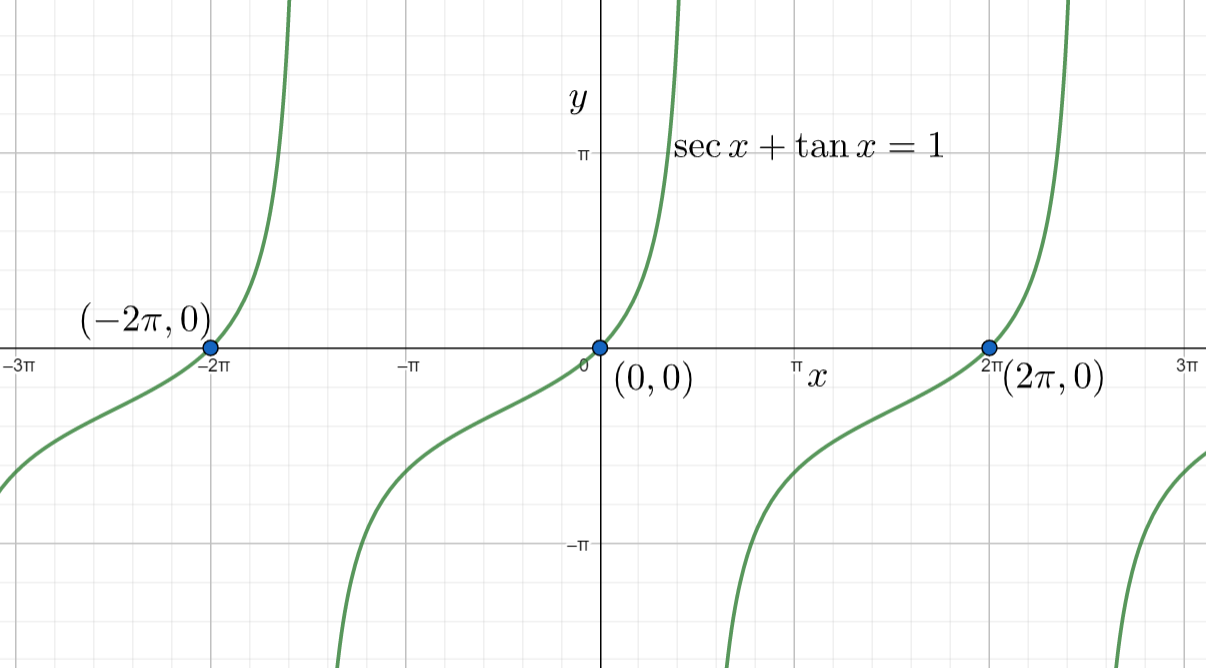
From the above graph also, we can observe that the solution of the given equation in the given interval is $0$ only. In the interval they have included the value of $0$ but not the value of $2\pi $, so we are not considering the value of $2\pi $ as a solution in the given interval.
Complete step by step answer:
Given equation, $\sec x+\tan x=1$.
We have the trigonometric identity ${{\sec }^{2}}x-{{\tan }^{2}}x=1$. Applying the formula ${{a}^{2}}-{{b}^{2}}=\left( a+b \right)\left( a-b \right)$ in the trigonometric identity, then we will get
$\left( \sec x+\tan x \right)\left( \sec x-\tan x \right)=1$
Substituting the value $\sec x+\tan x=1$ in the above equation and simplifying it, then we will have
$\begin{align}
& 1\left( \sec x-\tan x \right)=1 \\
& \Rightarrow \sec x-\tan x=1 \\
\end{align}$
We have the values $\sec x+\tan x=1$, $\sec x-\tan x=1$. Adding both the values to get the value of $\sec x$, then we will get
$\sec x+\tan x+\left( \sec -\tan x \right)=1+1$
Simplifying the above equation by using mathematical operations, then we will get
$\begin{align}
& \sec x+\tan x+\sec x-\tan x=2 \\
& \Rightarrow 2\sec x=2 \\
& \Rightarrow \sec x=1 \\
\end{align}$
From basic definitions of trigonometry, we have the formula $\sec x=\dfrac{1}{\cos x}$. Substituting this value in the above equation, then we will get
$\begin{align}
& \dfrac{1}{\cos x}=1 \\
& \Rightarrow \cos x=1 \\
\end{align}$
We have the trigonometric value $\cos 0{}^\circ =1$. Substituting this value in the above equation, then we will have
$\cos x=\cos 0{}^\circ $
We can write the general solution of the equation $\cos x=\cos \theta $ as $x=2k\pi \pm \theta $, $k\in Z$. So, the general solution of the equation $\cos x=\cos 0{}^\circ $ will be
$\begin{align}
& x=2k\pi \pm 0 \\
& \Rightarrow x=2k\pi \\
\end{align}$, $k\in Z$.
Now substitute $k=0,1,2,...$ in the general solution to get the solutions of the given equation, then we will get
$x=0,2\pi ,4\pi ,...$
The solutions of the given equation $\sec x+\tan x=1$ lies in the interval $\left[ 0,2\pi \right)$ is only $0$.
Note: We can also plot the graph of the given equation and observe the solution of the given equation in the given interval. The graph of the given equation $\sec x+\tan x=1$ will be
From the above graph also, we can observe that the solution of the given equation in the given interval is $0$ only. In the interval they have included the value of $0$ but not the value of $2\pi $, so we are not considering the value of $2\pi $ as a solution in the given interval.
Recently Updated Pages
Master Class 11 English: Engaging Questions & Answers for Success

Master Class 11 Maths: Engaging Questions & Answers for Success
Master Class 11 Biology: Engaging Questions & Answers for Success
Master Class 11 Social Science: Engaging Questions & Answers for Success
Master Class 11 Physics: Engaging Questions & Answers for Success
Master Class 11 Accountancy: Engaging Questions & Answers for Success
Trending doubts
One Metric ton is equal to kg A 10000 B 1000 C 100 class 11 physics CBSE
Discuss the various forms of bacteria class 11 biology CBSE
Draw a diagram of a plant cell and label at least eight class 11 biology CBSE
State the laws of reflection of light
Explain zero factorial class 11 maths CBSE
10 examples of friction in our daily life