




How do you find all real and complex roots of $2{{x}^{4}}+3{{x}^{3}}-{{x}^{2}}+5=0$ ?
Answer
 Verified
548.1k+ views
Hint: We are given a polynomial equation of 4-degree. This implies that this equation has 4 roots. However, all of these might not be real roots and rather would be complex roots. Therefore, we will use Descartes's method to find all the roots of the given equation. Using this method, we will do simple comparing of coefficients of like terms and solve them further.
Complete step-by-step solution:
The Descartes’ method involves assuming the biquadratic equation as the product of two quadratic equations which can be then compared to the coefficients of the actual equation.
Given the polynomial function, $2{{x}^{4}}+3{{x}^{3}}-{{x}^{2}}+5=0$.
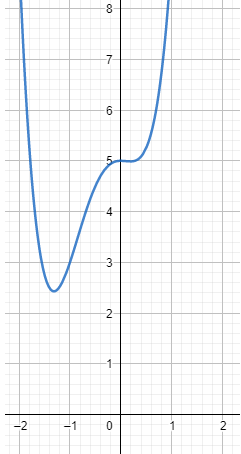
Looking at the graph of the function, we understand that the function does not have any real roots as it is not cutting through the x-axis even once.
For $2{{x}^{4}}+3{{x}^{3}}-{{x}^{2}}+5=0$, we have only unreal roots which would occur in conjugate pairs.
Let $2{{x}^{4}}+3{{x}^{3}}-{{x}^{2}}+5=\left( a{{x}^{2}}+bx+c \right)\left( d{{x}^{2}}+ex+f \right)$
Thus on solving, we get
$a=2,b=\sqrt{\dfrac{11}{5}},c=1,d=1,e=-\sqrt{55},f=5$
$\begin{align}
& \Rightarrow 2{{x}^{4}}+3{{x}^{3}}-{{x}^{2}}+5=\left( 2{{x}^{2}}+\sqrt{\dfrac{11}{5}}x+1 \right)\left( 1.{{x}^{2}}-\sqrt{55}x+5 \right) \\
& \Rightarrow 2{{x}^{4}}+3{{x}^{3}}-{{x}^{2}}+5=\left( 2{{x}^{2}}+\sqrt{\dfrac{11}{5}}x+1 \right)\left( {{x}^{2}}-\sqrt{55}x+5 \right) \\
\end{align}$
The roots of these quadratics are the roots of the given 4-degree polynomial given as $x=\dfrac{-b\pm \sqrt{{{b}^{2}}-4ac}}{2a}$.
Roots of $2{{x}^{2}}+\sqrt{\dfrac{11}{5}}x+1$:
$x=\dfrac{-\sqrt{\dfrac{11}{5}}\pm \sqrt{{{\left( \sqrt{\dfrac{11}{5}} \right)}^{2}}-4\left( 2 \right)\left( 1 \right)}}{2\left( 2 \right)}$
$\begin{align}
& \Rightarrow x=\dfrac{-\sqrt{\dfrac{11}{5}}\pm \sqrt{\dfrac{11}{5}-8}}{4} \\
& \Rightarrow x=\dfrac{-\sqrt{\dfrac{11}{5}}\pm \sqrt{\dfrac{-29}{5}}}{4} \\
\end{align}$
We shall replace the negative one under the root by iota.
$\Rightarrow x=\dfrac{-\sqrt{11}\pm i \sqrt{29}}{4\sqrt{5}}$
Thus the roots of $2{{x}^{2}}+\sqrt{\dfrac{11}{5}}x+1$ are $\dfrac{-\sqrt{11}+\iota \sqrt{29}}{4\sqrt{5}},\dfrac{-\sqrt{11}-\iota \sqrt{29}}{4\sqrt{5}}$.
Now, the roots of ${{x}^{2}}-\sqrt{55}x+5$.
$x=\dfrac{-\left( -\sqrt{55} \right)\pm \sqrt{{{\left( -\sqrt{55} \right)}^{2}}-4\left( 1 \right)\left( 5 \right)}}{2\left( 1 \right)}$
$\begin{align}
& \Rightarrow x=\dfrac{\sqrt{55}\pm \sqrt{55-20}}{2} \\
& \Rightarrow x=\dfrac{\sqrt{55}\pm \sqrt{35}}{2} \\
\end{align}$
Thus the roots of ${{x}^{2}}-\sqrt{55}x+5$ are $\dfrac{\sqrt{55}+\sqrt{35}}{2},\dfrac{\sqrt{55}-\sqrt{35}}{2}$.
Therefore, all real and complex roots of $2{{x}^{4}}+3{{x}^{3}}-{{x}^{2}}+5=0$are $\dfrac{-\sqrt{11}+\iota \sqrt{29}}{4\sqrt{5}},\dfrac{-\sqrt{11}-\iota \sqrt{29}}{4\sqrt{5}}$and $\dfrac{\sqrt{55}+\sqrt{35}}{2},\dfrac{\sqrt{55}-\sqrt{35}}{2}$.
Note: The non-real, complex roots come in conjugate pairs. This means that there can never be one non-real or complex, rather non-real roots will always occur in the number of 2 or multiples of 2. Another method of locating the roots is by sketching the graph and then seeing where the graph meets the y-axis.
Complete step-by-step solution:
The Descartes’ method involves assuming the biquadratic equation as the product of two quadratic equations which can be then compared to the coefficients of the actual equation.
Given the polynomial function, $2{{x}^{4}}+3{{x}^{3}}-{{x}^{2}}+5=0$.
Looking at the graph of the function, we understand that the function does not have any real roots as it is not cutting through the x-axis even once.
For $2{{x}^{4}}+3{{x}^{3}}-{{x}^{2}}+5=0$, we have only unreal roots which would occur in conjugate pairs.
Let $2{{x}^{4}}+3{{x}^{3}}-{{x}^{2}}+5=\left( a{{x}^{2}}+bx+c \right)\left( d{{x}^{2}}+ex+f \right)$
Thus on solving, we get
$a=2,b=\sqrt{\dfrac{11}{5}},c=1,d=1,e=-\sqrt{55},f=5$
$\begin{align}
& \Rightarrow 2{{x}^{4}}+3{{x}^{3}}-{{x}^{2}}+5=\left( 2{{x}^{2}}+\sqrt{\dfrac{11}{5}}x+1 \right)\left( 1.{{x}^{2}}-\sqrt{55}x+5 \right) \\
& \Rightarrow 2{{x}^{4}}+3{{x}^{3}}-{{x}^{2}}+5=\left( 2{{x}^{2}}+\sqrt{\dfrac{11}{5}}x+1 \right)\left( {{x}^{2}}-\sqrt{55}x+5 \right) \\
\end{align}$
The roots of these quadratics are the roots of the given 4-degree polynomial given as $x=\dfrac{-b\pm \sqrt{{{b}^{2}}-4ac}}{2a}$.
Roots of $2{{x}^{2}}+\sqrt{\dfrac{11}{5}}x+1$:
$x=\dfrac{-\sqrt{\dfrac{11}{5}}\pm \sqrt{{{\left( \sqrt{\dfrac{11}{5}} \right)}^{2}}-4\left( 2 \right)\left( 1 \right)}}{2\left( 2 \right)}$
$\begin{align}
& \Rightarrow x=\dfrac{-\sqrt{\dfrac{11}{5}}\pm \sqrt{\dfrac{11}{5}-8}}{4} \\
& \Rightarrow x=\dfrac{-\sqrt{\dfrac{11}{5}}\pm \sqrt{\dfrac{-29}{5}}}{4} \\
\end{align}$
We shall replace the negative one under the root by iota.
$\Rightarrow x=\dfrac{-\sqrt{11}\pm i \sqrt{29}}{4\sqrt{5}}$
Thus the roots of $2{{x}^{2}}+\sqrt{\dfrac{11}{5}}x+1$ are $\dfrac{-\sqrt{11}+\iota \sqrt{29}}{4\sqrt{5}},\dfrac{-\sqrt{11}-\iota \sqrt{29}}{4\sqrt{5}}$.
Now, the roots of ${{x}^{2}}-\sqrt{55}x+5$.
$x=\dfrac{-\left( -\sqrt{55} \right)\pm \sqrt{{{\left( -\sqrt{55} \right)}^{2}}-4\left( 1 \right)\left( 5 \right)}}{2\left( 1 \right)}$
$\begin{align}
& \Rightarrow x=\dfrac{\sqrt{55}\pm \sqrt{55-20}}{2} \\
& \Rightarrow x=\dfrac{\sqrt{55}\pm \sqrt{35}}{2} \\
\end{align}$
Thus the roots of ${{x}^{2}}-\sqrt{55}x+5$ are $\dfrac{\sqrt{55}+\sqrt{35}}{2},\dfrac{\sqrt{55}-\sqrt{35}}{2}$.
Therefore, all real and complex roots of $2{{x}^{4}}+3{{x}^{3}}-{{x}^{2}}+5=0$are $\dfrac{-\sqrt{11}+\iota \sqrt{29}}{4\sqrt{5}},\dfrac{-\sqrt{11}-\iota \sqrt{29}}{4\sqrt{5}}$and $\dfrac{\sqrt{55}+\sqrt{35}}{2},\dfrac{\sqrt{55}-\sqrt{35}}{2}$.
Note: The non-real, complex roots come in conjugate pairs. This means that there can never be one non-real or complex, rather non-real roots will always occur in the number of 2 or multiples of 2. Another method of locating the roots is by sketching the graph and then seeing where the graph meets the y-axis.
Recently Updated Pages
Master Class 11 Computer Science: Engaging Questions & Answers for Success

Master Class 11 Business Studies: Engaging Questions & Answers for Success
Master Class 11 Economics: Engaging Questions & Answers for Success
Master Class 11 English: Engaging Questions & Answers for Success
Master Class 11 Maths: Engaging Questions & Answers for Success
Master Class 11 Biology: Engaging Questions & Answers for Success
Trending doubts
One Metric ton is equal to kg A 10000 B 1000 C 100 class 11 physics CBSE
There are 720 permutations of the digits 1 2 3 4 5 class 11 maths CBSE
Discuss the various forms of bacteria class 11 biology CBSE
Draw a diagram of a plant cell and label at least eight class 11 biology CBSE
State the laws of reflection of light
Explain zero factorial class 11 maths CBSE