




How do you find all $\dfrac{\cos 2x}{\sin 3x-\sin x}$ in the interval $\left[ 0,2\pi \right)$ ?
Answer
 Verified
548.7k+ views
Hint: Firstly, we simplify the above trigonometric function, especially the denominator using trigonometric identities and formula. After evaluating we get simpler trigonometric terms for whom we find the solutions in the range $\left[ 0,2\pi \right)$ .
Complete step-by-step solution:
The given trigonometric function is $y=\dfrac{\cos 2x}{\sin 3x-\sin x}$
Consider the denominator $\sin 3x-\sin x$
We now simplify this using the trigonometric identity which is,
$\sin A-\sin B=2\cos \left( \dfrac{A+B}{2} \right)\sin \left( \dfrac{A-B}{2} \right)$
$\Rightarrow \sin 3x-\sin x=2\cos \left( \dfrac{3x+x}{2} \right)\sin \left( \dfrac{3x-x}{2} \right)$
On further evaluating we get,
$\Rightarrow 2\cos \left( \dfrac{4x}{2} \right)\sin \left( \dfrac{2x}{2} \right)$
$\Rightarrow 2\cos \left( 2x \right)\sin \left( x \right)$
Now substitute this back into our equation and rewrite the terms accordingly.
$\Rightarrow y=\dfrac{\cos 2x}{2\cos \left( 2x \right)\sin \left( x \right)}$
Now rearrange the terms,
$\Rightarrow y=\dfrac{1}{2}\left( \dfrac{\cos 2x}{\cos 2x} \right)\left( \dfrac{1}{\sin \left( x \right)} \right)$
We can further represent one of the terms as, $\dfrac{1}{\sin \left( x \right)}=\cos ecx$
Hence $\dfrac{1}{2}\cos ecx,\cos 2x\ne 0$
Writing the general equation for $coes2x\ne 0$
Here, $2x\ne \left( 2n+1 \right)\dfrac{\pi }{2};n=0,\pm 1,\pm 2.....$
$\Rightarrow x\ne \left( 2n+1 \right)\dfrac{\pi }{4}$
Now we know that $\dfrac{1}{2}\cos ecx\notin \dfrac{1}{2}\left( -1,1 \right)=\left( -\dfrac{1}{2},\dfrac{1}{2} \right)$
Now let us substitute the values to get the solutions.
For $n=0$ ; $x\ne \dfrac{\pi }{4}$
For $n=1$ ; $x\ne \dfrac{3\pi }{4}$
For $n=2$ ; $x\ne \dfrac{5\pi }{4}$
For $n=3$ ; $x\ne \dfrac{7\pi }{4}$
Hence all the values except $\dfrac{\pi }{4},\dfrac{3\pi }{4},\dfrac{5\pi }{4},\dfrac{7\pi }{4}$ are the solution for the trigonometric expression.
The graph for the trigonometric function is as follows.
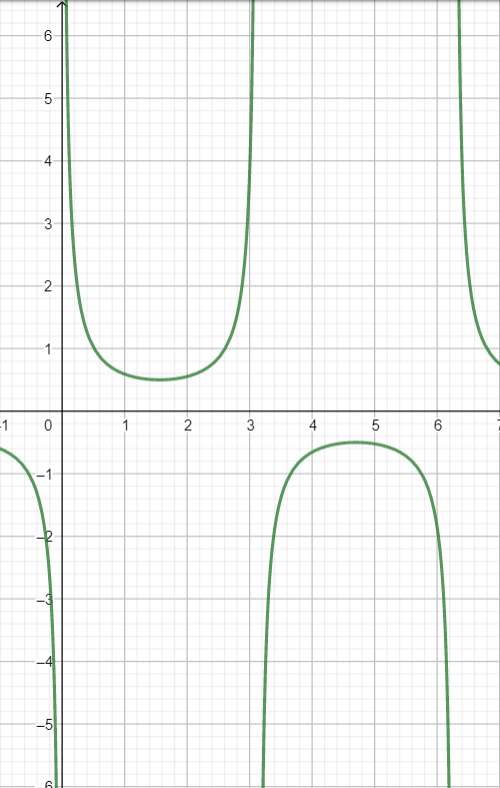
Note: Whenever complex equations are given to solve one must always Firstly start from the complex side and then convert all the terms into $\sin \theta$ or $\cos \theta$ . Then combine them into single fractions. Now it is most likely to use Trigonometric identities for the transformations if there are any.
Know when and where to apply the Subtraction-Addition formula. Must check where the Trigonometric functions become negative in which Quadrant to easily find the values in the given range.
Complete step-by-step solution:
The given trigonometric function is $y=\dfrac{\cos 2x}{\sin 3x-\sin x}$
Consider the denominator $\sin 3x-\sin x$
We now simplify this using the trigonometric identity which is,
$\sin A-\sin B=2\cos \left( \dfrac{A+B}{2} \right)\sin \left( \dfrac{A-B}{2} \right)$
$\Rightarrow \sin 3x-\sin x=2\cos \left( \dfrac{3x+x}{2} \right)\sin \left( \dfrac{3x-x}{2} \right)$
On further evaluating we get,
$\Rightarrow 2\cos \left( \dfrac{4x}{2} \right)\sin \left( \dfrac{2x}{2} \right)$
$\Rightarrow 2\cos \left( 2x \right)\sin \left( x \right)$
Now substitute this back into our equation and rewrite the terms accordingly.
$\Rightarrow y=\dfrac{\cos 2x}{2\cos \left( 2x \right)\sin \left( x \right)}$
Now rearrange the terms,
$\Rightarrow y=\dfrac{1}{2}\left( \dfrac{\cos 2x}{\cos 2x} \right)\left( \dfrac{1}{\sin \left( x \right)} \right)$
We can further represent one of the terms as, $\dfrac{1}{\sin \left( x \right)}=\cos ecx$
Hence $\dfrac{1}{2}\cos ecx,\cos 2x\ne 0$
Writing the general equation for $coes2x\ne 0$
Here, $2x\ne \left( 2n+1 \right)\dfrac{\pi }{2};n=0,\pm 1,\pm 2.....$
$\Rightarrow x\ne \left( 2n+1 \right)\dfrac{\pi }{4}$
Now we know that $\dfrac{1}{2}\cos ecx\notin \dfrac{1}{2}\left( -1,1 \right)=\left( -\dfrac{1}{2},\dfrac{1}{2} \right)$
Now let us substitute the values to get the solutions.
For $n=0$ ; $x\ne \dfrac{\pi }{4}$
For $n=1$ ; $x\ne \dfrac{3\pi }{4}$
For $n=2$ ; $x\ne \dfrac{5\pi }{4}$
For $n=3$ ; $x\ne \dfrac{7\pi }{4}$
Hence all the values except $\dfrac{\pi }{4},\dfrac{3\pi }{4},\dfrac{5\pi }{4},\dfrac{7\pi }{4}$ are the solution for the trigonometric expression.
The graph for the trigonometric function is as follows.
Note: Whenever complex equations are given to solve one must always Firstly start from the complex side and then convert all the terms into $\sin \theta$ or $\cos \theta$ . Then combine them into single fractions. Now it is most likely to use Trigonometric identities for the transformations if there are any.
Know when and where to apply the Subtraction-Addition formula. Must check where the Trigonometric functions become negative in which Quadrant to easily find the values in the given range.
Recently Updated Pages
Master Class 11 Business Studies: Engaging Questions & Answers for Success

Master Class 11 Economics: Engaging Questions & Answers for Success
Master Class 11 Computer Science: Engaging Questions & Answers for Success
Master Class 11 English: Engaging Questions & Answers for Success
Master Class 11 Maths: Engaging Questions & Answers for Success
Master Class 11 Biology: Engaging Questions & Answers for Success
Trending doubts
One Metric ton is equal to kg A 10000 B 1000 C 100 class 11 physics CBSE
Discuss the various forms of bacteria class 11 biology CBSE
Draw a diagram of a plant cell and label at least eight class 11 biology CBSE
State the laws of reflection of light
Explain zero factorial class 11 maths CBSE
10 examples of friction in our daily life