




Find a vector of magnitude 3 and perpendicular to both the vectors, \[\overset{\to }{\mathop{a}}\,=2\overset{\wedge }{\mathop{i}}\,-2\overset{\wedge }{\mathop{j}}\,+\overset{\wedge }{\mathop{k}}\,\] and \[\overset{\to }{\mathop{b}}\,=2\overset{\wedge }{\mathop{i}}\,+2\overset{\wedge }{\mathop{j}}\,+3\overset{\wedge }{\mathop{k}}\,\].
Answer
 Verified
614.7k+ views
- Hint: Take the vector to find as \[\overset{\to }{\mathop{r}}\,=x\overset{\wedge }{\mathop{i}}\,+y\overset{\wedge }{\mathop{j}}\,+z\overset{\wedge }{\mathop{k}}\,\]. As vector \[\overset{\to }{\mathop{r}}\,\] is perpendicular to \[\overset{\to }{\mathop{a}}\,\] and \[\overset{\to }{\mathop{b}}\,\], their dot product will be zero. Thus form two equations and solve them using cross multiplication method. As \[\left| \overset{\to }{\mathop{r}}\, \right|=3\], form the equation and substitute values of x, y, z and thus get \[\overset{\to }{\mathop{r}}\,\].
Complete step-by-step solution -
Here we are given two vector equations,
\[\overset{\to }{\mathop{a}}\,=2\overset{\wedge }{\mathop{i}}\,-2\overset{\wedge }{\mathop{j}}\,+\overset{\wedge }{\mathop{k}}\,\] - (1)
\[\overset{\to }{\mathop{b}}\,=2\overset{\wedge }{\mathop{i}}\,+2\overset{\wedge }{\mathop{j}}\,+3\overset{\wedge }{\mathop{k}}\,\] - (2)
Now we need to find a vector, which has magnitude 3 and this vector should be perpendicular to the vector \[\overset{\to }{\mathop{a}}\,\] and \[\overset{\to }{\mathop{b}}\,\].
Now let us assume the vector as \[\overset{\to }{\mathop{r}}\,\].
i.e. \[\overset{\to }{\mathop{r}}\,=x\overset{\wedge }{\mathop{i}}\,+y\overset{\wedge }{\mathop{j}}\,+z\overset{\wedge }{\mathop{k}}\,\] - (3)
We are given that the magnitude of \[\overset{\to }{\mathop{r}}\,\] is 3. i.e. \[\left| \overset{\to }{\mathop{r}}\, \right|=3\]
Thus we can write that, \[\left| \overset{\to }{\mathop{r}}\, \right|=\sqrt{{{x}^{2}}+{{y}^{2}}+{{z}^{2}}}\]
\[\therefore \sqrt{{{x}^{2}}+{{y}^{2}}+{{z}^{2}}}=3\]
Now taking square on both sides,
\[\therefore {{x}^{2}}+{{y}^{2}}+{{z}^{2}}={{\left( 3 \right)}^{2}}\]
Thus we get the expression as,
\[\therefore {{x}^{2}}+{{y}^{2}}+{{z}^{2}}=9-(4)\]
It is said that \[\overset{\to }{\mathop{r}}\,\bot \overset{\to }{\mathop{a}}\,\] and \[\overset{\to }{\mathop{r}}\,\bot \overset{\to }{\mathop{b}}\,\]. Thus their dot product will be zero.
\[\begin{align}
& \overset{\to }{\mathop{r}}\,.\overset{\to }{\mathop{a}}\,=0 \\
& \left( x\overset{\wedge }{\mathop{i}}\,+y\overset{\wedge }{\mathop{j}}\,+z\overset{\wedge }{\mathop{k}}\, \right).\left( 2\overset{\wedge }{\mathop{i}}\,-2\overset{\wedge }{\mathop{j}}\,+\overset{\wedge }{\mathop{k}}\, \right)=0 \\
& 2x-2y+z=0-(5) \\
\end{align}\]
Similarly, \[\overset{\to }{\mathop{r}}\,.\overset{\to }{\mathop{b}}\,=0\]
\[\begin{align}
& \left( x\overset{\wedge }{\mathop{i}}\,+y\overset{\wedge }{\mathop{j}}\,+z\overset{\wedge }{\mathop{k}}\, \right).\left( 2\overset{\wedge }{\mathop{i}}\,+2\overset{\wedge }{\mathop{j}}\,+3\overset{\wedge }{\mathop{k}}\, \right)=0 \\
& 2x+2y+3z=0-(6) \\
\end{align}\]
Now let us consider equation (5) and equation (6), 2x – 2y + z = 0.
By using the cross multiplication method, 2x + 2y + 3z = 0.
We can write as, \[{{a}_{1}}x+{{b}_{1}}y+{{c}_{1}}=0\], \[{{a}_{2}}x+{{b}_{2}}y+{{c}_{2}}=0\]
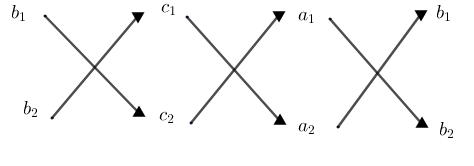
i.e., \[\dfrac{x}{{{b}_{1}}{{c}_{2}}-{{b}_{2}}{{c}_{1}}}=\dfrac{y}{{{c}_{1}}{{a}_{2}}-{{c}_{2}}{{a}_{1}}}=\dfrac{1}{{{a}_{1}}{{b}_{2}}-{{a}_{2}}{{b}_{1}}}\]
Similarly for equation, 2x – 2y + z = 0 and 2x + 2y + 3z =0
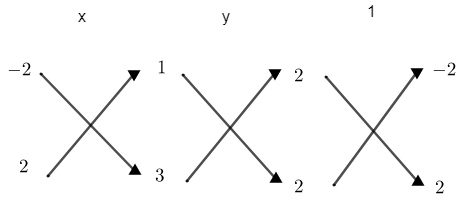
Thus we can write,
\[\begin{align}
& \dfrac{x}{\left( -2\times 3 \right)-\left( 2\times 1 \right)}=\dfrac{y}{\left( 1\times 2 \right)-\left( 3\times 2 \right)}=\dfrac{1}{\left( 2\times 2 \right)-\left( -2\times 2 \right)} \\
& \Rightarrow \dfrac{x}{-6-2}=\dfrac{y}{2-6}=\dfrac{z}{4+4} \\
& \dfrac{x}{-8}=\dfrac{y}{-4}=\dfrac{z}{8} \\
\end{align}\]
Multiplying with 4, we can simplify the expression further as,
\[\dfrac{x}{-2}=\dfrac{y}{-1}=\dfrac{z}{2}\]
Let’s say they are equal to k, thus we can write that,
\[\dfrac{x}{-2}=k,\dfrac{y}{-1}=k\] and \[\dfrac{z}{2}=k\]
\[\therefore x=-2k,y=-k,z=2k-(7)\]
Now let us put these values in equation (4).
\[\begin{align}
& {{x}^{2}}+{{y}^{2}}+{{z}^{2}}=9 \\
& {{\left( -2k \right)}^{2}}+{{\left( k \right)}^{2}}+{{\left( 2k \right)}^{2}}=9 \\
& 4{{k}^{2}}+{{k}^{2}}+4{{k}^{2}}=9 \\
& 9{{k}^{2}}=9\Rightarrow {{k}^{2}}=\dfrac{9}{9}=1 \\
\end{align}\]
i.e. \[k=\sqrt{1}=\pm 1\]
Thus we got, \[k=\pm 1\], now put this in (7) and get values of x, y and z.
x = -2, y = -1, z = 2, when k = 1.
x = 2, y = +1, z = -2, when k = -1.
So, we can say that, \[\overset{\to }{\mathop{r}}\,=-2\overset{\wedge }{\mathop{i}}\,-\overset{\wedge }{\mathop{j}}\,+2\overset{\wedge }{\mathop{k}}\,\] or \[\overset{\to }{\mathop{r}}\,=2\overset{\wedge }{\mathop{i}}\,+\overset{\wedge }{\mathop{j}}\,-2\overset{\wedge }{\mathop{k}}\,\].
Thus we got the required vector as, \[\overset{\to }{\mathop{r}}\,=-2\overset{\wedge }{\mathop{i}}\,-\overset{\wedge }{\mathop{j}}\,+2\overset{\wedge }{\mathop{k}}\,\] or \[\overset{\to }{\mathop{r}}\,=2\overset{\wedge }{\mathop{i}}\,+\overset{\wedge }{\mathop{j}}\,-2\overset{\wedge }{\mathop{k}}\,\].
Note: Remember how to do the cross multiplication method, as it is explained above. You can also solve it using the Cross product method instead of dot product. If in cross product then take, \[\overset{\to }{\mathop{a}}\,=\dfrac{\overset{\to }{\mathop{a}}\,\times \overset{\to }{\mathop{b}}\,}{\left| \overset{\to }{\mathop{a}}\,\times \overset{\to }{\mathop{b}}\, \right|}\] to get the vector quantity of \[\overset{\to }{\mathop{r}}\,\].
Complete step-by-step solution -
Here we are given two vector equations,
\[\overset{\to }{\mathop{a}}\,=2\overset{\wedge }{\mathop{i}}\,-2\overset{\wedge }{\mathop{j}}\,+\overset{\wedge }{\mathop{k}}\,\] - (1)
\[\overset{\to }{\mathop{b}}\,=2\overset{\wedge }{\mathop{i}}\,+2\overset{\wedge }{\mathop{j}}\,+3\overset{\wedge }{\mathop{k}}\,\] - (2)
Now we need to find a vector, which has magnitude 3 and this vector should be perpendicular to the vector \[\overset{\to }{\mathop{a}}\,\] and \[\overset{\to }{\mathop{b}}\,\].
Now let us assume the vector as \[\overset{\to }{\mathop{r}}\,\].
i.e. \[\overset{\to }{\mathop{r}}\,=x\overset{\wedge }{\mathop{i}}\,+y\overset{\wedge }{\mathop{j}}\,+z\overset{\wedge }{\mathop{k}}\,\] - (3)
We are given that the magnitude of \[\overset{\to }{\mathop{r}}\,\] is 3. i.e. \[\left| \overset{\to }{\mathop{r}}\, \right|=3\]
Thus we can write that, \[\left| \overset{\to }{\mathop{r}}\, \right|=\sqrt{{{x}^{2}}+{{y}^{2}}+{{z}^{2}}}\]
\[\therefore \sqrt{{{x}^{2}}+{{y}^{2}}+{{z}^{2}}}=3\]
Now taking square on both sides,
\[\therefore {{x}^{2}}+{{y}^{2}}+{{z}^{2}}={{\left( 3 \right)}^{2}}\]
Thus we get the expression as,
\[\therefore {{x}^{2}}+{{y}^{2}}+{{z}^{2}}=9-(4)\]
It is said that \[\overset{\to }{\mathop{r}}\,\bot \overset{\to }{\mathop{a}}\,\] and \[\overset{\to }{\mathop{r}}\,\bot \overset{\to }{\mathop{b}}\,\]. Thus their dot product will be zero.
\[\begin{align}
& \overset{\to }{\mathop{r}}\,.\overset{\to }{\mathop{a}}\,=0 \\
& \left( x\overset{\wedge }{\mathop{i}}\,+y\overset{\wedge }{\mathop{j}}\,+z\overset{\wedge }{\mathop{k}}\, \right).\left( 2\overset{\wedge }{\mathop{i}}\,-2\overset{\wedge }{\mathop{j}}\,+\overset{\wedge }{\mathop{k}}\, \right)=0 \\
& 2x-2y+z=0-(5) \\
\end{align}\]
Similarly, \[\overset{\to }{\mathop{r}}\,.\overset{\to }{\mathop{b}}\,=0\]
\[\begin{align}
& \left( x\overset{\wedge }{\mathop{i}}\,+y\overset{\wedge }{\mathop{j}}\,+z\overset{\wedge }{\mathop{k}}\, \right).\left( 2\overset{\wedge }{\mathop{i}}\,+2\overset{\wedge }{\mathop{j}}\,+3\overset{\wedge }{\mathop{k}}\, \right)=0 \\
& 2x+2y+3z=0-(6) \\
\end{align}\]
Now let us consider equation (5) and equation (6), 2x – 2y + z = 0.
By using the cross multiplication method, 2x + 2y + 3z = 0.
We can write as, \[{{a}_{1}}x+{{b}_{1}}y+{{c}_{1}}=0\], \[{{a}_{2}}x+{{b}_{2}}y+{{c}_{2}}=0\]
i.e., \[\dfrac{x}{{{b}_{1}}{{c}_{2}}-{{b}_{2}}{{c}_{1}}}=\dfrac{y}{{{c}_{1}}{{a}_{2}}-{{c}_{2}}{{a}_{1}}}=\dfrac{1}{{{a}_{1}}{{b}_{2}}-{{a}_{2}}{{b}_{1}}}\]
Similarly for equation, 2x – 2y + z = 0 and 2x + 2y + 3z =0
Thus we can write,
\[\begin{align}
& \dfrac{x}{\left( -2\times 3 \right)-\left( 2\times 1 \right)}=\dfrac{y}{\left( 1\times 2 \right)-\left( 3\times 2 \right)}=\dfrac{1}{\left( 2\times 2 \right)-\left( -2\times 2 \right)} \\
& \Rightarrow \dfrac{x}{-6-2}=\dfrac{y}{2-6}=\dfrac{z}{4+4} \\
& \dfrac{x}{-8}=\dfrac{y}{-4}=\dfrac{z}{8} \\
\end{align}\]
Multiplying with 4, we can simplify the expression further as,
\[\dfrac{x}{-2}=\dfrac{y}{-1}=\dfrac{z}{2}\]
Let’s say they are equal to k, thus we can write that,
\[\dfrac{x}{-2}=k,\dfrac{y}{-1}=k\] and \[\dfrac{z}{2}=k\]
\[\therefore x=-2k,y=-k,z=2k-(7)\]
Now let us put these values in equation (4).
\[\begin{align}
& {{x}^{2}}+{{y}^{2}}+{{z}^{2}}=9 \\
& {{\left( -2k \right)}^{2}}+{{\left( k \right)}^{2}}+{{\left( 2k \right)}^{2}}=9 \\
& 4{{k}^{2}}+{{k}^{2}}+4{{k}^{2}}=9 \\
& 9{{k}^{2}}=9\Rightarrow {{k}^{2}}=\dfrac{9}{9}=1 \\
\end{align}\]
i.e. \[k=\sqrt{1}=\pm 1\]
Thus we got, \[k=\pm 1\], now put this in (7) and get values of x, y and z.
x = -2, y = -1, z = 2, when k = 1.
x = 2, y = +1, z = -2, when k = -1.
So, we can say that, \[\overset{\to }{\mathop{r}}\,=-2\overset{\wedge }{\mathop{i}}\,-\overset{\wedge }{\mathop{j}}\,+2\overset{\wedge }{\mathop{k}}\,\] or \[\overset{\to }{\mathop{r}}\,=2\overset{\wedge }{\mathop{i}}\,+\overset{\wedge }{\mathop{j}}\,-2\overset{\wedge }{\mathop{k}}\,\].
Thus we got the required vector as, \[\overset{\to }{\mathop{r}}\,=-2\overset{\wedge }{\mathop{i}}\,-\overset{\wedge }{\mathop{j}}\,+2\overset{\wedge }{\mathop{k}}\,\] or \[\overset{\to }{\mathop{r}}\,=2\overset{\wedge }{\mathop{i}}\,+\overset{\wedge }{\mathop{j}}\,-2\overset{\wedge }{\mathop{k}}\,\].
Note: Remember how to do the cross multiplication method, as it is explained above. You can also solve it using the Cross product method instead of dot product. If in cross product then take, \[\overset{\to }{\mathop{a}}\,=\dfrac{\overset{\to }{\mathop{a}}\,\times \overset{\to }{\mathop{b}}\,}{\left| \overset{\to }{\mathop{a}}\,\times \overset{\to }{\mathop{b}}\, \right|}\] to get the vector quantity of \[\overset{\to }{\mathop{r}}\,\].
Recently Updated Pages
Basicity of sulphurous acid and sulphuric acid are

Master Class 12 English: Engaging Questions & Answers for Success
Master Class 12 Social Science: Engaging Questions & Answers for Success
Master Class 12 Maths: Engaging Questions & Answers for Success
Master Class 12 Economics: Engaging Questions & Answers for Success
Master Class 12 Physics: Engaging Questions & Answers for Success
Trending doubts
Which are the Top 10 Largest Countries of the World?
Draw a labelled sketch of the human eye class 12 physics CBSE
Draw ray diagrams each showing i myopic eye and ii class 12 physics CBSE
Give 10 examples of unisexual and bisexual flowers
Coming together federation is practiced in A India class 12 social science CBSE
Write the formula to find the shortest distance between class 12 maths CBSE