




How do you find a standard form equation for the line with slope $\dfrac{2}{3}$ that passes through the point $\left( 3,6 \right)$?
Answer
 Verified
557.7k+ views
Hint: In this problem we need to calculate the equation of the line which is having the slope $\dfrac{2}{3}$ and passes through the point $\left( 3,6 \right)$. We have the formula for the equation of the line having slope $m$ and passes through a point $\left( {{x}_{1}},{{y}_{1}} \right)$ as $\left( y-{{y}_{1}} \right)=m\left( x-{{x}_{1}} \right)$. So, we will substitute all the values we have in the above equation and simplify the obtained equation by using the distribution law of multiplication over subtraction. After simplifying the equation, we will get our required solution.
Complete answer:
Given that the line has slope $\dfrac{2}{3}$.
$\Rightarrow m=\dfrac{2}{3}$
Now the line passes through the point $\left( 3,6 \right)$
$\Rightarrow \left( {{x}_{1}},{{y}_{1}} \right)=\left( 3,6 \right)$
We know that the equation of the line having slope $m$ and passes through a point $\left( {{x}_{1}},{{y}_{1}} \right)$ is
$\left( y-{{y}_{1}} \right)=m\left( x-{{x}_{1}} \right)$
Substituting the values of $m$, ${{x}_{1}}$, ${{y}_{1}}$ in the above equation, then we will get
$\Rightarrow \left( y-6 \right)=\dfrac{2}{3}\left( x-3 \right)$
Doing cross multiplication in the above equation, then we will get
$\Rightarrow 3\left( y-6 \right)=2\left( x-3 \right)$
From the distribution law of multiplication over subtraction we have $a\left( b-c \right)=ab-ac$. Applying this law in the above equation, then we will get
$\begin{align}
& \Rightarrow 3\times y-3\times 6=2\times x-2\times 3 \\
& \Rightarrow 3y-18=2x-6 \\
\end{align}$
Shifting the term $3y-18$ which is on the left hand side to right hand side. When there is a shifting from one side to another side is takes place there should be change of sign also takes place, then we will get
$\Rightarrow 2x-6-3y+18=0$
Simplifying and rearranging the term in the above equation, then we will get the equation of the required line as
$\therefore 2x-3y+12=0$
And the graph of the above line will be
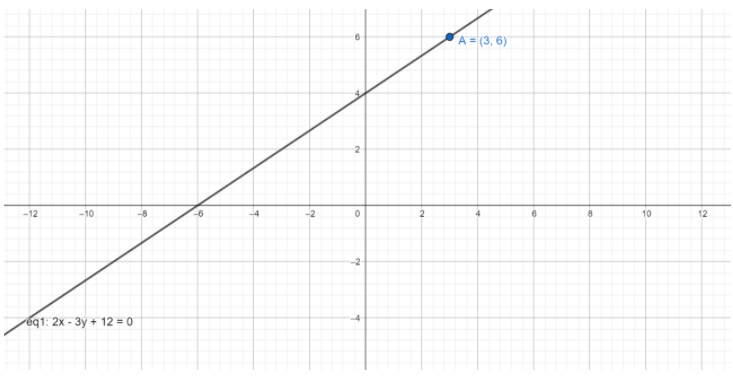
Note: We can also check that whether the obtained equation is correct or wrong by substituting the given point in the obtained equation. Then we will get
$\begin{align}
& \Rightarrow 2\left( 3 \right)-3\left( 6 \right)+12=0 \\
& \Rightarrow 6-18+12=0 \\
& \Rightarrow -18+18=0 \\
& \Rightarrow 0=0 \\
& \Rightarrow LHS=RHS \\
\end{align}$
Hence the obtained equation is correct.
Complete answer:
Given that the line has slope $\dfrac{2}{3}$.
$\Rightarrow m=\dfrac{2}{3}$
Now the line passes through the point $\left( 3,6 \right)$
$\Rightarrow \left( {{x}_{1}},{{y}_{1}} \right)=\left( 3,6 \right)$
We know that the equation of the line having slope $m$ and passes through a point $\left( {{x}_{1}},{{y}_{1}} \right)$ is
$\left( y-{{y}_{1}} \right)=m\left( x-{{x}_{1}} \right)$
Substituting the values of $m$, ${{x}_{1}}$, ${{y}_{1}}$ in the above equation, then we will get
$\Rightarrow \left( y-6 \right)=\dfrac{2}{3}\left( x-3 \right)$
Doing cross multiplication in the above equation, then we will get
$\Rightarrow 3\left( y-6 \right)=2\left( x-3 \right)$
From the distribution law of multiplication over subtraction we have $a\left( b-c \right)=ab-ac$. Applying this law in the above equation, then we will get
$\begin{align}
& \Rightarrow 3\times y-3\times 6=2\times x-2\times 3 \\
& \Rightarrow 3y-18=2x-6 \\
\end{align}$
Shifting the term $3y-18$ which is on the left hand side to right hand side. When there is a shifting from one side to another side is takes place there should be change of sign also takes place, then we will get
$\Rightarrow 2x-6-3y+18=0$
Simplifying and rearranging the term in the above equation, then we will get the equation of the required line as
$\therefore 2x-3y+12=0$
And the graph of the above line will be
Note: We can also check that whether the obtained equation is correct or wrong by substituting the given point in the obtained equation. Then we will get
$\begin{align}
& \Rightarrow 2\left( 3 \right)-3\left( 6 \right)+12=0 \\
& \Rightarrow 6-18+12=0 \\
& \Rightarrow -18+18=0 \\
& \Rightarrow 0=0 \\
& \Rightarrow LHS=RHS \\
\end{align}$
Hence the obtained equation is correct.
Recently Updated Pages
Master Class 11 Business Studies: Engaging Questions & Answers for Success

Master Class 11 Economics: Engaging Questions & Answers for Success
Master Class 11 Computer Science: Engaging Questions & Answers for Success
Master Class 11 English: Engaging Questions & Answers for Success
Master Class 11 Maths: Engaging Questions & Answers for Success
Master Class 11 Biology: Engaging Questions & Answers for Success
Trending doubts
One Metric ton is equal to kg A 10000 B 1000 C 100 class 11 physics CBSE
Discuss the various forms of bacteria class 11 biology CBSE
Draw a diagram of a plant cell and label at least eight class 11 biology CBSE
State the laws of reflection of light
Explain zero factorial class 11 maths CBSE
10 examples of friction in our daily life