




Fill in the blanks
Lining of blood vessels is made up of ________.
Answer
 Verified
618k+ views
Hint:The blood vessels are conducting vessels for the circulation of blood throughout the body. The blood transports various nutrients and gases required by cells. The transport occurs by diffusion. Thus, the lining of blood vessels needs to be made up of cells having thin walls. These cells made up pavement like epithelium.
Complete answer:The blood vessels form an important circulatory unit of the body. These are thin long tubules spread throughout the body. They carry blood that is a connective transport tissue. The blood carries nutrients and oxygen from one place to another where they are required. Gaseous exchange occurs in the lungs between alveoli and blood vessels. Also, the diffusion of various substances occurs through blood vessels to various tissues.
For the diffusion purpose, the blood vessels need to have smooth and thin linings. Thus simple squamous epithelium makes up the lining of blood vessels. These are made up of cells having very thin cell walls and dense cytoplasm that allows appropriate material exchange. It is a type of simple epithelium that consists of a single layer of cells attached to a basement membrane. Squamous or flat cells form a single layer that is also called pavement epithelium. This is because cells appear to be arranged like tiles on a floor.
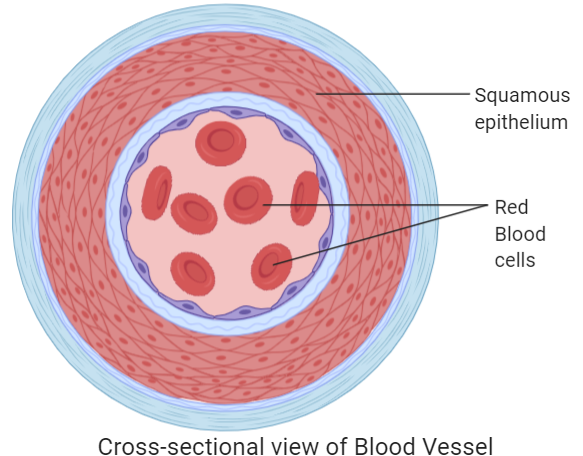
The cell's squamous epithelium provides a smooth surface having low-friction due to which fluid can move easily and quickly. The cells are thin that facilitates quick transfer and exchange of molecules across the vessels.
Thus, we can say that ‘Lining of blood vessels is made up of squamous epithelium’.
Note:The characteristic feature of squamous epithelium is that they provide a way for the exchange of molecules. However, it has various other functions. It provides a smooth and frictionless site at places where secretion takes place. It also protects underlying tissues from light stresses. Thus, they are present in places where transportation and absorption of molecules happen.
Complete answer:The blood vessels form an important circulatory unit of the body. These are thin long tubules spread throughout the body. They carry blood that is a connective transport tissue. The blood carries nutrients and oxygen from one place to another where they are required. Gaseous exchange occurs in the lungs between alveoli and blood vessels. Also, the diffusion of various substances occurs through blood vessels to various tissues.
For the diffusion purpose, the blood vessels need to have smooth and thin linings. Thus simple squamous epithelium makes up the lining of blood vessels. These are made up of cells having very thin cell walls and dense cytoplasm that allows appropriate material exchange. It is a type of simple epithelium that consists of a single layer of cells attached to a basement membrane. Squamous or flat cells form a single layer that is also called pavement epithelium. This is because cells appear to be arranged like tiles on a floor.
The cell's squamous epithelium provides a smooth surface having low-friction due to which fluid can move easily and quickly. The cells are thin that facilitates quick transfer and exchange of molecules across the vessels.
Thus, we can say that ‘Lining of blood vessels is made up of squamous epithelium’.
Note:The characteristic feature of squamous epithelium is that they provide a way for the exchange of molecules. However, it has various other functions. It provides a smooth and frictionless site at places where secretion takes place. It also protects underlying tissues from light stresses. Thus, they are present in places where transportation and absorption of molecules happen.
Recently Updated Pages
The given figure shows two endocrine glands marked class 11 biology NEET_UG

Match columnI with columnII and select the correct class 11 biology NEET
Match column I with column II and select the correct class 11 biology NEET_UG
Which floral family has left 9 right + 1 arrangement class 11 biology NEET_UG
Which is not a variety of sheep A Lohi B Beetal C Nellore class 11 biology NEET_UG
Match column I with column II and select the correct class 11 biology NEET_UG
Trending doubts
Difference Between Prokaryotic Cells and Eukaryotic Cells
One Metric ton is equal to kg A 10000 B 1000 C 100 class 11 physics CBSE
Two of the body parts which do not appear in MRI are class 11 biology CBSE
10 examples of friction in our daily life
Draw a diagram of nephron and explain its structur class 11 biology CBSE
Draw a diagram of a plant cell and label at least eight class 11 biology CBSE