




Fill in the blank.
In a uniform circular motion ________ will remain constant.
A. acceleration
B. time
C. speed
D. direction
Answer
 Verified
588.3k+ views
Hint: Motion of an object along the circumference of a circle or rotation in a circular shaped path can be defined as the circular motion. It may be uniform which has a fixed angular rate of rotation and also fixed speed. Or it may be non-uniform with a varying rate of rotation. This will help you to solve this question.
Complete step by step answer:
The movement of an object following a circular path is referred to as a circular motion. The motion of an object which is in motion with a fixed speed along a circular path is known as Uniform Circular Motion. For this case, the speed will be the same but the velocity will be different. If an object is moving in a circle, it will be having a little amount of acceleration experienced towards the centre which is the cause for the movement around the centre. As this acceleration is being tangential to the velocity of a particle at each and every moment, it will be varying the direction of velocity only. That is, the magnitude will be a constant and therefore the motion is known as uniform circular motion. This acceleration is known as centripetal acceleration and the force acting towards the centre is referred to as centripetal force. Therefore when a body is in uniform circular motion, the velocity will be varying, acceleration will be changing and time also will be varying for sure.
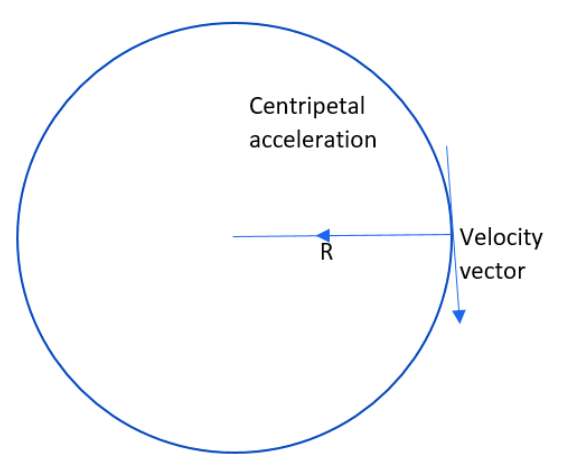
So, the correct answer is “Option C”.
Note: For uniform circular motion, the tangential acceleration will be zero, but the radial acceleration will be there. In case of non-uniform circular motion, the tangential acceleration will not be zero. Therefore the speed of particles will increase or decrease. Thus the net acceleration will be the resultant sum of radial acceleration as well as tangential acceleration.
Complete step by step answer:
The movement of an object following a circular path is referred to as a circular motion. The motion of an object which is in motion with a fixed speed along a circular path is known as Uniform Circular Motion. For this case, the speed will be the same but the velocity will be different. If an object is moving in a circle, it will be having a little amount of acceleration experienced towards the centre which is the cause for the movement around the centre. As this acceleration is being tangential to the velocity of a particle at each and every moment, it will be varying the direction of velocity only. That is, the magnitude will be a constant and therefore the motion is known as uniform circular motion. This acceleration is known as centripetal acceleration and the force acting towards the centre is referred to as centripetal force. Therefore when a body is in uniform circular motion, the velocity will be varying, acceleration will be changing and time also will be varying for sure.
So, the correct answer is “Option C”.
Note: For uniform circular motion, the tangential acceleration will be zero, but the radial acceleration will be there. In case of non-uniform circular motion, the tangential acceleration will not be zero. Therefore the speed of particles will increase or decrease. Thus the net acceleration will be the resultant sum of radial acceleration as well as tangential acceleration.
Recently Updated Pages
Basicity of sulphurous acid and sulphuric acid are

Master Class 11 Business Studies: Engaging Questions & Answers for Success
Master Class 11 Computer Science: Engaging Questions & Answers for Success
Master Class 11 Economics: Engaging Questions & Answers for Success
Master Class 11 Social Science: Engaging Questions & Answers for Success
Master Class 11 English: Engaging Questions & Answers for Success
Trending doubts
One Metric ton is equal to kg A 10000 B 1000 C 100 class 11 physics CBSE
State and prove Bernoullis theorem class 11 physics CBSE
Actinoid contraction is more than lanthanoid contraction class 11 chemistry CBSE
The transition element that has lowest enthalpy of class 11 chemistry CBSE
Can anyone list 10 advantages and disadvantages of friction
State the laws of reflection of light