




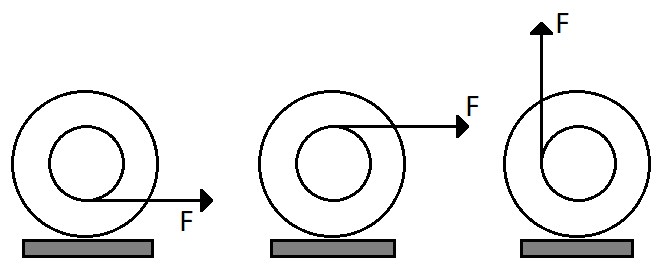
Figure shows three identical yo-yos initially at rest on a horizontal surface. For each yo-yo the string is pulled in the direction shown. In each case there is sufficient friction for the yo-yo to roll without slipping. Draw a free-body diagram for each yo-yo. In what direction will each yo-yo rotate?
Answer
 Verified
581.4k+ views
Hint
To draw the free body diagram, we need to draw all the forces that are acting on the yo-yo. The sum of all these forces will give us the net force and from there we can find the net torque. The direction of the net torque gives the direction in which the yo-yo rotates.
Complete step by step answer
The free body diagrams are drawn by considering all the forces that are acting on the yo-yo. So the free body diagram of the first yo-yo is given by the following diagram.
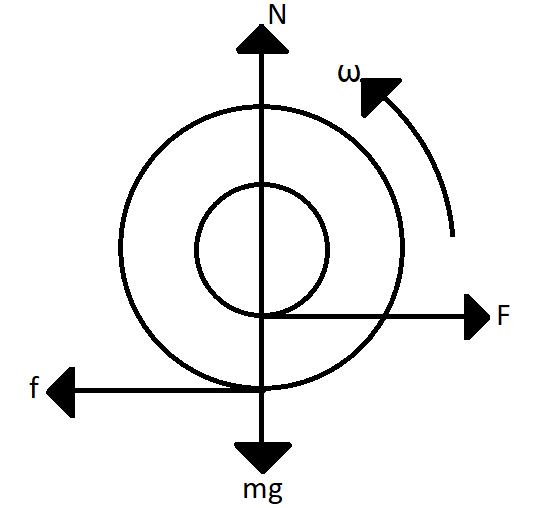
The point of contact of the yo-yo on the ground will be the point through which the axis passes. So the force exerted on the yo-yo will produce a net anti-clockwise torque. Due to this the yo-yo will rotate in the anti-clockwise direction.
For the second case, the free body diagram is given by,
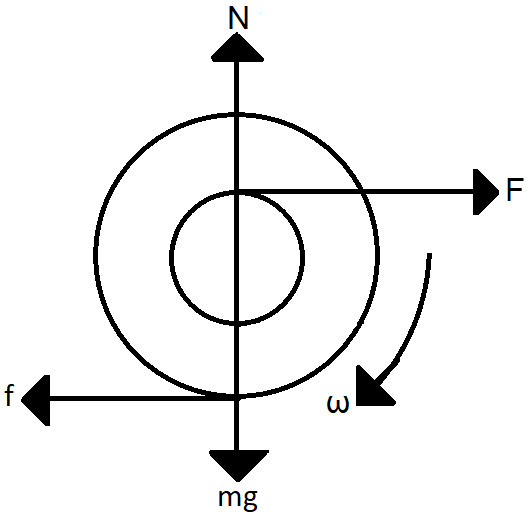
In this case also as the previous one, the force on the yo-yo will produce a clockwise torque and due to this the yo-yo will have a clockwise motion.
For the third case the free body diagram will be as follows,
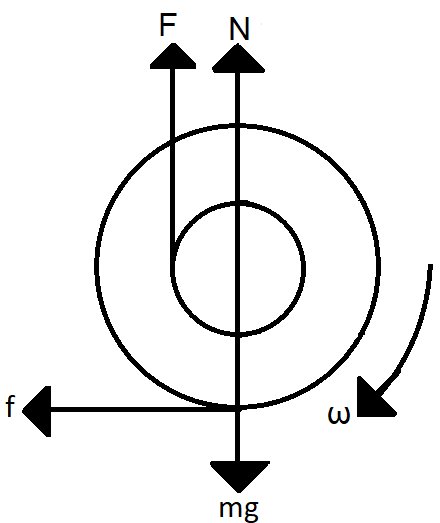
In this case also the force on the yo-yo will produce a clockwise torque and due to this the yo-yo will have a clockwise motion.
Therefore, the yo-yo will have clockwise motion in the second and third case and anti-clockwise motion in the first case.
Note
Free body diagrams in physics are used to visualize the applied forces and the resulting actions on a body due to those forces. They consist of a simple version of the body and the forces drawn with straight line arrows. And the momenta are drawn with curved lines if necessary to depict the direction of motion of the body.
To draw the free body diagram, we need to draw all the forces that are acting on the yo-yo. The sum of all these forces will give us the net force and from there we can find the net torque. The direction of the net torque gives the direction in which the yo-yo rotates.
Complete step by step answer
The free body diagrams are drawn by considering all the forces that are acting on the yo-yo. So the free body diagram of the first yo-yo is given by the following diagram.
The point of contact of the yo-yo on the ground will be the point through which the axis passes. So the force exerted on the yo-yo will produce a net anti-clockwise torque. Due to this the yo-yo will rotate in the anti-clockwise direction.
For the second case, the free body diagram is given by,
In this case also as the previous one, the force on the yo-yo will produce a clockwise torque and due to this the yo-yo will have a clockwise motion.
For the third case the free body diagram will be as follows,
In this case also the force on the yo-yo will produce a clockwise torque and due to this the yo-yo will have a clockwise motion.
Therefore, the yo-yo will have clockwise motion in the second and third case and anti-clockwise motion in the first case.
Note
Free body diagrams in physics are used to visualize the applied forces and the resulting actions on a body due to those forces. They consist of a simple version of the body and the forces drawn with straight line arrows. And the momenta are drawn with curved lines if necessary to depict the direction of motion of the body.
Recently Updated Pages
Master Class 11 Computer Science: Engaging Questions & Answers for Success

Master Class 11 Business Studies: Engaging Questions & Answers for Success
Master Class 11 Economics: Engaging Questions & Answers for Success
Master Class 11 English: Engaging Questions & Answers for Success
Master Class 11 Maths: Engaging Questions & Answers for Success
Master Class 11 Biology: Engaging Questions & Answers for Success
Trending doubts
One Metric ton is equal to kg A 10000 B 1000 C 100 class 11 physics CBSE
There are 720 permutations of the digits 1 2 3 4 5 class 11 maths CBSE
Discuss the various forms of bacteria class 11 biology CBSE
Draw a diagram of a plant cell and label at least eight class 11 biology CBSE
State the laws of reflection of light
Explain zero factorial class 11 maths CBSE