




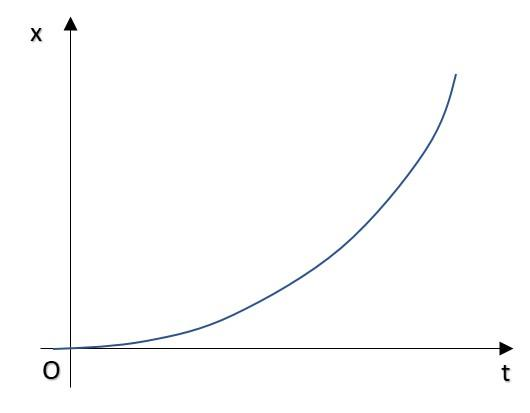
Figure shows the x-t plot of 1-D motion of a particle. Is it correct to say from the graph that the particle moves in a straight line for t < 0 and on a parabolic path for t > 0? If not, suggest a suitable physical context for this graph.
Answer
 Verified
585.9k+ views
Hint: Considering only the motion of particles due to natural parameters like gravity, any motion on earth could be divided into two categories. straight line and parabolic path. A motion is parabolic if the initial velocity is not in the direction of acceleration due to gravity. Whereas a motion is a straight line only if either the velocity is zero or is in or opposite to the direction of acceleration due to gravity.
Complete step by step answer:
Since we’ve been asked about physical context, we can suggest the motion or situation related to daily life problems. We have to think about a scenario where displacement and time varies in parabolic form.
Let’s consider the free fall motion of a body. During free fall, we have acceleration of the body to be constant. Let’s see what will be the relation between displacement (x) and time (t).
We have $a= g$
As $a = \dfrac{dv}{dt}$
Hence $g = \dfrac{dv}{dt}$
$\implies dv = g dt$
Integrating both sides, we get;
$\int dv = \int gdt$
$\implies v = g\int dt$
$\implies v = gt + c$
Now, we have considered free fall of the body, which means at $t=0, \ v = 0$
Thus applying this condition, we get;
$0 = g(0) + c$
$\implies c = 0$
Hence we have $v = gt$
Now, as $v = \dfrac{dx}{dt}$
Thus, $\dfrac{dx}{dt} = gt$
$\implies dx = gtdt$
Integrating, we get
$\int dx = \int gtdt$
$\implies x = g \int tdt = g \dfrac{t^2}{2}$
Hence we get, $x = \dfrac{gt^2}{2}$
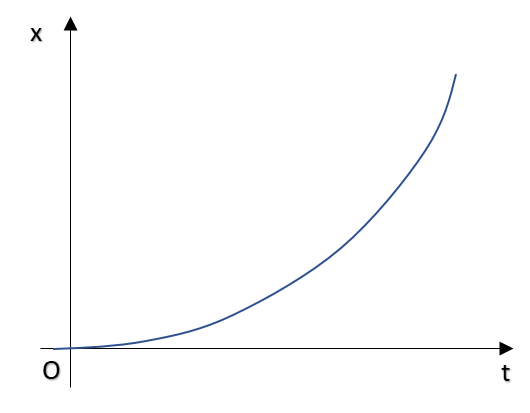
Hence, we can see that if the body undergoes a constant acceleration, its path is parabolic with time.
But saying that it moves in a parabolic path won’t be correct. For that we have to establish an equation between ‘x’ and ‘y’ coordinates. As it is mentioned that it is free fall, means it doesn’t have any velocity in any direction. Hence the path will be straight line, not parabolic.
Note: By seeing the x-t graph, we cannot say anything about the motion of particles. Before t =0, the displacement of the body was not changing with time which suggests that the body is at rest. After t=0, the body started moving with a constant acceleration.
Complete step by step answer:
Since we’ve been asked about physical context, we can suggest the motion or situation related to daily life problems. We have to think about a scenario where displacement and time varies in parabolic form.
Let’s consider the free fall motion of a body. During free fall, we have acceleration of the body to be constant. Let’s see what will be the relation between displacement (x) and time (t).
We have $a= g$
As $a = \dfrac{dv}{dt}$
Hence $g = \dfrac{dv}{dt}$
$\implies dv = g dt$
Integrating both sides, we get;
$\int dv = \int gdt$
$\implies v = g\int dt$
$\implies v = gt + c$
Now, we have considered free fall of the body, which means at $t=0, \ v = 0$
Thus applying this condition, we get;
$0 = g(0) + c$
$\implies c = 0$
Hence we have $v = gt$
Now, as $v = \dfrac{dx}{dt}$
Thus, $\dfrac{dx}{dt} = gt$
$\implies dx = gtdt$
Integrating, we get
$\int dx = \int gtdt$
$\implies x = g \int tdt = g \dfrac{t^2}{2}$
Hence we get, $x = \dfrac{gt^2}{2}$
Hence, we can see that if the body undergoes a constant acceleration, its path is parabolic with time.
But saying that it moves in a parabolic path won’t be correct. For that we have to establish an equation between ‘x’ and ‘y’ coordinates. As it is mentioned that it is free fall, means it doesn’t have any velocity in any direction. Hence the path will be straight line, not parabolic.
Note: By seeing the x-t graph, we cannot say anything about the motion of particles. Before t =0, the displacement of the body was not changing with time which suggests that the body is at rest. After t=0, the body started moving with a constant acceleration.
Recently Updated Pages
Master Class 11 Computer Science: Engaging Questions & Answers for Success

Master Class 11 Business Studies: Engaging Questions & Answers for Success
Master Class 11 Economics: Engaging Questions & Answers for Success
Master Class 11 English: Engaging Questions & Answers for Success
Master Class 11 Maths: Engaging Questions & Answers for Success
Master Class 11 Biology: Engaging Questions & Answers for Success
Trending doubts
One Metric ton is equal to kg A 10000 B 1000 C 100 class 11 physics CBSE
There are 720 permutations of the digits 1 2 3 4 5 class 11 maths CBSE
Discuss the various forms of bacteria class 11 biology CBSE
Draw a diagram of a plant cell and label at least eight class 11 biology CBSE
State the laws of reflection of light
Explain zero factorial class 11 maths CBSE