




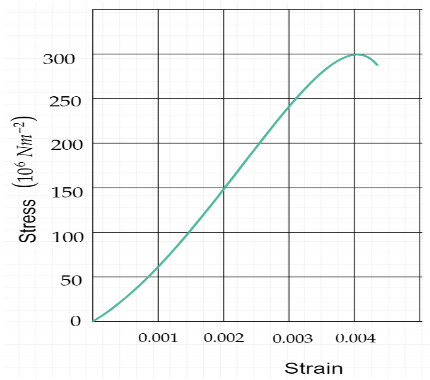
Figure shows stress-strain curve for a given material. What are (a) Young’s Modulus and (b) approximate yield strength for this material?
Answer
 Verified
551.7k+ views
Hint: First of all, we have to understand the meaning of Young’s Modulus.Young’s Modulus of a substance is defined as the elasticity of a substance, in some way. It is the amount of stress that acts on a substance having some strain. Then, we have to understand the yield strength of the material and hence find the answer to the given question.
Complete step by step answer:
Young’s Modulus also known as the modulus of elasticity is referred to as the mechanical property which indicates the tensile strength of a substance. It is the amount of strain that a material possesses to the stress exerted on the same amount of the material. The SI unit of Young’s Modulus is $\dfrac{N}{{{m^2}}}$. So, in order to find the Young’s Modulus, the formula required is,
${\text{Young's Modulus}} = \dfrac{{{\text{Stress}}}}{{{\text{Strain}}}}$
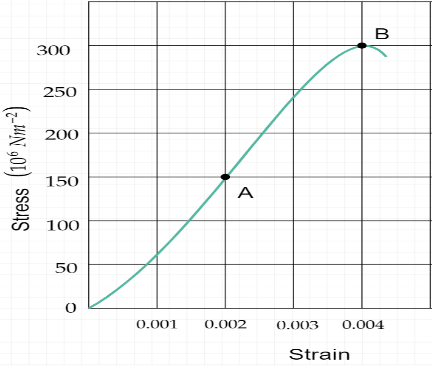
(a) In the given graph, let us consider the point A we get,
$\text{Young’s Modulus} = \dfrac{{150 \times {{10}^6}}}{{0.002}} \\
\therefore \text{Young’s Modulus} = 7.5 \times {10^{10}}{\text{ }}\dfrac{N}{{{m^2}}}$
(b) Yield strength of a material is defined as the stress level till which the material starts to deform plastically is known as yield strength. The yield point is the point on the curve on which it gradually starts to decrease.In the given graph, point B is the yield point.
$\text{Yield strength} =300 \times {10^6}{\text{ }}\dfrac{N}{{{m^2}}} \\
\therefore \text{Yield strength} = 3 \times {10^8}{\text{ }}\dfrac{N}{{{m^2}}}$
So, the yield strength is $3 \times {10^8}{\text{ }}\dfrac{N}{{{m^2}}}$.
Note: It must be noted that at plastic deformation the structure or shape of the substance does not deform totally or permanently, it just temporarily deforms. It is often difficult to determine the exact point where yielding begins so we consider an approximate value. This is where the stress to give a certain amount of strain is used to define the yield strength.
Complete step by step answer:
Young’s Modulus also known as the modulus of elasticity is referred to as the mechanical property which indicates the tensile strength of a substance. It is the amount of strain that a material possesses to the stress exerted on the same amount of the material. The SI unit of Young’s Modulus is $\dfrac{N}{{{m^2}}}$. So, in order to find the Young’s Modulus, the formula required is,
${\text{Young's Modulus}} = \dfrac{{{\text{Stress}}}}{{{\text{Strain}}}}$
(a) In the given graph, let us consider the point A we get,
$\text{Young’s Modulus} = \dfrac{{150 \times {{10}^6}}}{{0.002}} \\
\therefore \text{Young’s Modulus} = 7.5 \times {10^{10}}{\text{ }}\dfrac{N}{{{m^2}}}$
(b) Yield strength of a material is defined as the stress level till which the material starts to deform plastically is known as yield strength. The yield point is the point on the curve on which it gradually starts to decrease.In the given graph, point B is the yield point.
$\text{Yield strength} =300 \times {10^6}{\text{ }}\dfrac{N}{{{m^2}}} \\
\therefore \text{Yield strength} = 3 \times {10^8}{\text{ }}\dfrac{N}{{{m^2}}}$
So, the yield strength is $3 \times {10^8}{\text{ }}\dfrac{N}{{{m^2}}}$.
Note: It must be noted that at plastic deformation the structure or shape of the substance does not deform totally or permanently, it just temporarily deforms. It is often difficult to determine the exact point where yielding begins so we consider an approximate value. This is where the stress to give a certain amount of strain is used to define the yield strength.
Recently Updated Pages
Basicity of sulphurous acid and sulphuric acid are

Master Class 11 English: Engaging Questions & Answers for Success
Master Class 11 Physics: Engaging Questions & Answers for Success
Master Class 11 Computer Science: Engaging Questions & Answers for Success
Master Class 11 Chemistry: Engaging Questions & Answers for Success
Master Class 11 Social Science: Engaging Questions & Answers for Success
Trending doubts
Difference Between Prokaryotic Cells and Eukaryotic Cells
Two of the body parts which do not appear in MRI are class 11 biology CBSE
One Metric ton is equal to kg A 10000 B 1000 C 100 class 11 physics CBSE
10 examples of friction in our daily life
Draw a diagram of nephron and explain its structur class 11 biology CBSE
What will happen if the mucus is not secreted by the class 11 biology CBSE