




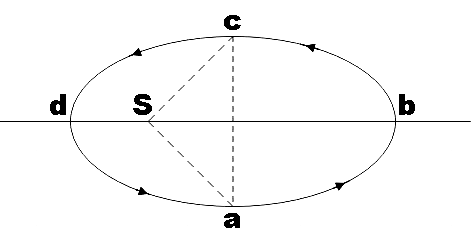
Figure shows elliptical path $abcd$ of a planet around the sun such that the area of triangle $csa$ is $\dfrac{1}{4}$ the area of the ellipse (see figure). With db as the semi-major axis, and ca as the semi minor axis, if ${{t}_{1}}$ is the time taken for planet to go over path $abc$ and ${{t}_{2}}$ for path taken over $cda$, then,
A. ${{t}_{1}}=4{{t}_{2}}$
B.${{t}_{1}}=2{{t}_{2}}$
C.${{t}_{1}}=3{{t}_{2}}$
D.${{t}_{1}}={{t}_{2}}$
Answer
 Verified
639.3k+ views
Hint: As a first step you could recall Kepler’s second law of planetary motion. Now you could find the area swept by the planet for traveling from $a$ to c through b and the area swept by the planet when it moves from c to a through d. Then by applying the law, you will get the required relation between the time periods.
Complete step by step answer:
Figure shows elliptical path $abcd$ of a planet around the sun such that the area of triangle $csa$ is $\dfrac{1}{4}$ the area of the ellipse (see figure). With db as the semi-major axis, and ca as the semi minor axis, if ${{t}_{1}}$ is the time taken for planet to go over path $abc$ and ${{t}_{2}}$ for path taken over $cda$, then,
In the question, we are given an elliptical path $abcd$ of some planet around the sun such that the area of the triangle $csa$ marked in the given figure is one-fourth the whole area of the ellipse. We are asked to find the time taken to cover $cda$ in terms of time taken to cover the path $abc$.
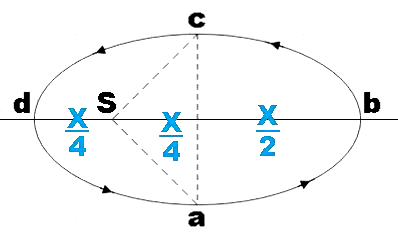
Let the total area of the ellipse be X, then the area of the triangle marked in the given figure will be, $\dfrac{x}{4}$
We have a semi-ellipse $abc$, whose area will be $\dfrac{X}{2}$ and in the left half, the area excluding the triangle part will be, $\dfrac{X}{4}$
Now, let us recall Kepler’s second law. This law states that the imaginary line connecting a planet and the sun sweeps out equal areas in equal interval of time or simply, areal velocity of the planet around the sun is a constant, that is,
${{v}_{A}}=\dfrac{A}{t}=k$
$\Rightarrow \dfrac{{{A}_{1}}}{{{t}_{1}}}=\dfrac{{{A}_{2}}}{{{t}_{2}}}$ ………………………. (1)
From the figure, ${{A}_{1}}$ is the area swept by the planet traveling from $a$ to c through b and ${{A}_{2}}$ is the area swept by the planet when it moves from c to a through d.
${{A}_{2}}=\dfrac{X}{4}$ …………………………………… (2)
${{A}_{1}}=\dfrac{X}{2}+\dfrac{X}{4}=\dfrac{3X}{4}$ ………………………… (3)
Substituting (2) and (3) in (1), we get,
$\dfrac{\left( \dfrac{3X}{4} \right)}{{{t}_{1}}}=\dfrac{\left( \dfrac{X}{4} \right)}{{{t}_{2}}}$
$\Rightarrow \dfrac{3}{{{t}_{1}}}=\dfrac{1}{{{t}_{2}}}$
$\therefore {{t}_{1}}=3{{t}_{2}}$
Therefore, we found the required relation to be ${{t}_{1}}=3{{t}_{2}}$.
So, the correct answer is “Option C”.
Note: Other than the law used in solving this question, we have two other Kepler’s laws for planetary motion. The first law is called the law of elliptical orbit which states that every planet moves around in an elliptical orbit with the sun at one of its focus. Then the other law is called the law of harmonics which states that the square of the time period of a planet is directly proportional to the cube of its orbital radius.
Complete step by step answer:
Figure shows elliptical path $abcd$ of a planet around the sun such that the area of triangle $csa$ is $\dfrac{1}{4}$ the area of the ellipse (see figure). With db as the semi-major axis, and ca as the semi minor axis, if ${{t}_{1}}$ is the time taken for planet to go over path $abc$ and ${{t}_{2}}$ for path taken over $cda$, then,
In the question, we are given an elliptical path $abcd$ of some planet around the sun such that the area of the triangle $csa$ marked in the given figure is one-fourth the whole area of the ellipse. We are asked to find the time taken to cover $cda$ in terms of time taken to cover the path $abc$.
Let the total area of the ellipse be X, then the area of the triangle marked in the given figure will be, $\dfrac{x}{4}$
We have a semi-ellipse $abc$, whose area will be $\dfrac{X}{2}$ and in the left half, the area excluding the triangle part will be, $\dfrac{X}{4}$
Now, let us recall Kepler’s second law. This law states that the imaginary line connecting a planet and the sun sweeps out equal areas in equal interval of time or simply, areal velocity of the planet around the sun is a constant, that is,
${{v}_{A}}=\dfrac{A}{t}=k$
$\Rightarrow \dfrac{{{A}_{1}}}{{{t}_{1}}}=\dfrac{{{A}_{2}}}{{{t}_{2}}}$ ………………………. (1)
From the figure, ${{A}_{1}}$ is the area swept by the planet traveling from $a$ to c through b and ${{A}_{2}}$ is the area swept by the planet when it moves from c to a through d.
${{A}_{2}}=\dfrac{X}{4}$ …………………………………… (2)
${{A}_{1}}=\dfrac{X}{2}+\dfrac{X}{4}=\dfrac{3X}{4}$ ………………………… (3)
Substituting (2) and (3) in (1), we get,
$\dfrac{\left( \dfrac{3X}{4} \right)}{{{t}_{1}}}=\dfrac{\left( \dfrac{X}{4} \right)}{{{t}_{2}}}$
$\Rightarrow \dfrac{3}{{{t}_{1}}}=\dfrac{1}{{{t}_{2}}}$
$\therefore {{t}_{1}}=3{{t}_{2}}$
Therefore, we found the required relation to be ${{t}_{1}}=3{{t}_{2}}$.
So, the correct answer is “Option C”.
Note: Other than the law used in solving this question, we have two other Kepler’s laws for planetary motion. The first law is called the law of elliptical orbit which states that every planet moves around in an elliptical orbit with the sun at one of its focus. Then the other law is called the law of harmonics which states that the square of the time period of a planet is directly proportional to the cube of its orbital radius.
Recently Updated Pages
If x a + bt + ct2 where x is in meters and t is in class 11 physics CBSE

A car covers the first half distance between two places class 11 physics CBSE
The resultant of two vectors overrightarrow P and overrightarrow class 11 physics CBSE
Find the value of cos 135 class 11 maths CBSE
A mass M is held in place by an applied force F and class 11 physics CBSE
A solution of glucose in water is labelled as 10 dfracwv class 11 chemistry CBSE
Trending doubts
Find the value of the expression given below sin 30circ class 11 maths CBSE
One Metric ton is equal to kg A 10000 B 1000 C 100 class 11 physics CBSE
Draw a diagram of nephron and explain its structur class 11 biology CBSE
10 examples of friction in our daily life
Proton was discovered by A Thomson B Rutherford C Chadwick class 11 chemistry CBSE
Bond order ofO2 O2+ O2 and O22 is in order A O2 langle class 11 chemistry CBSE