




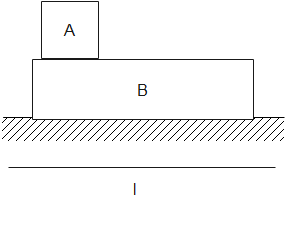
Figure shows a small time elapsed before the block separated from the plank. Block A of mass $m$ kept at the left end of a plank B of mass $M=2m$ and length $l$. The system can slide on a horizontal road. The system is started towards right with the initial velocity $v$. The friction coefficient between the road and plank is $\dfrac{1}{2}$ and that between the plank and the block is $\dfrac{1}{4}$. Find the time elapsed before the block separates from the plank.
Answer
 Verified
542.4k+ views
Hint: To find the time taken for the block A to fall from plank B we can use the equations of motion. Here the distance the block needs to cover in before falling is $l$ and the block initially starts from rest, thus we need to find the acceleration of the block A with respect to B
Formula used:
$f=\mu mg$
$s=ut+\dfrac{1}{2}at^2$
Complete step by step answer:
Consider the step-up as given in the figure above. Let the mass of the block A be $m$ and that of B be $M$. Given that $M=2m$ , also the length of the B plank is $l$ long, is placed on a road. Let it move with a velocity $v$, as shown below.
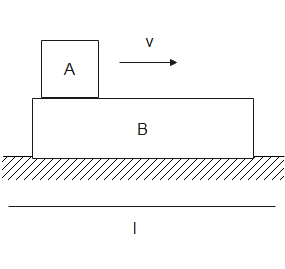
Clearly, when this system is moved, there exists friction. Since friction is a contact force, here there are two frictions, which act on the system. They are at the road - plank interface and the plank-block interface.
Also, given that coefficient of friction between the road and plank is $\dfrac{1}{2}$ and that between the plank and the block is $\dfrac{1}{4}$.
Now consider the system is displaced, such that after time $t$, the block A will fall from the plank. Let us look at the individual blocks, then we have, $f_{a}$ and $f_b$ to be the friction acting on the A and B respectively.
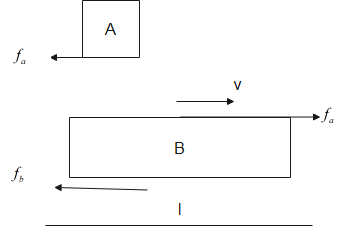
Clearly, $f_a=\mu mg=\dfrac{mg}{4}$ and $f_b=\mu (M+m)g=\dfrac{3mg}{2}$
Then the retardation due to friction is given as
$a_{a}=\dfrac{f_{a}}{m}=\dfrac{mg}{4m}=\dfrac{g}{4}$
$a_b=\dfrac{f_b-f_a}{M}=\dfrac{\left(\dfrac{3mg}{2}-\dfrac{mg}{4}\right)}{2m}=\dfrac{5g}{8}$
From the above equations, clearly, $a_b$>$a_a$. This implies that the after $t$ the block will fall down from the plank B.
Then the relative density of block A with respect to the plank B is given as
$a=a_b-a_a=\dfrac{5g}{8}-\dfrac{g}{4}=\dfrac{3g}{8}$
Then, here, $u=0$ and $a=\dfrac{3g}{8}$ and $s=l$, from the equation of motion, $s=ut+\dfrac{1}{2}at^2$, we can say that
$l=\dfrac{1}{2}\times \dfrac{3g}{8}\times t^2$
$\implies t=4\sqrt{\dfrac{l}{3}}$
Thus the time elapsed before the block separates from the plank is $4\sqrt{\dfrac{l}{3}}$.
Note: Here there are two surfaces and hence, the system has two contact forces. Since both the friction act on the plank B in the opposite direction, to find the net retardation we need to subtract both the friction. And then use the acceleration to find the time taken for the block to separate from the plank.
Formula used:
$f=\mu mg$
$s=ut+\dfrac{1}{2}at^2$
Complete step by step answer:
Consider the step-up as given in the figure above. Let the mass of the block A be $m$ and that of B be $M$. Given that $M=2m$ , also the length of the B plank is $l$ long, is placed on a road. Let it move with a velocity $v$, as shown below.
Clearly, when this system is moved, there exists friction. Since friction is a contact force, here there are two frictions, which act on the system. They are at the road - plank interface and the plank-block interface.
Also, given that coefficient of friction between the road and plank is $\dfrac{1}{2}$ and that between the plank and the block is $\dfrac{1}{4}$.
Now consider the system is displaced, such that after time $t$, the block A will fall from the plank. Let us look at the individual blocks, then we have, $f_{a}$ and $f_b$ to be the friction acting on the A and B respectively.
Clearly, $f_a=\mu mg=\dfrac{mg}{4}$ and $f_b=\mu (M+m)g=\dfrac{3mg}{2}$
Then the retardation due to friction is given as
$a_{a}=\dfrac{f_{a}}{m}=\dfrac{mg}{4m}=\dfrac{g}{4}$
$a_b=\dfrac{f_b-f_a}{M}=\dfrac{\left(\dfrac{3mg}{2}-\dfrac{mg}{4}\right)}{2m}=\dfrac{5g}{8}$
From the above equations, clearly, $a_b$>$a_a$. This implies that the after $t$ the block will fall down from the plank B.
Then the relative density of block A with respect to the plank B is given as
$a=a_b-a_a=\dfrac{5g}{8}-\dfrac{g}{4}=\dfrac{3g}{8}$
Then, here, $u=0$ and $a=\dfrac{3g}{8}$ and $s=l$, from the equation of motion, $s=ut+\dfrac{1}{2}at^2$, we can say that
$l=\dfrac{1}{2}\times \dfrac{3g}{8}\times t^2$
$\implies t=4\sqrt{\dfrac{l}{3}}$
Thus the time elapsed before the block separates from the plank is $4\sqrt{\dfrac{l}{3}}$.
Note: Here there are two surfaces and hence, the system has two contact forces. Since both the friction act on the plank B in the opposite direction, to find the net retardation we need to subtract both the friction. And then use the acceleration to find the time taken for the block to separate from the plank.
Recently Updated Pages
Master Class 11 Business Studies: Engaging Questions & Answers for Success

Master Class 11 Economics: Engaging Questions & Answers for Success
Master Class 11 Computer Science: Engaging Questions & Answers for Success
Master Class 11 English: Engaging Questions & Answers for Success
Master Class 11 Maths: Engaging Questions & Answers for Success
Master Class 11 Biology: Engaging Questions & Answers for Success
Trending doubts
One Metric ton is equal to kg A 10000 B 1000 C 100 class 11 physics CBSE
Discuss the various forms of bacteria class 11 biology CBSE
Draw a diagram of a plant cell and label at least eight class 11 biology CBSE
State the laws of reflection of light
Explain zero factorial class 11 maths CBSE
10 examples of friction in our daily life