



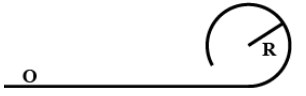
Figure shows a rough track, a portion of which is in the form of a cylinder of radius $R$. With what minimum linear speed should a sphere of radius $r$ be set rolling on the horizontal part so that it completely goes round the circle on the cylindrical part.
Answer
 Verified
516.9k+ views
Hint: The average speed of an object in a given time period is the object's distance travelled separated by the interval's length; the instantaneous speed is the average speed's limit as the interval's duration reaches nil. The measurements of speed are distance separated by time.
Complete step by step answer:
Speed and velocity have distinct definitions, such as distance and displacement do (despite their similarities). Speed is a scalar quantity that describes "the rate at which an object moves." The rate at which an object travels over a given distance is known as speed. A fast-moving target moves quickly and travels a vast distance in a brief period of time. A slow-moving target with a low speed, on the other hand, travels a comparatively limited amount of space in the same amount of time. A zero speed object is one that does not move at all.
The law of conservation of energy says that the overall energy of an isolated object remains constant; it is said to be conserved over time in physics and chemistry. When a stick of dynamite explodes, chemical energy is converted to kinetic energy.
\[{K_1} + {U_1} = {K_2} + {U_2}\]
Now According to the given question,
At top most point we have
$\dfrac{{{\text{m}}{{\text{v}}^2}}}{{{\text{R}} - {\text{r}}}} = {\text{mg}}$
Which becomes
${{\text{v}}^2} = {\text{g}}({\text{R}} - {\text{r}})$
Let's say the sphere is thrown with a velocity of v, and we're using energy conservation laws.
$ \Rightarrow \dfrac{1}{2}{\text{m}}{{\text{v}}^2} + \dfrac{1}{2}{\text{l}}{\omega ^2} = 2{\text{mg}}({\text{R}} - {\text{r}}) + \dfrac{1}{2}{\text{m}}{{\text{v}}^2} + \dfrac{1}{2}{\text{l}}{\omega ^2}$
$ \Rightarrow \dfrac{7}{{10}}{{\text{v}}^{\prime 2}} = 2{\text{g}}({\text{R}} - {\text{r}}) + \dfrac{7}{{10}}{{\text{v}}^2}$
Upon simplification
$ \Rightarrow {v^{\prime 2}} = \dfrac{{20}}{7}g(R - r) + g(R - r)$
Hence,
$\therefore {{\mathbf{v}}^\prime } = \sqrt {\dfrac{{27}}{7}} {\mathbf{g}}({\mathbf{R}} - {\mathbf{r}})$
Hence, the minimum linear speed should be $\sqrt {\dfrac{{27}}{7}} {\mathbf{g}}({\mathbf{R}} - {\mathbf{r}})$.
Note: Linear speed is the measurement of a travelling object's concrete distance travelled. Linear speed is the rate at which an object travels in a straight line. In simple terms, it is the distance travelled by a linear path in a given amount of time.
Complete step by step answer:
Speed and velocity have distinct definitions, such as distance and displacement do (despite their similarities). Speed is a scalar quantity that describes "the rate at which an object moves." The rate at which an object travels over a given distance is known as speed. A fast-moving target moves quickly and travels a vast distance in a brief period of time. A slow-moving target with a low speed, on the other hand, travels a comparatively limited amount of space in the same amount of time. A zero speed object is one that does not move at all.
The law of conservation of energy says that the overall energy of an isolated object remains constant; it is said to be conserved over time in physics and chemistry. When a stick of dynamite explodes, chemical energy is converted to kinetic energy.
\[{K_1} + {U_1} = {K_2} + {U_2}\]
Now According to the given question,
At top most point we have
$\dfrac{{{\text{m}}{{\text{v}}^2}}}{{{\text{R}} - {\text{r}}}} = {\text{mg}}$
Which becomes
${{\text{v}}^2} = {\text{g}}({\text{R}} - {\text{r}})$
Let's say the sphere is thrown with a velocity of v, and we're using energy conservation laws.
$ \Rightarrow \dfrac{1}{2}{\text{m}}{{\text{v}}^2} + \dfrac{1}{2}{\text{l}}{\omega ^2} = 2{\text{mg}}({\text{R}} - {\text{r}}) + \dfrac{1}{2}{\text{m}}{{\text{v}}^2} + \dfrac{1}{2}{\text{l}}{\omega ^2}$
$ \Rightarrow \dfrac{7}{{10}}{{\text{v}}^{\prime 2}} = 2{\text{g}}({\text{R}} - {\text{r}}) + \dfrac{7}{{10}}{{\text{v}}^2}$
Upon simplification
$ \Rightarrow {v^{\prime 2}} = \dfrac{{20}}{7}g(R - r) + g(R - r)$
Hence,
$\therefore {{\mathbf{v}}^\prime } = \sqrt {\dfrac{{27}}{7}} {\mathbf{g}}({\mathbf{R}} - {\mathbf{r}})$
Hence, the minimum linear speed should be $\sqrt {\dfrac{{27}}{7}} {\mathbf{g}}({\mathbf{R}} - {\mathbf{r}})$.
Note: Linear speed is the measurement of a travelling object's concrete distance travelled. Linear speed is the rate at which an object travels in a straight line. In simple terms, it is the distance travelled by a linear path in a given amount of time.
Recently Updated Pages
Master Class 11 Computer Science: Engaging Questions & Answers for Success

Master Class 11 Business Studies: Engaging Questions & Answers for Success
Master Class 11 Economics: Engaging Questions & Answers for Success
Master Class 11 English: Engaging Questions & Answers for Success
Master Class 11 Maths: Engaging Questions & Answers for Success
Master Class 11 Biology: Engaging Questions & Answers for Success
Trending doubts
One Metric ton is equal to kg A 10000 B 1000 C 100 class 11 physics CBSE
There are 720 permutations of the digits 1 2 3 4 5 class 11 maths CBSE
Discuss the various forms of bacteria class 11 biology CBSE
Draw a diagram of a plant cell and label at least eight class 11 biology CBSE
State the laws of reflection of light
Explain zero factorial class 11 maths CBSE