




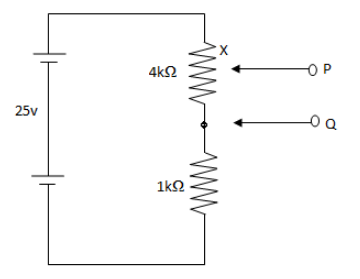
Figure shows a potential divider circuit, which by adjustment of the position of the contact X, can be used to provide a variable potential difference between the terminals P and Q. What are the limits of this potential difference?
A. \[0\] and \[20\,{\text{mV}}\]
B. \[{\text{5}}\] and \[25\,{\text{mV}}\]
C. \[0\] and \[20\,{\text{V}}\]
D. \[0\] and \[25\,{\text{V}}\]
Answer
 Verified
575.7k+ views
Hint: We are asked to find the lower limit and upper limit of potential difference between the terminals P and Q. To find the lower limit move the terminal P to the lower end of resistor \[{\text{4}}\,{\text{k}}\Omega \] and to find the upper limit, move the terminal P to the upper end of resistor \[{\text{4}}\,{\text{k}}\Omega \].
Complete step by step answer:
We are given a circuit and asked to find the range of potential difference between the terminals P and Q.Let us first find the lower limit of the potential difference between the terminals P and Q.We can find the lower limit of potential difference by moving the terminal P to the lower end of \[{\text{4}}\,{\text{k}}\Omega \] resistor that is towards terminal Q. In this case, the potential difference between P and Q will be zero. Therefore, the lower limit of the potential difference between the terminals P and Q will be \[0\,{\text{V}}\].
Now, we find the upper limit of potential difference between the terminals P and Q. In this case we move the terminal P to the upper end of \[{\text{4}}\,{\text{k}}\Omega \] resistor that is away from the terminal Q.Here, let \[i\] be the current flowing through the circuit.
We redraw the circuit.
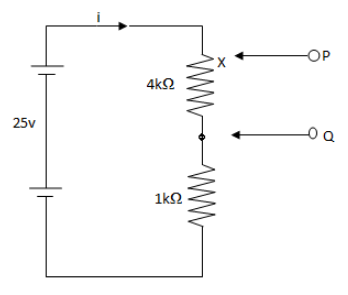
Here, the equivalent resistance will be,
\[R = {\text{4}}\,{\text{k}}\Omega + 1\,{\text{k\Omega }}\]
\[ \Rightarrow R = 5\,{\text{k}}\Omega \]
Current through a circuit is,
\[{\text{voltage}} = {\text{current}} \times {\text{resistance}}\] (i)
Here, voltage is \[25\,{\text{V}}\]
Putting the values of voltage and equivalent resistance in equation (i) we get,
\[25\, = i \times 5\]
\[ \Rightarrow i\, = \dfrac{{25}}{5} = 5\,{\text{A}}\]
Now, voltage across the resistor \[{\text{4}}\,{\text{k}}\Omega \] will be (using equation (i))
\[{V_{PQ}} = i \times 4\]
Putting the value of \[i\] in the above equation we get,
\[{V_{PQ}} = 5 \times 4\]
\[ \therefore {V_{PQ}} = 20\,{\text{V}}\]
Therefore, the upper limit of potential difference between the terminals P and Q is \[20\,{\text{V}}\].So, the limits of potential difference between the terminals P and Q are \[0\,{\text{V}}\]and \[20\,{\text{V}}\].
Hence, the correct answer is option C.
Note:Using a potential divider circuit, we can get different voltages from a common supply voltage. One example of a potential divider is potentiometer. Potential divider circuits can be used for controlling audio volume, for controlling temperature in the freezer.
Complete step by step answer:
We are given a circuit and asked to find the range of potential difference between the terminals P and Q.Let us first find the lower limit of the potential difference between the terminals P and Q.We can find the lower limit of potential difference by moving the terminal P to the lower end of \[{\text{4}}\,{\text{k}}\Omega \] resistor that is towards terminal Q. In this case, the potential difference between P and Q will be zero. Therefore, the lower limit of the potential difference between the terminals P and Q will be \[0\,{\text{V}}\].
Now, we find the upper limit of potential difference between the terminals P and Q. In this case we move the terminal P to the upper end of \[{\text{4}}\,{\text{k}}\Omega \] resistor that is away from the terminal Q.Here, let \[i\] be the current flowing through the circuit.
We redraw the circuit.
Here, the equivalent resistance will be,
\[R = {\text{4}}\,{\text{k}}\Omega + 1\,{\text{k\Omega }}\]
\[ \Rightarrow R = 5\,{\text{k}}\Omega \]
Current through a circuit is,
\[{\text{voltage}} = {\text{current}} \times {\text{resistance}}\] (i)
Here, voltage is \[25\,{\text{V}}\]
Putting the values of voltage and equivalent resistance in equation (i) we get,
\[25\, = i \times 5\]
\[ \Rightarrow i\, = \dfrac{{25}}{5} = 5\,{\text{A}}\]
Now, voltage across the resistor \[{\text{4}}\,{\text{k}}\Omega \] will be (using equation (i))
\[{V_{PQ}} = i \times 4\]
Putting the value of \[i\] in the above equation we get,
\[{V_{PQ}} = 5 \times 4\]
\[ \therefore {V_{PQ}} = 20\,{\text{V}}\]
Therefore, the upper limit of potential difference between the terminals P and Q is \[20\,{\text{V}}\].So, the limits of potential difference between the terminals P and Q are \[0\,{\text{V}}\]and \[20\,{\text{V}}\].
Hence, the correct answer is option C.
Note:Using a potential divider circuit, we can get different voltages from a common supply voltage. One example of a potential divider is potentiometer. Potential divider circuits can be used for controlling audio volume, for controlling temperature in the freezer.
Recently Updated Pages
Master Class 12 Social Science: Engaging Questions & Answers for Success

Master Class 12 Physics: Engaging Questions & Answers for Success
Master Class 12 Maths: Engaging Questions & Answers for Success
Master Class 12 Economics: Engaging Questions & Answers for Success
Master Class 12 Chemistry: Engaging Questions & Answers for Success
Master Class 12 Business Studies: Engaging Questions & Answers for Success
Trending doubts
Which are the Top 10 Largest Countries of the World?
Draw a labelled sketch of the human eye class 12 physics CBSE
Explain the structure of megasporangium class 12 biology CBSE
What are the major means of transport Explain each class 12 social science CBSE
How many chromosomes are found in human ovum a 46 b class 12 biology CBSE
The diagram of the section of a maize grain is given class 12 biology CBSE