




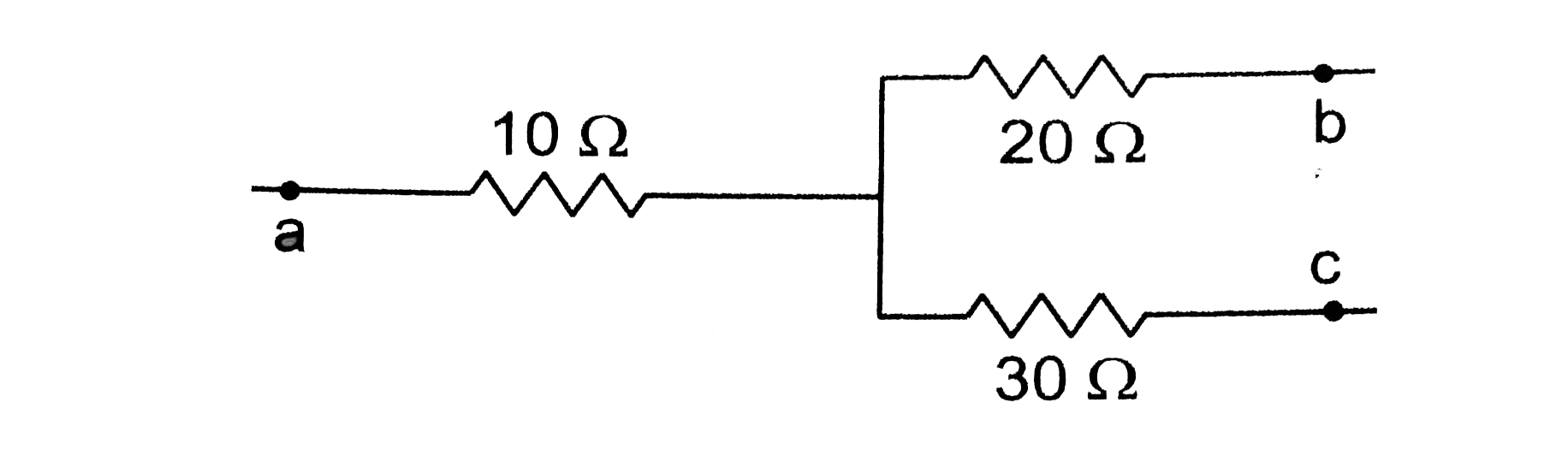
Figure shows a part of an electric circuit. The potentials at the points a, b and c are 30V, 12V and 2V respectively. Find the currents through the three resistors.
Answer
 Verified
570k+ views
Hint :To answer this question, we first need to understand what an electric circuit is. A channel for transmitting electric current is known as an electric circuit. An electric circuit consists of a device, such as a battery or a generator, that provides energy to the charged particles that make up the current; equipment that uses current, such as lamps, electric motors, or computers; and the connecting wires or transmission lines.
Complete Step By Step Answer:
KVL- Kirchhoff's circuit rules are two equalities in the lumped element model of electrical circuits that deal with current and potential difference. Gustav Kirchhoff, a German physicist, was the first to describe them in 1845. This broadened Georg Ohm's work and came before James Clerk Maxwell's.
KCL- Kirchhoff's circuit rules are two equalities in the lumped element model of electrical circuits that deal with current and potential difference. Gustav Kirchhoff, a German physicist, was the first to describe them in 1845. This broadened Georg Ohm's work and came before James Clerk Maxwell's.
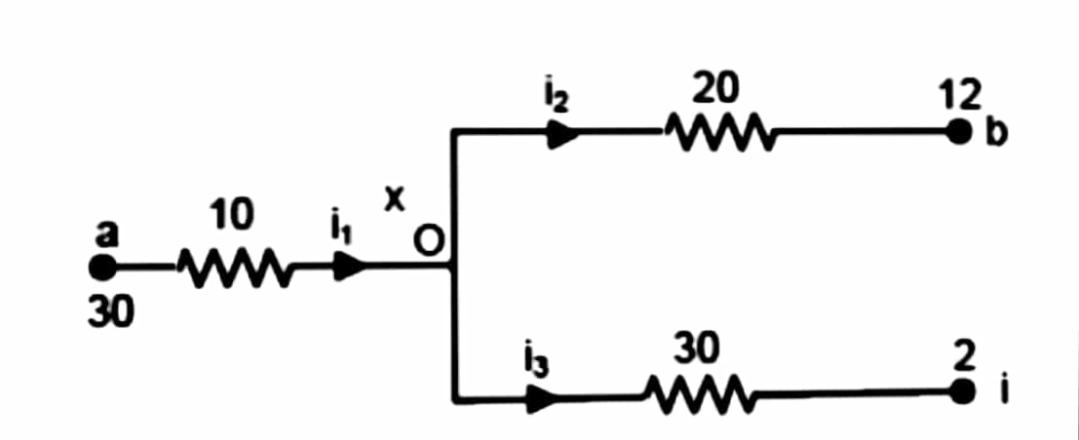
Let us assume that potential at O is V volts.
Applying ohm's law at each branch –
$ (30 - V) = 10{i_1} $
$ (V - 12) = 20{i_2} $
$ (V - 2) = 30{i_3} $
And by KCL we know that at point O
$ {i_1} = {i_2} + {i_3} $
Putting values
$ \dfrac{{30 - V}}{{10}} = \dfrac{{V - 12}}{{20}} + \dfrac{{V - 2}}{{30}} $
$ 30 - V = \dfrac{{V - 12}}{2} + \dfrac{{V - 2}}{3} $
$ 30 - V = \dfrac{{3V - 36 + 2V - 4}}{6} $
$ 180 - 6V = 5V - 40 $
$ 11V = 220 $
$ V = 20volts $
Putting values in current equations of each branch
So the final values of current are -
$ {i_1} = \dfrac{{30 - 20}}{{10}} = 1A \\
{i_2} = \dfrac{{20 - 12}}{{20}} = 0.4A \\
{i_3} = \dfrac{{20 - 2}}{{30}} = 0.6A $
Note :
Circuit analysis of more complex circuits is possible thanks to Kirchhoff's two laws. The technique is simple, despite the fact that the algebraic procedures are still somewhat complicated. These laws are widely used in the field of electrical engineering.
Complete Step By Step Answer:
KVL- Kirchhoff's circuit rules are two equalities in the lumped element model of electrical circuits that deal with current and potential difference. Gustav Kirchhoff, a German physicist, was the first to describe them in 1845. This broadened Georg Ohm's work and came before James Clerk Maxwell's.
KCL- Kirchhoff's circuit rules are two equalities in the lumped element model of electrical circuits that deal with current and potential difference. Gustav Kirchhoff, a German physicist, was the first to describe them in 1845. This broadened Georg Ohm's work and came before James Clerk Maxwell's.
Let us assume that potential at O is V volts.
Applying ohm's law at each branch –
$ (30 - V) = 10{i_1} $
$ (V - 12) = 20{i_2} $
$ (V - 2) = 30{i_3} $
And by KCL we know that at point O
$ {i_1} = {i_2} + {i_3} $
Putting values
$ \dfrac{{30 - V}}{{10}} = \dfrac{{V - 12}}{{20}} + \dfrac{{V - 2}}{{30}} $
$ 30 - V = \dfrac{{V - 12}}{2} + \dfrac{{V - 2}}{3} $
$ 30 - V = \dfrac{{3V - 36 + 2V - 4}}{6} $
$ 180 - 6V = 5V - 40 $
$ 11V = 220 $
$ V = 20volts $
Putting values in current equations of each branch
So the final values of current are -
$ {i_1} = \dfrac{{30 - 20}}{{10}} = 1A \\
{i_2} = \dfrac{{20 - 12}}{{20}} = 0.4A \\
{i_3} = \dfrac{{20 - 2}}{{30}} = 0.6A $
Note :
Circuit analysis of more complex circuits is possible thanks to Kirchhoff's two laws. The technique is simple, despite the fact that the algebraic procedures are still somewhat complicated. These laws are widely used in the field of electrical engineering.
Recently Updated Pages
If x a + bt + ct2 where x is in meters and t is in class 11 physics CBSE

A car covers the first half distance between two places class 11 physics CBSE
The resultant of two vectors overrightarrow P and overrightarrow class 11 physics CBSE
Find the value of cos 135 class 11 maths CBSE
A mass M is held in place by an applied force F and class 11 physics CBSE
A solution of glucose in water is labelled as 10 dfracwv class 11 chemistry CBSE
Trending doubts
One Metric ton is equal to kg A 10000 B 1000 C 100 class 11 physics CBSE
Find the value of the expression given below sin 30circ class 11 maths CBSE
What do you mean by retardation What is its SI uni class 11 physics CBSE
Draw a diagram of nephron and explain its structur class 11 biology CBSE
10 examples of friction in our daily life
Difference between physical and chemical change class 11 chemistry CBSE