




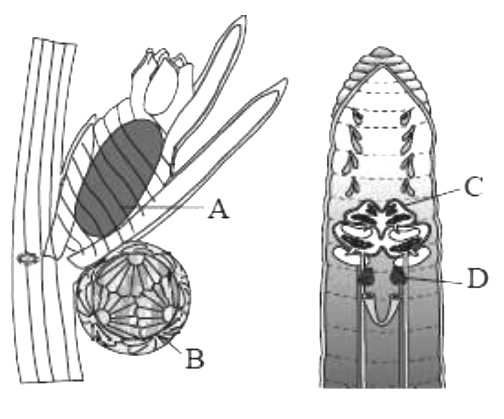
Figure P represents the reproductive organs of the Chara plant and figure Q represents the reproductive organs of earthworms. Select the option which correctly identifies male reproductive organs of the two organisms.
a. A and D
b. B and C
c. A and C
d. B and D
Answer
 Verified
624.9k+ views
Hint: Both plants and animals reproduce, either sexually or asexually where it needs reproductive organs to produce, the male reproductive parts of the plants are called androecium, while the female reproductive parts of the plant are gynoecium. And in the earthworm, both male and female reproductive organs are present in the same worm.
Complete answer:
Figure P:
- It is the part of the chara, where the genus Chara belongs to the family, Characeae.
- Where Chara is the freshwater green algae, which is generally found submerged in many places like, shallow water ponds, tanks, etc.
- The plant body of the Chara is multicellular, where it is differentiated into the main axis and rhizoids. While the main axis is further divided into nodes and internodes.
- When comes to the sex organs of the plant, male sex organs are called antheridium or globule.
- While female sex organ is called as oogonium.
- In the char, the globule is located below the oogonium, where the globule is spherically macroscopic, and consists of antheriods. So from the above figure P, The A indicates oogonium while the B indicates the globule. So for the P part, the answer if B.
Figure Q:
Earthworm is monoecious, or hermaphrodite, which means that both male and female reproductive organs are present in the same body, and the reproductive organs are present from the segments 9 to 15. Whereas male reproductive organs are testes, seminal vesicles, etc.
Where Testes-- 2 pairs-- 10th and 11th segment.
Seminal vesicles—2 pairs-- 11th and 12th segment.
Spermatic funnel-- 2 pairs-- 10th and 11th segment.
While female reproductive organs are ovaries, oviduct, and spermatheca.
Ovaries--1 pair-- 13th segment.
Oviduct--1 pair-- 13th segment.
So from the figure Q, C represent male reproductive organs while D represent female ones.
Hence, the correct answer is option (B).
Note: As earthworms are hermaphrodites, the cross fertilization occurs by copulation, where the earthworms lie in contact with each other in opposite directions, it mostly happens in the rainy season, early in the mornings and the dawn.
Complete answer:
Figure P:
- It is the part of the chara, where the genus Chara belongs to the family, Characeae.
- Where Chara is the freshwater green algae, which is generally found submerged in many places like, shallow water ponds, tanks, etc.
- The plant body of the Chara is multicellular, where it is differentiated into the main axis and rhizoids. While the main axis is further divided into nodes and internodes.
- When comes to the sex organs of the plant, male sex organs are called antheridium or globule.
- While female sex organ is called as oogonium.
- In the char, the globule is located below the oogonium, where the globule is spherically macroscopic, and consists of antheriods. So from the above figure P, The A indicates oogonium while the B indicates the globule. So for the P part, the answer if B.
Figure Q:
Earthworm is monoecious, or hermaphrodite, which means that both male and female reproductive organs are present in the same body, and the reproductive organs are present from the segments 9 to 15. Whereas male reproductive organs are testes, seminal vesicles, etc.
Where Testes-- 2 pairs-- 10th and 11th segment.
Seminal vesicles—2 pairs-- 11th and 12th segment.
Spermatic funnel-- 2 pairs-- 10th and 11th segment.
While female reproductive organs are ovaries, oviduct, and spermatheca.
Ovaries--1 pair-- 13th segment.
Oviduct--1 pair-- 13th segment.
So from the figure Q, C represent male reproductive organs while D represent female ones.
Hence, the correct answer is option (B).
Note: As earthworms are hermaphrodites, the cross fertilization occurs by copulation, where the earthworms lie in contact with each other in opposite directions, it mostly happens in the rainy season, early in the mornings and the dawn.
Recently Updated Pages
Master Class 11 English: Engaging Questions & Answers for Success

Master Class 11 Social Science: Engaging Questions & Answers for Success
Master Class 11 Maths: Engaging Questions & Answers for Success
Master Class 11 Biology: Engaging Questions & Answers for Success
Master Class 11 Physics: Engaging Questions & Answers for Success
Master Class 11 Chemistry: Engaging Questions & Answers for Success
Trending doubts
One Metric ton is equal to kg A 10000 B 1000 C 100 class 11 physics CBSE
Difference Between Prokaryotic Cells and Eukaryotic Cells
Two of the body parts which do not appear in MRI are class 11 biology CBSE
Find the value of the expression given below sin 30circ class 11 maths CBSE
Draw a diagram of a plant cell and label at least eight class 11 biology CBSE
10 examples of friction in our daily life