




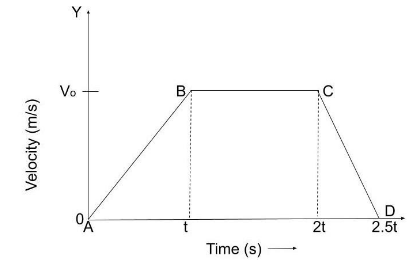
Figure below shows a velocity-time graph for a car starting from rest. The graph has three parts AB, BC and CD. Compare the distance travelled in part BC with the distance travelled in part AB.
Answer
 Verified
516.9k+ views
Hint: Let us first get some idea about the Motion in a straight line. Uniform motion occurs when a body moves in a straight line and covers the same amount of distance in the same period of time. In simple terms, if the rate of change of a body's velocity is constant, it is said to have uniform acceleration.
Complete step by step answer:
The motion of items travelling in a straight line is described using velocity-time graphs. They can be used to calculate displacement and show acceleration. Because the object's velocity is the derivative of its position graph, the area under the line in the velocity vs. time graph represents the object's displacement. (Time is on the x-axis, and velocity is on the y-axis.)
Let us now solve the question:
As we can see that the Distance travelled in part BC $ = $ Area of the rectangle tBC2t
$\text{Distance travelled in part BC} = $ Base $ \times $ Height
$\Rightarrow \text{Distance travelled in part BC} = \,(2t - t) \times {V_o}$
$\Rightarrow \text{Distance travelled in part BC} = \,{V_o} \times t \\ $
Now, the distance travelled in part AB $ = $ Area of the Triangle ABt
$\text{Distance travelled in part AB}= \,\dfrac{1}{2} \times base \times height$
$\therefore \text{Distance travelled in part AB}= \,\dfrac{1}{2} \times t \times {V_o}$
Therefore, the Distance travelled in Part BC : Distance travelled in part AB :: $2:1$.
Note:To solve this kind of question there are some points which we should keep on our finger-tips. In this problem we are using the concept of motion in a straight line, speed and velocity concept and basic concept of area under the curve.
Complete step by step answer:
The motion of items travelling in a straight line is described using velocity-time graphs. They can be used to calculate displacement and show acceleration. Because the object's velocity is the derivative of its position graph, the area under the line in the velocity vs. time graph represents the object's displacement. (Time is on the x-axis, and velocity is on the y-axis.)
Let us now solve the question:
As we can see that the Distance travelled in part BC $ = $ Area of the rectangle tBC2t
$\text{Distance travelled in part BC} = $ Base $ \times $ Height
$\Rightarrow \text{Distance travelled in part BC} = \,(2t - t) \times {V_o}$
$\Rightarrow \text{Distance travelled in part BC} = \,{V_o} \times t \\ $
Now, the distance travelled in part AB $ = $ Area of the Triangle ABt
$\text{Distance travelled in part AB}= \,\dfrac{1}{2} \times base \times height$
$\therefore \text{Distance travelled in part AB}= \,\dfrac{1}{2} \times t \times {V_o}$
Therefore, the Distance travelled in Part BC : Distance travelled in part AB :: $2:1$.
Note:To solve this kind of question there are some points which we should keep on our finger-tips. In this problem we are using the concept of motion in a straight line, speed and velocity concept and basic concept of area under the curve.
Recently Updated Pages
Master Class 11 Computer Science: Engaging Questions & Answers for Success

Master Class 11 Business Studies: Engaging Questions & Answers for Success
Master Class 11 Economics: Engaging Questions & Answers for Success
Master Class 11 English: Engaging Questions & Answers for Success
Master Class 11 Maths: Engaging Questions & Answers for Success
Master Class 11 Biology: Engaging Questions & Answers for Success
Trending doubts
One Metric ton is equal to kg A 10000 B 1000 C 100 class 11 physics CBSE
There are 720 permutations of the digits 1 2 3 4 5 class 11 maths CBSE
Discuss the various forms of bacteria class 11 biology CBSE
Draw a diagram of a plant cell and label at least eight class 11 biology CBSE
State the laws of reflection of light
Explain zero factorial class 11 maths CBSE