




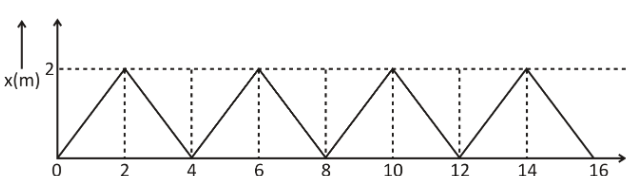
Fig shows the position-time (x-t) graph of one-dimensional motion of a body of mass $0.4\,kg$. What is the time interval between consecutive impulses received by body?
A. $2s$
B. $4s$
C. $8s$
D. $16s$
Answer
 Verified
566.7k+ views
Hint: For the first positive slope it is receiving some impulses and for the next negative slope, it will decrease or lose some impulse. The figure shows that the incline of the (x-t) diagram changes from positive to negative at time two seconds, and it changes from negative at time = four seconds, etc. Hence the course of speed is gotten after at regular intervals. Henceforth the body must get continuous driving forces after like clockwork.
Complete answer:
The figure shows that the incline of the diagram changes from positive to negative at time two seconds, and it changes from negative at time = four seconds, etc. Hence the course of speed is gotten after at regular intervals. Henceforth the body must get continuous driving forces after like clockwork.
The direction of velocity is reversed after every two seconds. Hence, the body must be receiving consecutive impulses after every two second.For the first positive slope it is receiving some impulses and for the next negative slope, it will decrease or lose some impulse.In this way, the right alternative is option A two second.
Hence, option A is the correct answer.
Note: While solving the problem, most of the students tend to make mistakes while finding the duration of time in which the velocity is reversed. It is important to note that velocity is a vector quantity, it both has direction and magnitude. It is important to note that impulse is nothing but a physical quantity, which defines the net effect of a force which acts over a time duration. It is important to remember that this is an important concept while we study momentum.
Complete answer:
The figure shows that the incline of the diagram changes from positive to negative at time two seconds, and it changes from negative at time = four seconds, etc. Hence the course of speed is gotten after at regular intervals. Henceforth the body must get continuous driving forces after like clockwork.
The direction of velocity is reversed after every two seconds. Hence, the body must be receiving consecutive impulses after every two second.For the first positive slope it is receiving some impulses and for the next negative slope, it will decrease or lose some impulse.In this way, the right alternative is option A two second.
Hence, option A is the correct answer.
Note: While solving the problem, most of the students tend to make mistakes while finding the duration of time in which the velocity is reversed. It is important to note that velocity is a vector quantity, it both has direction and magnitude. It is important to note that impulse is nothing but a physical quantity, which defines the net effect of a force which acts over a time duration. It is important to remember that this is an important concept while we study momentum.
Recently Updated Pages
Master Class 11 Business Studies: Engaging Questions & Answers for Success

Master Class 11 Economics: Engaging Questions & Answers for Success
Master Class 11 Computer Science: Engaging Questions & Answers for Success
Master Class 11 English: Engaging Questions & Answers for Success
Master Class 11 Maths: Engaging Questions & Answers for Success
Master Class 11 Biology: Engaging Questions & Answers for Success
Trending doubts
One Metric ton is equal to kg A 10000 B 1000 C 100 class 11 physics CBSE
Discuss the various forms of bacteria class 11 biology CBSE
Draw a diagram of a plant cell and label at least eight class 11 biology CBSE
State the laws of reflection of light
Explain zero factorial class 11 maths CBSE
10 examples of friction in our daily life