




${{[Fe{{F}_{6}}]}^{3-}}$ has Fe atom _________hybridized with unpaired_______electrons.
(A) ${{d}^{2}}s{{p}^{3}}$ , 4
(B) ${{d}^{2}}s{{p}^{3}}$ , 5
(C) $s{{p}^{3}}{{d}^{2}}$, 5
(D) $s{{p}^{3}}{{d}^{2}}$, 3
Answer
 Verified
616.8k+ views
Hint: The hybridization of the inorganic complexes is going to depend on the type of ligand. If the ligand is a strong ligand then the inner orbital complex is going to form and if the ligand is weak then the outer orbital complex is going to form.
Complete step by step solution:
-In ${{[Fe{{F}_{6}}]}^{3-}}$ one iron atom and six fluorine atoms are there.
-We know that fluorine is a weak ligand and forms an outer orbital complex with iron.
-The oxidation state of iron in ${{[Fe{{F}_{6}}]}^{3-}}$ is as follows.
x + 6(-1) = -3
x – 6 = -3
x = 3
Here x = oxidation state of iron
-The electronic configuration of iron is as follows.
\[1{{s}^{2}}2{{s}^{2}}2{{p}^{6}}3{{s}^{2}}3{{p}^{6}}4{{s}^{2}}3{{d}^{6}}4{{p}^{0}}4{{d}^{0}}\]
-The electronic configuration of iron in ${{[Fe{{F}_{6}}]}^{3-}}$ is as follows.
\[1{{s}^{2}}2{{s}^{2}}2{{p}^{6}}3{{s}^{2}}3{{p}^{6}}4{{s}^{0}}3{{d}^{5}}4{{p}^{0}}4{{d}^{0}}\]
-Six fluorine atoms donate electrons to iron.
-The hybridization of Fe atom in ${{[Fe{{F}_{6}}]}^{3-}}$ is as follows.
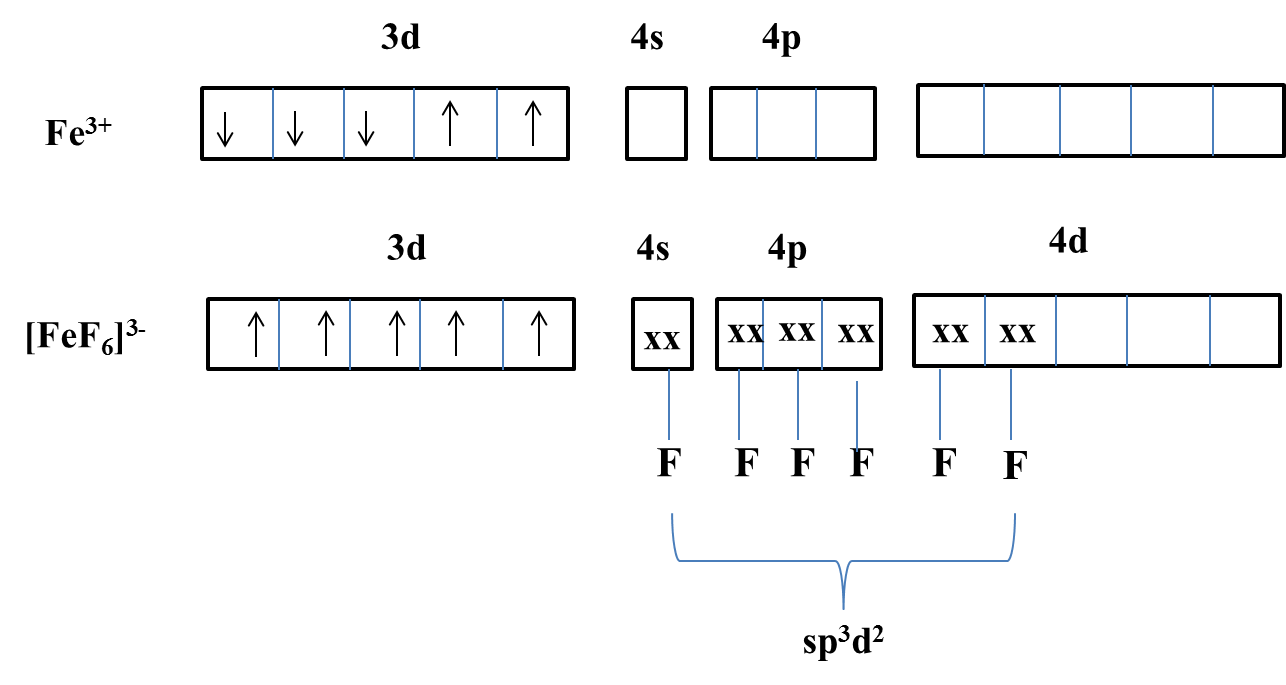
-From the above picture we can say that iron undergoes $s{{p}^{3}}{{d}^{2}}$ hybridization.
-From the above picture, we can also say that iron in ${{[Fe{{F}_{6}}]}^{3-}}$ have 5 unpaired electrons.
-Therefore the hybridization of iron in ${{[Fe{{F}_{6}}]}^{3-}}$ is $s{{p}^{3}}{{d}^{2}}$ with 5 unpaired electrons.
So, the correct option is (C).
Note: An inorganic metal complex in which the central metal atom utilizes outer d orbitals for hybridization then the complex is called outer orbital complex. An inorganic metal complex in which the central metal atom utilizes inner d orbitals for hybridization then the complex is called inner orbital complex.
Complete step by step solution:
-In ${{[Fe{{F}_{6}}]}^{3-}}$ one iron atom and six fluorine atoms are there.
-We know that fluorine is a weak ligand and forms an outer orbital complex with iron.
-The oxidation state of iron in ${{[Fe{{F}_{6}}]}^{3-}}$ is as follows.
x + 6(-1) = -3
x – 6 = -3
x = 3
Here x = oxidation state of iron
-The electronic configuration of iron is as follows.
\[1{{s}^{2}}2{{s}^{2}}2{{p}^{6}}3{{s}^{2}}3{{p}^{6}}4{{s}^{2}}3{{d}^{6}}4{{p}^{0}}4{{d}^{0}}\]
-The electronic configuration of iron in ${{[Fe{{F}_{6}}]}^{3-}}$ is as follows.
\[1{{s}^{2}}2{{s}^{2}}2{{p}^{6}}3{{s}^{2}}3{{p}^{6}}4{{s}^{0}}3{{d}^{5}}4{{p}^{0}}4{{d}^{0}}\]
-Six fluorine atoms donate electrons to iron.
-The hybridization of Fe atom in ${{[Fe{{F}_{6}}]}^{3-}}$ is as follows.
-From the above picture we can say that iron undergoes $s{{p}^{3}}{{d}^{2}}$ hybridization.
-From the above picture, we can also say that iron in ${{[Fe{{F}_{6}}]}^{3-}}$ have 5 unpaired electrons.
-Therefore the hybridization of iron in ${{[Fe{{F}_{6}}]}^{3-}}$ is $s{{p}^{3}}{{d}^{2}}$ with 5 unpaired electrons.
So, the correct option is (C).
Note: An inorganic metal complex in which the central metal atom utilizes outer d orbitals for hybridization then the complex is called outer orbital complex. An inorganic metal complex in which the central metal atom utilizes inner d orbitals for hybridization then the complex is called inner orbital complex.
Recently Updated Pages
Master Class 12 Economics: Engaging Questions & Answers for Success

Master Class 12 English: Engaging Questions & Answers for Success
Master Class 12 Social Science: Engaging Questions & Answers for Success
Master Class 12 Maths: Engaging Questions & Answers for Success
Master Class 12 Physics: Engaging Questions & Answers for Success
Master Class 11 Social Science: Engaging Questions & Answers for Success
Trending doubts
One Metric ton is equal to kg A 10000 B 1000 C 100 class 11 physics CBSE
Difference Between Prokaryotic Cells and Eukaryotic Cells
Two of the body parts which do not appear in MRI are class 11 biology CBSE
1 ton equals to A 100 kg B 1000 kg C 10 kg D 10000 class 11 physics CBSE
Draw a diagram of nephron and explain its structur class 11 biology CBSE
10 examples of friction in our daily life