




Fat is completely digested in the
A) Stomach
B) Mouth
C) Small intestine
D) Large intestine
Answer
 Verified
624k+ views
Hint:Digestion is the process of breaking down complex substances into smaller substances by the action of acids and enzymes.
Complete answer:
Let us first understand the process of digestion before we find the correct option. There are four stages involved in the process of digestion, Once the food is taken in via mouth is goes to the small intestine via stomach and is digested there
>Absorption of nutrients takes place in the small intestine.
>Reabsorption of nutrients from the undigested food takes place in the large intestine.
>The remaining product is excreted in the form of stools via rectum.
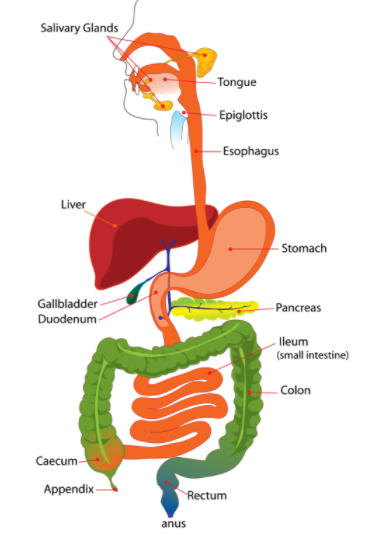
Option A: In the stomach, digestion of protein by the action peptidase takes place and not lipids. Therefore, this is the incorrect option.
Option B: In mouth starch is broken down by the action of salivary amylase, but lipids are not broken down in it. Therefore, this is the incorrect option.
Option C: In the small intestine, complete digestion of carbohydrates, fats and proteins takes place. Fats are common examples of lipids and they are digested in the small intestine. Therefore, this is the correct option.
As lipids are present in the small intestine, the pancreas and liver are stimulated to release pancreatic lipase and bile respectively which help in emulsification of fats.
Option D: In large intestine reabsorption of nutrients, water, and ions takes place. It is not involved in breakdown of lipid molecules. Therefore, this is the incorrect option.
Thus, the correct option is (C) Small intestine.
Note:The various sites for digestion of different particles are,
>Mouth - DIgestion of starch and initiation of digestion of fat
>Stomach - Digestion of protein
>Small intestine - Digestion of fats, protein and carbohydrates
>Large intestine - Reabsorption of water, ions and nutrients
Complete answer:
Let us first understand the process of digestion before we find the correct option. There are four stages involved in the process of digestion, Once the food is taken in via mouth is goes to the small intestine via stomach and is digested there
>Absorption of nutrients takes place in the small intestine.
>Reabsorption of nutrients from the undigested food takes place in the large intestine.
>The remaining product is excreted in the form of stools via rectum.
Option A: In the stomach, digestion of protein by the action peptidase takes place and not lipids. Therefore, this is the incorrect option.
Option B: In mouth starch is broken down by the action of salivary amylase, but lipids are not broken down in it. Therefore, this is the incorrect option.
Option C: In the small intestine, complete digestion of carbohydrates, fats and proteins takes place. Fats are common examples of lipids and they are digested in the small intestine. Therefore, this is the correct option.
As lipids are present in the small intestine, the pancreas and liver are stimulated to release pancreatic lipase and bile respectively which help in emulsification of fats.
Option D: In large intestine reabsorption of nutrients, water, and ions takes place. It is not involved in breakdown of lipid molecules. Therefore, this is the incorrect option.
Thus, the correct option is (C) Small intestine.
Note:The various sites for digestion of different particles are,
>Mouth - DIgestion of starch and initiation of digestion of fat
>Stomach - Digestion of protein
>Small intestine - Digestion of fats, protein and carbohydrates
>Large intestine - Reabsorption of water, ions and nutrients
Recently Updated Pages
Master Class 11 English: Engaging Questions & Answers for Success

Master Class 11 Social Science: Engaging Questions & Answers for Success
Master Class 11 Maths: Engaging Questions & Answers for Success
Master Class 11 Biology: Engaging Questions & Answers for Success
Master Class 11 Physics: Engaging Questions & Answers for Success
Master Class 11 Chemistry: Engaging Questions & Answers for Success
Trending doubts
One Metric ton is equal to kg A 10000 B 1000 C 100 class 11 physics CBSE
Difference Between Prokaryotic Cells and Eukaryotic Cells
Difference between physical and chemical change class 11 chemistry CBSE
Find the value of the expression given below sin 30circ class 11 maths CBSE
Two of the body parts which do not appear in MRI are class 11 biology CBSE
Draw a diagram of a plant cell and label at least eight class 11 biology CBSE