




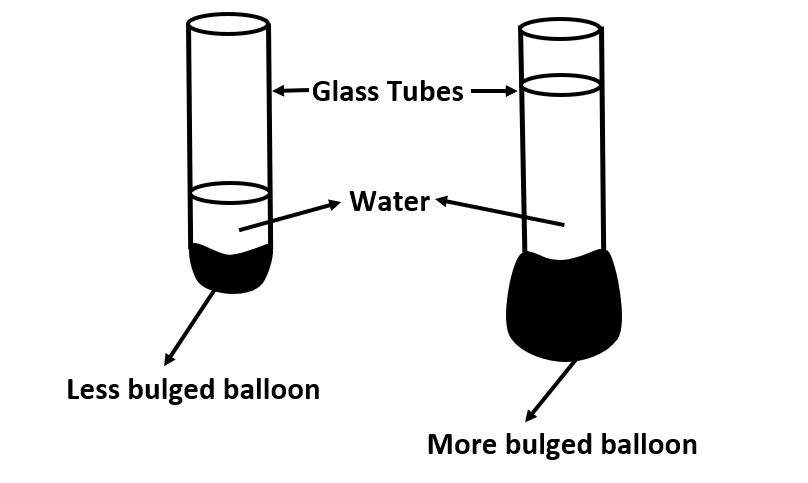
What fact about liquid pressure does the diagram in figure illustrate?
Answer
 Verified
557.1k+ views
Hint: In the diagram, we can see that both the glass test tubes are identical. But the water level in one is greater than the water level in another. Also, one of them has a less bulged balloon while the other has a more bulged balloon. This means that these balloons are somehow being affected by the different water levels in the glass tubes. We shall find this relation to come to our concluding statement.
Complete step-by-step solution:
Let the atmospheric pressure at the surface of water in both the glass tubes be given by ${{P}_{0}}$. And the density of water in these columns is denoted by $\rho $.
Also, let the heights of the water column in two glass tubes be ${{h}_{1}}$ and ${{h}_{2}}$. Where,
$\Rightarrow {{h}_{1}}< {{h}_{2}}$
Then, the pressure at the bottoms of the two tubes could be written as follows:
Let the pressure at the bottom of the first glass tube be ${{P}_{1}}$. Then it is equal to:
$\Rightarrow {{P}_{1}}={{P}_{0}}+\rho g{{h}_{1}}$ [Let this expression be equation number (1)]
Also, let the pressure at the bottom of the second glass tube be ${{P}_{2}}$. Then it is equal to:
$\Rightarrow {{P}_{2}}={{P}_{0}}+\rho g{{h}_{2}}$ [Let this expression be equation number (2)]
On comparing equation number (1) and (2), we see that:
$\Rightarrow {{P}_{2}} > {{P}_{1}}$ [$\because {{h}_{2}} > {{h}_{1}}$]
Hence, we can conclude that the liquid pressure increases with the increase in height of the liquid column above it. This is the reason why the balloon in the second column is more bulged.
Note: This difference in height to generate pressure is used in Hydraulics. For example, in the arms of a construction bulldozer, the arms move front and back at the point of their joint. This is done by using some specialized hydraulic liquids. When one end of the machine compresses the fluid, the other end moves ahead due to the increase in liquid column inside the arm.
Complete step-by-step solution:
Let the atmospheric pressure at the surface of water in both the glass tubes be given by ${{P}_{0}}$. And the density of water in these columns is denoted by $\rho $.
Also, let the heights of the water column in two glass tubes be ${{h}_{1}}$ and ${{h}_{2}}$. Where,
$\Rightarrow {{h}_{1}}< {{h}_{2}}$
Then, the pressure at the bottoms of the two tubes could be written as follows:
Let the pressure at the bottom of the first glass tube be ${{P}_{1}}$. Then it is equal to:
$\Rightarrow {{P}_{1}}={{P}_{0}}+\rho g{{h}_{1}}$ [Let this expression be equation number (1)]
Also, let the pressure at the bottom of the second glass tube be ${{P}_{2}}$. Then it is equal to:
$\Rightarrow {{P}_{2}}={{P}_{0}}+\rho g{{h}_{2}}$ [Let this expression be equation number (2)]
On comparing equation number (1) and (2), we see that:
$\Rightarrow {{P}_{2}} > {{P}_{1}}$ [$\because {{h}_{2}} > {{h}_{1}}$]
Hence, we can conclude that the liquid pressure increases with the increase in height of the liquid column above it. This is the reason why the balloon in the second column is more bulged.
Note: This difference in height to generate pressure is used in Hydraulics. For example, in the arms of a construction bulldozer, the arms move front and back at the point of their joint. This is done by using some specialized hydraulic liquids. When one end of the machine compresses the fluid, the other end moves ahead due to the increase in liquid column inside the arm.
Recently Updated Pages
Master Class 11 English: Engaging Questions & Answers for Success

Master Class 11 Maths: Engaging Questions & Answers for Success
Class 11 Question and Answer - Your Ultimate Solutions Guide
Master Class 11 Biology: Engaging Questions & Answers for Success
Master Class 11 Physics: Engaging Questions & Answers for Success
Master Class 11 Accountancy: Engaging Questions & Answers for Success
Trending doubts
Differentiate between an exothermic and an endothermic class 11 chemistry CBSE
One Metric ton is equal to kg A 10000 B 1000 C 100 class 11 physics CBSE
Difference Between Prokaryotic Cells and Eukaryotic Cells
There are 720 permutations of the digits 1 2 3 4 5 class 11 maths CBSE
Draw a diagram of a plant cell and label at least eight class 11 biology CBSE
1 Quintal is equal to a 110 kg b 10 kg c 100kg d 1000 class 11 physics CBSE