




What external changes are visible after the last moult of a cockroach nymph?
A. Mandibles become harder
B. Anal cerci develop
C. Both forewings and hindwings develop
C. Labium develops
Answer
 Verified
642.3k+ views
Hint: A thick and protective casing of cockroaches that are used for flying. It is an initial structure formed during the development of a nymph into an adult.
Step by step answer:
Cockroach exhibits pauro metabolous development. Cockroach moults several times in their lifetime and shed a layer of skin out of their skeleton. It moults it's hard-outer layer and it has to grow new layers periodically underneath the old layers. As they grow, nymphs undergo a process of development known as moulting. They moult thirteen times, after each moult, they appear more and more like adults. The second last nymphal stage develops wings. Before the last moult stage, wing pads develop. The development of nymph into the adult stage can take from a month to years. The development depends upon the type of environment, cockroach type, and the prevalence of diseases and parasites. When the cockroach reaches its adult stage then, it will not undergo moulting again. The young adult may look like a nymph, having wings that differentiate between a nymph and an adult. The number of moultings can vary from one type of cockroach to another.
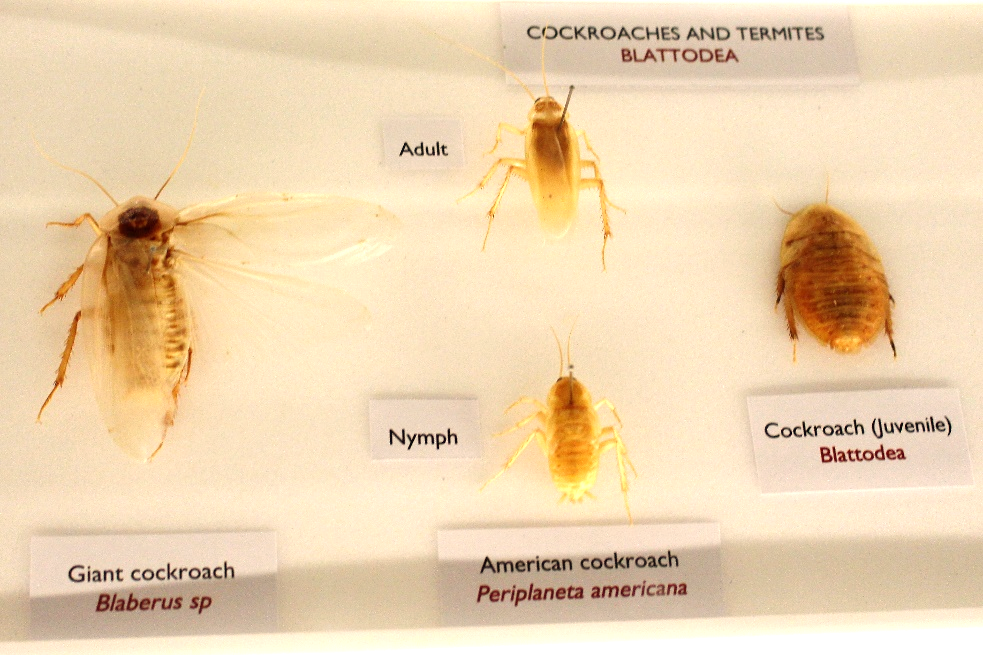
Hence, the correct option is (C) Both forewings and hindwings develop
Note: Moulting is also known as sloughing or ecdysis. It is a process by which cockroaches cast off a part of their body either at specific points in the life cycle.
Step by step answer:
Cockroach exhibits pauro metabolous development. Cockroach moults several times in their lifetime and shed a layer of skin out of their skeleton. It moults it's hard-outer layer and it has to grow new layers periodically underneath the old layers. As they grow, nymphs undergo a process of development known as moulting. They moult thirteen times, after each moult, they appear more and more like adults. The second last nymphal stage develops wings. Before the last moult stage, wing pads develop. The development of nymph into the adult stage can take from a month to years. The development depends upon the type of environment, cockroach type, and the prevalence of diseases and parasites. When the cockroach reaches its adult stage then, it will not undergo moulting again. The young adult may look like a nymph, having wings that differentiate between a nymph and an adult. The number of moultings can vary from one type of cockroach to another.
Hence, the correct option is (C) Both forewings and hindwings develop
Note: Moulting is also known as sloughing or ecdysis. It is a process by which cockroaches cast off a part of their body either at specific points in the life cycle.
Recently Updated Pages
Lysosomes are known as suicidal bags of cell why class 11 biology CBSE

Father s age is three times the sum of the ages of-class-11-maths-CBSE
Give a comparative account of the classes of kingdom class 11 biology CBSE
The ceiling of a long hall is 25m high What is the class 11 physics CBSE
Name the Largest and the Smallest Cell in the Human Body ?
Draw a welllabelled diagram of a plant cell class 11 biology CBSE
Trending doubts
Find the value of the expression given below sin 30circ class 11 maths CBSE
One Metric ton is equal to kg A 10000 B 1000 C 100 class 11 physics CBSE
Two of the body parts which do not appear in MRI are class 11 biology CBSE
10 examples of friction in our daily life
Proton was discovered by A Thomson B Rutherford C Chadwick class 11 chemistry CBSE
10 examples of diffusion in everyday life