




How do you express $\sin \left( {{{\sin }^{ - 1}}\left( x \right) + {{\cos }^{ - 1}}\left( y \right)} \right)$ without trigonometric function?
Answer
 Verified
492.6k+ views
Hint:Here, in the given question, we need to express $\sin \left( {{{\sin }^{ - 1}}\left( x \right) + {{\cos }^{ - 1}}\left( y \right)} \right)$ without trigonometric function. As we can see $\sin \left( {{{\sin }^{ - 1}}\left( x \right) + {{\cos }^{ - 1}}\left( y \right)} \right)$ is given in the form of an identity $\sin \left( {A + B} \right) = \sin A\cos B + \cos A\sin B$, so we will try to expand the given expression using this identity. After that we will use Pythagoras theorem to express functions in the form which is without any trigonometric function to get our required answer.
Formulae used:
$\sin \left( {A + B} \right) = \sin A\cos B + \cos A\sin B$
$\Rightarrow \sin \left( {{{\sin }^{ - 1}}x} \right) = x$
$\Rightarrow \cos \left( {{{\cos }^{ - 1}}y} \right) = y$
Complete step by step answer:
Given, $\sin \left( {{{\sin }^{ - 1}}\left( x \right) + {{\cos }^{ - 1}}\left( y \right)} \right)$
As we know, $\sin \left( {A + B} \right) = \sin A\cos B + \cos A\sin B$
Let $A = {\sin ^{ - 1}}x$ and $B = {\cos ^{ - 1}}y$.
$ \Rightarrow \sin \left( {{{\sin }^{ - 1}}x + {{\cos }^{ - 1}}y} \right) = \sin \left( {{{\sin }^{ - 1}}x} \right)\cos \left( {{{\cos }^{ - 1}}y} \right) + \cos \left( {{{\sin }^{ - 1}}x} \right)\sin \left( {{{\cos }^{ - 1}}y} \right)$
As we know, $\sin \left( {{{\sin }^{ - 1}}x} \right) = x$ and $\cos \left( {{{\cos }^{ - 1}}y} \right) = y$. Therefore, we get
$ \Rightarrow \sin \left( {{{\sin }^{ - 1}}x + {{\cos }^{ - 1}}y} \right) = xy + \cos \left( {{{\sin }^{ - 1}}x} \right)\sin \left( {{{\cos }^{ - 1}}y} \right).....\left( i \right)$
Now, we will solve $\cos \left( {{{\sin }^{ - 1}}x} \right)$ and $\sin \left( {{{\cos }^{ - 1}}y} \right)$ individually.
We have to find the value of $\cos \left( {{{\sin }^{ - 1}}x} \right) = \cos \left( {{{\sin }^{ - 1}}\dfrac{x}{1}} \right)$. As we know $\sin \theta = \dfrac{P}{H}$, from here we will find the value of base.
The right triangle with perpendicular = $x$ and hypotenuse = $1$. Therefore,
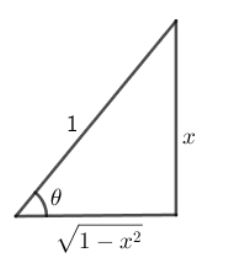
$Base = \sqrt {{H^2} - {P^2}} $
Base = $\sqrt {1 - {x^2}} $.
Therefore, we get
$ \Rightarrow {\sin ^{ - 1}}x = {\cos ^{ - 1}}\dfrac{{\sqrt {1 - {x^2}} }}{1}$.
Hence, $\cos \left( {{{\sin }^{ - 1}}x} \right) = \cos \left( {{{\cos }^{ - 1}}\dfrac{{\sqrt {1 - {x^2}} }}{1}} \right)$
$ \Rightarrow \cos \left( {{{\sin }^{ - 1}}x} \right) = \sqrt {1 - {x^2}} $
Now, we will find the value of $\sin \left( {{{\cos }^{ - 1}}y} \right) = \sin \left( {{{\cos }^{ - 1}}\dfrac{y}{1}} \right)$. As we know $\cos \theta = \dfrac{B}{H}$, from here we will find the value of perpendicular.
The right triangle with base = $y$ and hypotenuse = $1$. Therefore,
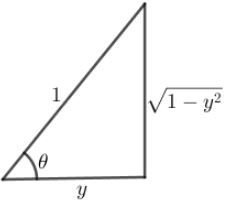
$Perpendicular = \sqrt {{H^2} - {B^2}} $
Perpendicular = $\sqrt {1 - {y^2}} $
Therefore, we get
$ \Rightarrow {\cos ^{ - 1}}y = {\sin ^{ - 1}}\dfrac{{\sqrt {1 - {y^2}} }}{1}$.
Hence, $\sin \left( {{{\cos }^{ - 1}}x} \right) = \sin \left( {{{\sin }^{ - 1}}\dfrac{{\sqrt {1 - {y^2}} }}{1}} \right)$
$ \Rightarrow \sin \left( {{{\cos }^{ - 1}}x} \right) = \sqrt {1 - {y^2}} $
Now, we will substitute value of $\cos \left( {{{\sin }^{ - 1}}x} \right)$ and $\sin \left( {{{\cos }^{ - 1}}y} \right)$ in $\left( i \right)$.
$\sin \left( {{{\sin }^{ - 1}}x + {{\cos }^{ - 1}}y} \right) = xy + \cos \left( {{{\sin }^{ - 1}}x} \right)\sin \left( {{{\cos }^{ - 1}}y} \right).....\left( i \right)$
$ \Rightarrow \sin \left( {{{\sin }^{ - 1}}x + {{\cos }^{ - 1}}y} \right) = xy + \sqrt {1 - {x^2}} \times \sqrt {1 - {y^2}} $
Therefore, we can write $\sin \left( {{{\sin }^{ - 1}}\left( x \right) + {{\cos }^{ - 1}}\left( y \right)} \right)$ without trigonometric functions as $xy + \sqrt {1 - {x^2}} \times \sqrt {1 - {y^2}} $.
Note:Remember that inverse trigonometric functions do the opposite of the regular trigonometric functions. For example: inverse $\sin e$ i.e., ${\sin ^{ - 1}}$ does the opposite of sine. The expression ${\sin ^{ - 1}}x$ is not the same as $\dfrac{1}{{\sin x}}$. In other words, the $ - 1$ is not an exponent. Instead, it simply means inverse function.
Formulae used:
$\sin \left( {A + B} \right) = \sin A\cos B + \cos A\sin B$
$\Rightarrow \sin \left( {{{\sin }^{ - 1}}x} \right) = x$
$\Rightarrow \cos \left( {{{\cos }^{ - 1}}y} \right) = y$
Complete step by step answer:
Given, $\sin \left( {{{\sin }^{ - 1}}\left( x \right) + {{\cos }^{ - 1}}\left( y \right)} \right)$
As we know, $\sin \left( {A + B} \right) = \sin A\cos B + \cos A\sin B$
Let $A = {\sin ^{ - 1}}x$ and $B = {\cos ^{ - 1}}y$.
$ \Rightarrow \sin \left( {{{\sin }^{ - 1}}x + {{\cos }^{ - 1}}y} \right) = \sin \left( {{{\sin }^{ - 1}}x} \right)\cos \left( {{{\cos }^{ - 1}}y} \right) + \cos \left( {{{\sin }^{ - 1}}x} \right)\sin \left( {{{\cos }^{ - 1}}y} \right)$
As we know, $\sin \left( {{{\sin }^{ - 1}}x} \right) = x$ and $\cos \left( {{{\cos }^{ - 1}}y} \right) = y$. Therefore, we get
$ \Rightarrow \sin \left( {{{\sin }^{ - 1}}x + {{\cos }^{ - 1}}y} \right) = xy + \cos \left( {{{\sin }^{ - 1}}x} \right)\sin \left( {{{\cos }^{ - 1}}y} \right).....\left( i \right)$
Now, we will solve $\cos \left( {{{\sin }^{ - 1}}x} \right)$ and $\sin \left( {{{\cos }^{ - 1}}y} \right)$ individually.
We have to find the value of $\cos \left( {{{\sin }^{ - 1}}x} \right) = \cos \left( {{{\sin }^{ - 1}}\dfrac{x}{1}} \right)$. As we know $\sin \theta = \dfrac{P}{H}$, from here we will find the value of base.
The right triangle with perpendicular = $x$ and hypotenuse = $1$. Therefore,
$Base = \sqrt {{H^2} - {P^2}} $
Base = $\sqrt {1 - {x^2}} $.
Therefore, we get
$ \Rightarrow {\sin ^{ - 1}}x = {\cos ^{ - 1}}\dfrac{{\sqrt {1 - {x^2}} }}{1}$.
Hence, $\cos \left( {{{\sin }^{ - 1}}x} \right) = \cos \left( {{{\cos }^{ - 1}}\dfrac{{\sqrt {1 - {x^2}} }}{1}} \right)$
$ \Rightarrow \cos \left( {{{\sin }^{ - 1}}x} \right) = \sqrt {1 - {x^2}} $
Now, we will find the value of $\sin \left( {{{\cos }^{ - 1}}y} \right) = \sin \left( {{{\cos }^{ - 1}}\dfrac{y}{1}} \right)$. As we know $\cos \theta = \dfrac{B}{H}$, from here we will find the value of perpendicular.
The right triangle with base = $y$ and hypotenuse = $1$. Therefore,
$Perpendicular = \sqrt {{H^2} - {B^2}} $
Perpendicular = $\sqrt {1 - {y^2}} $
Therefore, we get
$ \Rightarrow {\cos ^{ - 1}}y = {\sin ^{ - 1}}\dfrac{{\sqrt {1 - {y^2}} }}{1}$.
Hence, $\sin \left( {{{\cos }^{ - 1}}x} \right) = \sin \left( {{{\sin }^{ - 1}}\dfrac{{\sqrt {1 - {y^2}} }}{1}} \right)$
$ \Rightarrow \sin \left( {{{\cos }^{ - 1}}x} \right) = \sqrt {1 - {y^2}} $
Now, we will substitute value of $\cos \left( {{{\sin }^{ - 1}}x} \right)$ and $\sin \left( {{{\cos }^{ - 1}}y} \right)$ in $\left( i \right)$.
$\sin \left( {{{\sin }^{ - 1}}x + {{\cos }^{ - 1}}y} \right) = xy + \cos \left( {{{\sin }^{ - 1}}x} \right)\sin \left( {{{\cos }^{ - 1}}y} \right).....\left( i \right)$
$ \Rightarrow \sin \left( {{{\sin }^{ - 1}}x + {{\cos }^{ - 1}}y} \right) = xy + \sqrt {1 - {x^2}} \times \sqrt {1 - {y^2}} $
Therefore, we can write $\sin \left( {{{\sin }^{ - 1}}\left( x \right) + {{\cos }^{ - 1}}\left( y \right)} \right)$ without trigonometric functions as $xy + \sqrt {1 - {x^2}} \times \sqrt {1 - {y^2}} $.
Note:Remember that inverse trigonometric functions do the opposite of the regular trigonometric functions. For example: inverse $\sin e$ i.e., ${\sin ^{ - 1}}$ does the opposite of sine. The expression ${\sin ^{ - 1}}x$ is not the same as $\dfrac{1}{{\sin x}}$. In other words, the $ - 1$ is not an exponent. Instead, it simply means inverse function.
Recently Updated Pages
Master Class 11 Computer Science: Engaging Questions & Answers for Success

Master Class 11 Business Studies: Engaging Questions & Answers for Success
Master Class 11 Economics: Engaging Questions & Answers for Success
Master Class 11 English: Engaging Questions & Answers for Success
Master Class 11 Maths: Engaging Questions & Answers for Success
Master Class 11 Biology: Engaging Questions & Answers for Success
Trending doubts
One Metric ton is equal to kg A 10000 B 1000 C 100 class 11 physics CBSE
There are 720 permutations of the digits 1 2 3 4 5 class 11 maths CBSE
Discuss the various forms of bacteria class 11 biology CBSE
Draw a diagram of a plant cell and label at least eight class 11 biology CBSE
State the laws of reflection of light
Explain zero factorial class 11 maths CBSE