




Express in the 3 systems of angular measurement the magnitude of the angle of a regular decagon.
Answer
 Verified
608.7k+ views
Hint: We will use the formula $\left( n-2 \right)\times {{180}^{{}^\circ }}$ to find the sum of the interior angles of a regular decagon, and $\dfrac{\left( n-2 \right)}{n}\times {{180}^{{}^\circ }}$ to find the magnitude of each interior angles. Also, we will convert the answer into three systems- 1. Degree 2. Gradient 3. Radian.
We use formula $\left( x\times \dfrac{100}{90} \right)$ to convert degree into gradient and $x\times \dfrac{\pi }{180}$ to convert it into radian.
Complete step-by-step answer:
It is given in the question that we have to express the angular measurement and the magnitude of the angle of the regular decagon. Also, we have to express it into 3 systems.
So, basically decagon is a polygon having 10 equal sides. It can be represented as
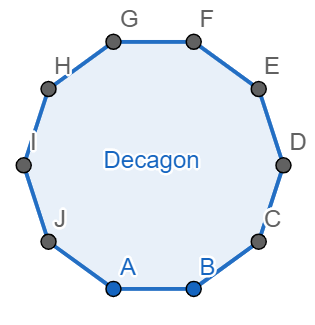
Also, here 3 system of angle measurements are
Degree measurements (English system)
Centesimal system (French system)
Circular system
Basically, in degree measurement, we use 1st ring angle as ${{90}^{{}^\circ }}$, also, ${{1}^{{}^\circ }}=60\text{ minutes}$ and $1\text{ minute}=60\text{seconds}$.
In centesimal system, we use $1=100'$ and $1'=100''$ and
In a circular system, we will use radian measurements. Radian is the angle subtended at the centre of the circle by an arc, that is, $\theta =\dfrac{arc}{radius}$. For conversion of degree into radian we use $\theta \times \dfrac{\pi }{180}$.
Now, we know that the sum of the interior angles of a regular decagon is given by $\left( n-2 \right)\times {{180}^{{}^\circ }}$. So, on putting $n=10$ in the formula, we get the sum of the interior angles of a regular decagon as
$=\left( 10-2 \right)\times {{180}^{{}^\circ }}$
$=8\times {{180}^{{}^\circ }}={{1440}^{{}^\circ }}$.
Now, we know that ${{1}^{{}^\circ }}\times \dfrac{\pi }{180}=0.01745\text{ }radian$, so $1440\times \dfrac{\pi }{180}=8\pi \text{ }radian$
$=24.4361\text{ }radians$.
Also, we know that ${{1}^{{}^\circ }}=60\text{ minutes}$ and $1\text{ minute}=60\text{seconds}$. So, 24.4362 in DMS will be
\[Degree=\operatorname{int}\left( 24.4361 \right)={{24}^{{}^\circ }}\]
\[Minutes\text{ }=\operatorname{int}\left( {{24.4361}^{{}^\circ }}-{{24}^{{}^\circ }} \right)\times 60'=26'\] and
\[seconds\text{ }=\operatorname{int}\left( 24.4361-24-\dfrac{26'}{60} \right)\times 3600=9.96''\].
Thus 24.4361 radian = \[{{24}^{{}^\circ }}26'9.96''\].
Also angle in grades is given by formula $\left( x\times \dfrac{100}{90} \right)$, where x is angle in degrees. Therefore, ${{1440}^{{}^\circ }}={{\left( 1440\times \dfrac{100}{90} \right)}^{g}}={{1600}^{g}}$.
Now, we know that each interior angle of a regular polygon with n sides is given by $\dfrac{\left( n-2 \right)}{n}\times {{180}^{{}^\circ }}$. Therefore, for decagon, we get $=\dfrac{\left( 10-2 \right)}{10}\times {{180}^{{}^\circ }}$ , solving further, we get,
$=\dfrac{8}{10}\times {{180}^{{}^\circ }}={{144}^{{}^\circ }}$.
Now, converting 144 degrees into radian. We know that ${{1}^{{}^\circ }}\times \dfrac{\pi }{180}=0.01745\text{ }radian$, so $144\times \dfrac{\pi }{180}=0.8\pi \text{ }radian$
$=2.513\text{ }radians$.
Also 2.513 radians in DMS
\[Degree=\operatorname{int}\left( 2.513 \right)={{2}^{{}^\circ }}\]
\[Minutes\text{ }=\operatorname{int}\left( {{2.513}^{{}^\circ }}-{{2}^{{}^\circ }} \right)\times 60'=30'\] and
\[seconds\text{ }=\operatorname{int}\left( 2.513-2-\dfrac{30'}{60} \right)\times 3600=46.8''\].
Thus 2.513 radian = \[{{2}^{{}^\circ }}30'46.8''\].
Also angle in grades is given by formula $\left( x\times \dfrac{100}{90} \right)$, where x is angle in degrees. Therefore, ${{144}^{{}^\circ }}={{\left( 144\times \dfrac{100}{90} \right)}^{g}}={{160}^{g}}$.
Note: Many time students don’t know about the 3 system of angle measurement and they may skip the major part of this solution in the exam. Also, many students don’t know about conversion of angle into degree, radian and grade, thus, it is recommended to learn to convert angles into different measuring systems.
We use formula $\left( x\times \dfrac{100}{90} \right)$ to convert degree into gradient and $x\times \dfrac{\pi }{180}$ to convert it into radian.
Complete step-by-step answer:
It is given in the question that we have to express the angular measurement and the magnitude of the angle of the regular decagon. Also, we have to express it into 3 systems.
So, basically decagon is a polygon having 10 equal sides. It can be represented as
Also, here 3 system of angle measurements are
Degree measurements (English system)
Centesimal system (French system)
Circular system
Basically, in degree measurement, we use 1st ring angle as ${{90}^{{}^\circ }}$, also, ${{1}^{{}^\circ }}=60\text{ minutes}$ and $1\text{ minute}=60\text{seconds}$.
In centesimal system, we use $1=100'$ and $1'=100''$ and
In a circular system, we will use radian measurements. Radian is the angle subtended at the centre of the circle by an arc, that is, $\theta =\dfrac{arc}{radius}$. For conversion of degree into radian we use $\theta \times \dfrac{\pi }{180}$.
Now, we know that the sum of the interior angles of a regular decagon is given by $\left( n-2 \right)\times {{180}^{{}^\circ }}$. So, on putting $n=10$ in the formula, we get the sum of the interior angles of a regular decagon as
$=\left( 10-2 \right)\times {{180}^{{}^\circ }}$
$=8\times {{180}^{{}^\circ }}={{1440}^{{}^\circ }}$.
Now, we know that ${{1}^{{}^\circ }}\times \dfrac{\pi }{180}=0.01745\text{ }radian$, so $1440\times \dfrac{\pi }{180}=8\pi \text{ }radian$
$=24.4361\text{ }radians$.
Also, we know that ${{1}^{{}^\circ }}=60\text{ minutes}$ and $1\text{ minute}=60\text{seconds}$. So, 24.4362 in DMS will be
\[Degree=\operatorname{int}\left( 24.4361 \right)={{24}^{{}^\circ }}\]
\[Minutes\text{ }=\operatorname{int}\left( {{24.4361}^{{}^\circ }}-{{24}^{{}^\circ }} \right)\times 60'=26'\] and
\[seconds\text{ }=\operatorname{int}\left( 24.4361-24-\dfrac{26'}{60} \right)\times 3600=9.96''\].
Thus 24.4361 radian = \[{{24}^{{}^\circ }}26'9.96''\].
Also angle in grades is given by formula $\left( x\times \dfrac{100}{90} \right)$, where x is angle in degrees. Therefore, ${{1440}^{{}^\circ }}={{\left( 1440\times \dfrac{100}{90} \right)}^{g}}={{1600}^{g}}$.
Now, we know that each interior angle of a regular polygon with n sides is given by $\dfrac{\left( n-2 \right)}{n}\times {{180}^{{}^\circ }}$. Therefore, for decagon, we get $=\dfrac{\left( 10-2 \right)}{10}\times {{180}^{{}^\circ }}$ , solving further, we get,
$=\dfrac{8}{10}\times {{180}^{{}^\circ }}={{144}^{{}^\circ }}$.
Now, converting 144 degrees into radian. We know that ${{1}^{{}^\circ }}\times \dfrac{\pi }{180}=0.01745\text{ }radian$, so $144\times \dfrac{\pi }{180}=0.8\pi \text{ }radian$
$=2.513\text{ }radians$.
Also 2.513 radians in DMS
\[Degree=\operatorname{int}\left( 2.513 \right)={{2}^{{}^\circ }}\]
\[Minutes\text{ }=\operatorname{int}\left( {{2.513}^{{}^\circ }}-{{2}^{{}^\circ }} \right)\times 60'=30'\] and
\[seconds\text{ }=\operatorname{int}\left( 2.513-2-\dfrac{30'}{60} \right)\times 3600=46.8''\].
Thus 2.513 radian = \[{{2}^{{}^\circ }}30'46.8''\].
Also angle in grades is given by formula $\left( x\times \dfrac{100}{90} \right)$, where x is angle in degrees. Therefore, ${{144}^{{}^\circ }}={{\left( 144\times \dfrac{100}{90} \right)}^{g}}={{160}^{g}}$.
Note: Many time students don’t know about the 3 system of angle measurement and they may skip the major part of this solution in the exam. Also, many students don’t know about conversion of angle into degree, radian and grade, thus, it is recommended to learn to convert angles into different measuring systems.
Recently Updated Pages
Master Class 11 Computer Science: Engaging Questions & Answers for Success

Master Class 11 Business Studies: Engaging Questions & Answers for Success
Master Class 11 Economics: Engaging Questions & Answers for Success
Master Class 11 English: Engaging Questions & Answers for Success
Master Class 11 Maths: Engaging Questions & Answers for Success
Master Class 11 Biology: Engaging Questions & Answers for Success
Trending doubts
One Metric ton is equal to kg A 10000 B 1000 C 100 class 11 physics CBSE
There are 720 permutations of the digits 1 2 3 4 5 class 11 maths CBSE
Discuss the various forms of bacteria class 11 biology CBSE
Draw a diagram of a plant cell and label at least eight class 11 biology CBSE
State the laws of reflection of light
Explain zero factorial class 11 maths CBSE