




Explain with chemical equation, what happens when slaked lime reacts with chlorine?
Answer
 Verified
645.6k+ views
Hint: The slaked lime is the hydroxide of calcium which in reaction with the chlorine gas produces the compound which has a unique property of disinfection as it acts as an oxidant or basic in nature.
Complete step by step answer:
Slaked lime is calcium hydroxide present in solid state,$Ca{{(OH)}_{2}}$. It is formed by adding water to CaO, that is, quicklime.
\[CaO(s)+{{H}_{2}}O(l)\to Ca{{(OH)}_{2}}(s)\]
The slightly moist slaked lime on reaction with chlorine forms calcium hypochlorite, calcium chloride and water.
\[2Ca{{(OH)}_{2}}+2C{{l}_{2}}(g)\to Ca{{(OCl)}_{2}}(s)+CaC{{l}_{2}}(s)+2{{H}_{2}}O(l)\]
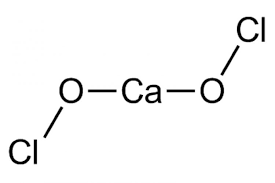
Here, the $Ca{{(OCl)}_{2}}$ has a calcium cation $C{{a}^{2+}}$ and two hypochlorite ions $Cl{{O}^{-}}$ which has the chlorine in $(+1)$ charge and oxygen in ${{O}^{2-}}$. Thus, calcium hypochlorite acts as an oxidising agent and is highly basic. It is an exothermic reaction with the release of heat.
The reaction can also be written for dry slaked lime as, $Ca{{(OH)}_{2}}(s)+C{{l}_{2}}(g)\to CaOC{{l}_{2}}(s)+{{H}_{2}}O(l)$, where the $CaOC{{l}_{2}}$ formed has $C{{l}^{-}}$ and $Cl{{O}^{-}}$ions along with $C{{a}^{2+}}$.
Both $Ca{{(OCl)}_{2}}$and $CaOC{{l}_{2}}$,that is, calcium hypochlorite is known as the bleaching powder and smell of chlorine due to its high availability.
Note: The dilute aqueous solution of slaked lime is known as lime water. The calcium hypochlorite formed is the solid form of chlorine used for chlorination in disinfectants. Therefore, it is used for purification of wastewater or portable water due to its disinfecting ability by the chlorine present having the oxidising nature. Thereby, also, dealing with the taste and odour problem in the disinfected drinking water. It is stored in a cool and dry place, away from any acid, organic materials, and metals.
Complete step by step answer:
Slaked lime is calcium hydroxide present in solid state,$Ca{{(OH)}_{2}}$. It is formed by adding water to CaO, that is, quicklime.
\[CaO(s)+{{H}_{2}}O(l)\to Ca{{(OH)}_{2}}(s)\]
The slightly moist slaked lime on reaction with chlorine forms calcium hypochlorite, calcium chloride and water.
\[2Ca{{(OH)}_{2}}+2C{{l}_{2}}(g)\to Ca{{(OCl)}_{2}}(s)+CaC{{l}_{2}}(s)+2{{H}_{2}}O(l)\]
Here, the $Ca{{(OCl)}_{2}}$ has a calcium cation $C{{a}^{2+}}$ and two hypochlorite ions $Cl{{O}^{-}}$ which has the chlorine in $(+1)$ charge and oxygen in ${{O}^{2-}}$. Thus, calcium hypochlorite acts as an oxidising agent and is highly basic. It is an exothermic reaction with the release of heat.
The reaction can also be written for dry slaked lime as, $Ca{{(OH)}_{2}}(s)+C{{l}_{2}}(g)\to CaOC{{l}_{2}}(s)+{{H}_{2}}O(l)$, where the $CaOC{{l}_{2}}$ formed has $C{{l}^{-}}$ and $Cl{{O}^{-}}$ions along with $C{{a}^{2+}}$.
Both $Ca{{(OCl)}_{2}}$and $CaOC{{l}_{2}}$,that is, calcium hypochlorite is known as the bleaching powder and smell of chlorine due to its high availability.
Note: The dilute aqueous solution of slaked lime is known as lime water. The calcium hypochlorite formed is the solid form of chlorine used for chlorination in disinfectants. Therefore, it is used for purification of wastewater or portable water due to its disinfecting ability by the chlorine present having the oxidising nature. Thereby, also, dealing with the taste and odour problem in the disinfected drinking water. It is stored in a cool and dry place, away from any acid, organic materials, and metals.
Recently Updated Pages
Which will be the least stable resonating structure class 11 chemistry CBSE

How many 5 digit telephone numbers can be construc-class-11-maths-CBSE
How do you find the angle of the resultant vector class 11 physics CBSE
Draw labelled diagram of the following i Gram seed class 11 biology CBSE
1 Quintal is equal to a 110 kg b 10 kg c 100kg d 1000 class 11 physics CBSE
What is the need and importance of classification class 11 biology CBSE
Trending doubts
One Metric ton is equal to kg A 10000 B 1000 C 100 class 11 physics CBSE
Find the value of the expression given below sin 30circ class 11 maths CBSE
Draw a diagram of nephron and explain its structur class 11 biology CBSE
10 examples of friction in our daily life
Proton was discovered by A Thomson B Rutherford C Chadwick class 11 chemistry CBSE
The teeth used for biting and cutting food are called class 11 biology CBSE