




Explain the term perianth.
Answer
 Verified
672k+ views
Hint: It is the non-reproductive part of the flower that forms an envelope surrounding the sexual parts of flowers.
Complete step-by-step answer:
Calyx and corolla are collectively called the perianth. Perianth enclosed the reproductive part of flowers. It is divided into outer and inner whorls. The sepals are the outermost layer which is usually green and encloses the flower bud. They are collectively called the calyx. However, the petals are the next layer of floral appendages internal to the calyx. The sepals and petals in flowers are accessory parts or sterile appendages that protect the flower buds and attract pollinators.
In some plants, the calyx and corolla are separately called dichlamydeous while in some plants they both are indistinguishable and called monochlamydeous. A flower without perianth is called achlamydeous. If the perianth is not differentiated into the calyx and the corolla, called perigon.
The symmetry of flowers decided by the perianth. When the perianth is bisected over the central axis from any point the symmetrical halves are produced, the flower is called actinomorphic. When flowers are bisected and produce only one line that produces symmetrical halves, called zygomorphic.
Types of perianth:
Aposepalous: When the sepals are free, the calyx is called aposepalous.
Synsepalous: If the sepals are partially or wholly fused, the calyx is called as synsepalous.
Asepalous: A flower without calyx is called as asepalous
Sympetalous: The petals are united to form a tubular corolla, called sympetalous.
Apopetalus: If the petals are free, the corolla is called apopetalous.
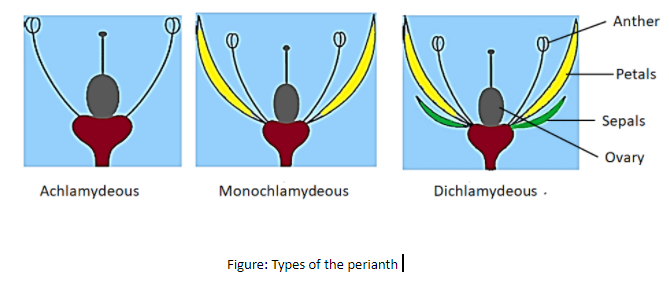
Note: -In the mosses and liverworts, the perianth is the sterile tube-like tissue that surrounds the female reproductive structure.
-In flowers, sepals and petals are collectively called tepals.
Complete step-by-step answer:
Calyx and corolla are collectively called the perianth. Perianth enclosed the reproductive part of flowers. It is divided into outer and inner whorls. The sepals are the outermost layer which is usually green and encloses the flower bud. They are collectively called the calyx. However, the petals are the next layer of floral appendages internal to the calyx. The sepals and petals in flowers are accessory parts or sterile appendages that protect the flower buds and attract pollinators.
In some plants, the calyx and corolla are separately called dichlamydeous while in some plants they both are indistinguishable and called monochlamydeous. A flower without perianth is called achlamydeous. If the perianth is not differentiated into the calyx and the corolla, called perigon.
The symmetry of flowers decided by the perianth. When the perianth is bisected over the central axis from any point the symmetrical halves are produced, the flower is called actinomorphic. When flowers are bisected and produce only one line that produces symmetrical halves, called zygomorphic.
Types of perianth:
Aposepalous: When the sepals are free, the calyx is called aposepalous.
Synsepalous: If the sepals are partially or wholly fused, the calyx is called as synsepalous.
Asepalous: A flower without calyx is called as asepalous
Sympetalous: The petals are united to form a tubular corolla, called sympetalous.
Apopetalus: If the petals are free, the corolla is called apopetalous.
Note: -In the mosses and liverworts, the perianth is the sterile tube-like tissue that surrounds the female reproductive structure.
-In flowers, sepals and petals are collectively called tepals.
Recently Updated Pages
Which will be the least stable resonating structure class 11 chemistry CBSE

How many 5 digit telephone numbers can be construc-class-11-maths-CBSE
How do you find the angle of the resultant vector class 11 physics CBSE
Draw labelled diagram of the following i Gram seed class 11 biology CBSE
1 Quintal is equal to a 110 kg b 10 kg c 100kg d 1000 class 11 physics CBSE
What is the need and importance of classification class 11 biology CBSE
Trending doubts
Find the value of the expression given below sin 30circ class 11 maths CBSE
One Metric ton is equal to kg A 10000 B 1000 C 100 class 11 physics CBSE
10 examples of friction in our daily life
Draw a diagram of a plant cell and label at least eight class 11 biology CBSE
Difference between physical and chemical change class 11 chemistry CBSE
Proton was discovered by A Thomson B Rutherford C Chadwick class 11 chemistry CBSE