




Explain the surface tension on the basis of molecular theory.
Answer
 Verified
612k+ views
Hint: We need to understand both the physical parameters to define each other in the terms of the other. Surface tension is a physical phenomenon, which is visible to us whereas molecular theory is the abstract theory developed from the assumptions.
Complete step-by-step solution
The Surface tension is the physical property experienced by a liquid due to the free or unbonded molecules along the boundaries of the liquid container. It is defined as the force exerted by the liquid molecules along the upper surface of a container per unit length of the container. It is given as –
\[S=\dfrac{F}{2l}\]
The molecular theory for the Surface theory describes that this force exerted by the liquid is due to the extra energy possessed by the molecules along the boundaries which are not bonded to any molecules on the top portion. This excess energy makes the liquid to be less in an equilibrium condition, so the molecules tend to do some work on the particles surrounding it including the container. The strength of molecular interactions within the molecules of the liquid and the interaction with the surrounding material determines whether the liquid wets the surface or not.
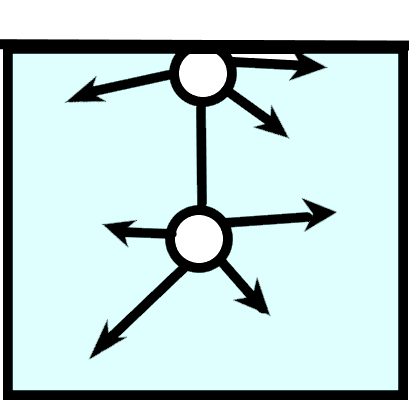
Surface tension can do external work like any other force. This ability of the Surface tension of liquids is employed in many situations to study the properties of the liquids and their dependence on the temperature, pressure, and other physical parameters.
Note: The development of bubbles and drops in a circular form is to reduce the energy in the system of the liquid. The sphere is the shape, which has the lowest energy possible for any given volume. This condition is utilized by the liquids to be at minimum energy.
Complete step-by-step solution
The Surface tension is the physical property experienced by a liquid due to the free or unbonded molecules along the boundaries of the liquid container. It is defined as the force exerted by the liquid molecules along the upper surface of a container per unit length of the container. It is given as –
\[S=\dfrac{F}{2l}\]
The molecular theory for the Surface theory describes that this force exerted by the liquid is due to the extra energy possessed by the molecules along the boundaries which are not bonded to any molecules on the top portion. This excess energy makes the liquid to be less in an equilibrium condition, so the molecules tend to do some work on the particles surrounding it including the container. The strength of molecular interactions within the molecules of the liquid and the interaction with the surrounding material determines whether the liquid wets the surface or not.
Surface tension can do external work like any other force. This ability of the Surface tension of liquids is employed in many situations to study the properties of the liquids and their dependence on the temperature, pressure, and other physical parameters.
Note: The development of bubbles and drops in a circular form is to reduce the energy in the system of the liquid. The sphere is the shape, which has the lowest energy possible for any given volume. This condition is utilized by the liquids to be at minimum energy.
Recently Updated Pages
Master Class 11 English: Engaging Questions & Answers for Success

Master Class 11 Social Science: Engaging Questions & Answers for Success
Master Class 11 Maths: Engaging Questions & Answers for Success
Master Class 11 Biology: Engaging Questions & Answers for Success
Master Class 11 Physics: Engaging Questions & Answers for Success
Master Class 11 Chemistry: Engaging Questions & Answers for Success
Trending doubts
One Metric ton is equal to kg A 10000 B 1000 C 100 class 11 physics CBSE
Difference Between Prokaryotic Cells and Eukaryotic Cells
Two of the body parts which do not appear in MRI are class 11 biology CBSE
Find the value of the expression given below sin 30circ class 11 maths CBSE
Draw a diagram of a plant cell and label at least eight class 11 biology CBSE
10 examples of friction in our daily life