




Explain the starch – sugar interconversion hypothesis of stomatal opening and closing.
Answer
 Verified
570.9k+ views
Hint: To explain the mechanism of transpiration, so many physiologists proposed their view in different types of theories. Out of which one of the most important theories is starch - sugar conversion theory which was proposed by Scarth in 1932.
Complete step by step answer:
According to starch-sugar interconversion theory, the interconversion of starch and sugar is because of a change in pH guard cells.
In day time- Photosynthesis takes place in guard cells, $C{{O}_{2}}$ concentration reduced by this pH of guard cells increases. When pH increases, starch phosphorylase becomes active. Then hydrolysis of starch gets converted into glucose -1 - phosphate.
When the glucose - 1 - phosphate synthesized in the guard cell. Osmotic pressure of the guard cell increases. Osmotic pressure is also known as suction pressure because of this suction pressure, water starts to move from subsidiary cells to guard cells. Hence, the turgidity of the guard cell starts to increase and the stomata open.
$\text{Starch + P}{{\text{O}}_{4}}\underset{\begin{smallmatrix}
\text{phosphorylase-synthesis} \\
\text{pH-5(At night)}
\end{smallmatrix}}{\overset{\begin{smallmatrix}
\text{pH-7 (in day time)} \\
\text{phosphorylase-hydrolyses}
\end{smallmatrix}}{\longleftrightarrow}}\text{Glucose-1-phosphate}$.
At night- The reverse process occurs, when $C{{O}_{2}}$ concentration starts to rise inside that cytoplasm of the guard cell because the synthetic process stop. Hence, the pH decreases. At decreased pH, another enzyme hexokinase converts glucose - 1 - phosphate into starch at night. By this osmotic pressure of guard cells decreases and water moves out of guard cells. Finally, the stomata start to close because of the flaccid condition of guard cells, that's why the name has been given as interconversion of starch and sugar.
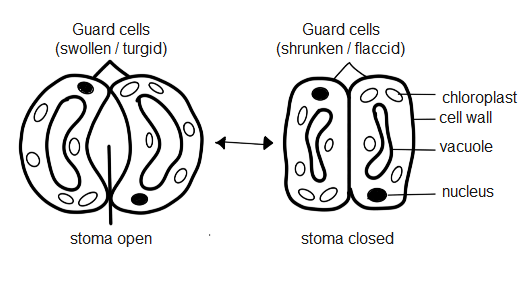
Fig (1): Stomatal movements.
Note: Many theories have been proposed regarding the opening and closing of stomata but they are four major theories of stomatal movement which are accepted: 1. glycolate metabolism theory 2. photosynthesis in guard cell theory 3. Theory of starch - sugar interconversion and 4. Active ${{K}^{+}}$ transport or Potassium pump theory and Role of Abscisic Acid or Active potassium pump theory proposed by Fujino in 1952.
Complete step by step answer:
According to starch-sugar interconversion theory, the interconversion of starch and sugar is because of a change in pH guard cells.
In day time- Photosynthesis takes place in guard cells, $C{{O}_{2}}$ concentration reduced by this pH of guard cells increases. When pH increases, starch phosphorylase becomes active. Then hydrolysis of starch gets converted into glucose -1 - phosphate.
When the glucose - 1 - phosphate synthesized in the guard cell. Osmotic pressure of the guard cell increases. Osmotic pressure is also known as suction pressure because of this suction pressure, water starts to move from subsidiary cells to guard cells. Hence, the turgidity of the guard cell starts to increase and the stomata open.
$\text{Starch + P}{{\text{O}}_{4}}\underset{\begin{smallmatrix}
\text{phosphorylase-synthesis} \\
\text{pH-5(At night)}
\end{smallmatrix}}{\overset{\begin{smallmatrix}
\text{pH-7 (in day time)} \\
\text{phosphorylase-hydrolyses}
\end{smallmatrix}}{\longleftrightarrow}}\text{Glucose-1-phosphate}$.
At night- The reverse process occurs, when $C{{O}_{2}}$ concentration starts to rise inside that cytoplasm of the guard cell because the synthetic process stop. Hence, the pH decreases. At decreased pH, another enzyme hexokinase converts glucose - 1 - phosphate into starch at night. By this osmotic pressure of guard cells decreases and water moves out of guard cells. Finally, the stomata start to close because of the flaccid condition of guard cells, that's why the name has been given as interconversion of starch and sugar.
Fig (1): Stomatal movements.
Note: Many theories have been proposed regarding the opening and closing of stomata but they are four major theories of stomatal movement which are accepted: 1. glycolate metabolism theory 2. photosynthesis in guard cell theory 3. Theory of starch - sugar interconversion and 4. Active ${{K}^{+}}$ transport or Potassium pump theory and Role of Abscisic Acid or Active potassium pump theory proposed by Fujino in 1952.
Recently Updated Pages
Master Class 11 Social Science: Engaging Questions & Answers for Success

Master Class 11 Physics: Engaging Questions & Answers for Success
Master Class 11 Maths: Engaging Questions & Answers for Success
Master Class 11 Economics: Engaging Questions & Answers for Success
Master Class 11 Computer Science: Engaging Questions & Answers for Success
Master Class 11 Chemistry: Engaging Questions & Answers for Success
Trending doubts
How many bones are in the spine class 11 biology CBSE
State and prove Bernoullis theorem class 11 physics CBSE
Discuss the various forms of bacteria class 11 biology CBSE
Draw a diagram of nephron and explain its structur class 11 biology CBSE
What organs are located on the left side of your body class 11 biology CBSE
Draw a labelled diagram showing structure of LS of class 11 biology CBSE