




Explain the replication of bacteriophage with the help of a suitable diagram.
Answer
 Verified
603k+ views
Hint: Bacteriophage is a virus that replicates and infects only bacterial cells. Viruses are obligate parasites that are considered as acellular organisms. They behave like living organisms inside any living body. Replication is the process of formation of multiple copies of the phage genome.
Complete answer:
The bacteriophage virus is often used as a cloning vector for various biotechnology applications. But, it requires any living host’s bacterial body to replicate which is a very complex procedure. During replication, the phage attaches to the host bacterial cells, it introduces its gene to the cytoplasm of the host cell. Then it uses the ribosomes of the host cells to make proteins.
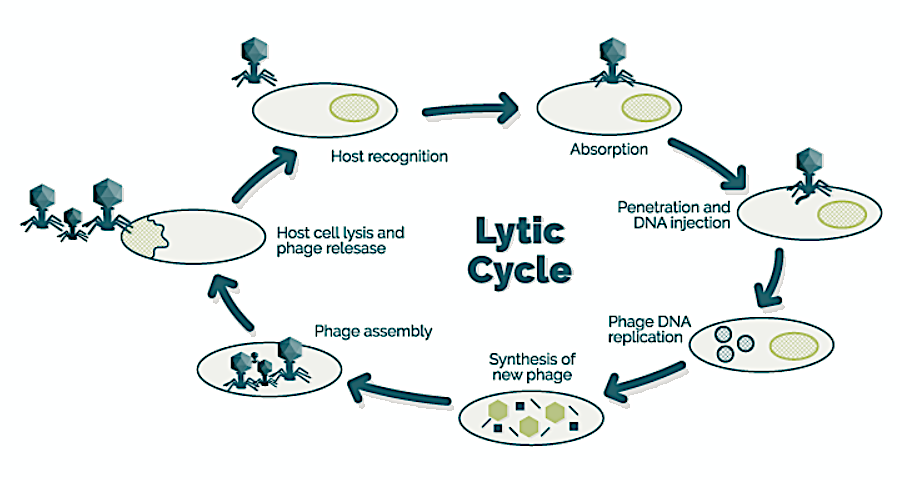
The replication of bacteriophage involves the following steps:
1. The process of bacteriophage replication starts with the attachment of phage to E. coli and injection of the phage chromosome.
2. The breakdown of bacterial chromosomes through phage-specific enzymes has occurred.
3. As a result, the chromosome of phages is replicated by using bacterial materials and enzymes of phage.
4. The genes of phages express themselves in order to produce phage structural components.
5. The progeny phage particles are assembled at this stage.
6. At last the bacterial wall undergoes lysis resulting in the release of progeny phages.
Note: The structure of bacteriophage contains a protein capsule. It needs a host body to replicate. The bacterial plasmid has the ability to form multiple clones of any foreign DNA segment. The bacterium E.coli, as well as bacteriophage, are considered as the most widely used cloning vector in certain genetic engineering processes.
Complete answer:
The bacteriophage virus is often used as a cloning vector for various biotechnology applications. But, it requires any living host’s bacterial body to replicate which is a very complex procedure. During replication, the phage attaches to the host bacterial cells, it introduces its gene to the cytoplasm of the host cell. Then it uses the ribosomes of the host cells to make proteins.
The replication of bacteriophage involves the following steps:
1. The process of bacteriophage replication starts with the attachment of phage to E. coli and injection of the phage chromosome.
2. The breakdown of bacterial chromosomes through phage-specific enzymes has occurred.
3. As a result, the chromosome of phages is replicated by using bacterial materials and enzymes of phage.
4. The genes of phages express themselves in order to produce phage structural components.
5. The progeny phage particles are assembled at this stage.
6. At last the bacterial wall undergoes lysis resulting in the release of progeny phages.
Note: The structure of bacteriophage contains a protein capsule. It needs a host body to replicate. The bacterial plasmid has the ability to form multiple clones of any foreign DNA segment. The bacterium E.coli, as well as bacteriophage, are considered as the most widely used cloning vector in certain genetic engineering processes.
Recently Updated Pages
Master Class 12 Business Studies: Engaging Questions & Answers for Success

Master Class 12 Chemistry: Engaging Questions & Answers for Success
Master Class 12 Biology: Engaging Questions & Answers for Success
Class 12 Question and Answer - Your Ultimate Solutions Guide
Master Class 11 English: Engaging Questions & Answers for Success
Master Class 11 Social Science: Engaging Questions & Answers for Success
Trending doubts
Which are the Top 10 Largest Countries of the World?
Draw a labelled sketch of the human eye class 12 physics CBSE
Differentiate between homogeneous and heterogeneous class 12 chemistry CBSE
Differentiate between Pyramid of energy and pyramid class 12 biology CBSE
Why is the cell called the structural and functional class 12 biology CBSE
Draw the diagram of the pyramid of energy Explain In class 12 biology CBSE