




Explain the refraction of light through a glass-slab with a neat ray diagram.
Answer
 Verified
599.4k+ views
Hint: When the light ray travels from rarer to denser medium it bends towards the normal while that of rarer to denser goes away from normal.
Complete step by step solution: Consider a rectangular glass slab PQRS having parallel faces PQ and RS as shown in below figure.
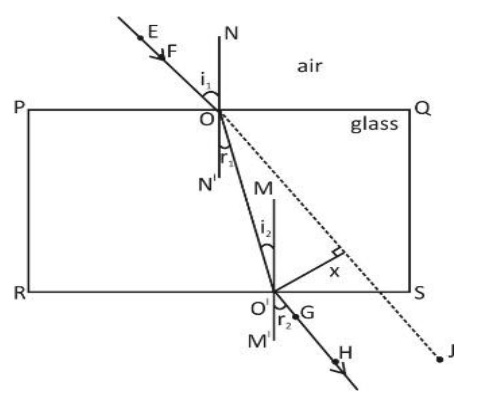
A ray of light EF in air is incident on the glass surface PQ at point O. As the ray EO enters from air (rarer medium) to glass (denser medium), the ray bends towards normal and follows the path $O{O^l}$ inside the glass slab. At point ${O^l}$, refraction enters from glass (denser medium) to air (rarer medium) the ray bends away from normal and follows the path ${O^l}H$ outside the glass slab. Here the ray EF is called incident ray, $O{O^l}$ called refracted ray and ${O^l}H$ called emergent ray.
As per the laws of refraction, the emergent ray ${O^l}H$ will be parallel to the incident ray EF. The perpendicular distance ${O^l}I = x$ between the original path of incident ray and the emergent ray is called the lateral displacement.
Note: When the light ray has incidental in a medium and after this the light ray reflected in different media and then comes out in the same medium as it was incidence then the incident ray and emergent ray are parallel to each other.
Complete step by step solution: Consider a rectangular glass slab PQRS having parallel faces PQ and RS as shown in below figure.
A ray of light EF in air is incident on the glass surface PQ at point O. As the ray EO enters from air (rarer medium) to glass (denser medium), the ray bends towards normal and follows the path $O{O^l}$ inside the glass slab. At point ${O^l}$, refraction enters from glass (denser medium) to air (rarer medium) the ray bends away from normal and follows the path ${O^l}H$ outside the glass slab. Here the ray EF is called incident ray, $O{O^l}$ called refracted ray and ${O^l}H$ called emergent ray.
As per the laws of refraction, the emergent ray ${O^l}H$ will be parallel to the incident ray EF. The perpendicular distance ${O^l}I = x$ between the original path of incident ray and the emergent ray is called the lateral displacement.
Note: When the light ray has incidental in a medium and after this the light ray reflected in different media and then comes out in the same medium as it was incidence then the incident ray and emergent ray are parallel to each other.
Recently Updated Pages
Master Class 10 Computer Science: Engaging Questions & Answers for Success

Master Class 10 Social Science: Engaging Questions & Answers for Success
Master Class 10 Science: Engaging Questions & Answers for Success
Master Class 10 Maths: Engaging Questions & Answers for Success
Master Class 10 General Knowledge: Engaging Questions & Answers for Success
Master Class 10 English: Engaging Questions & Answers for Success
Trending doubts
In basketball, how many quarters are played in an NBA game?
10 examples of evaporation in daily life with explanations
What is the full form of POSCO class 10 social science CBSE
In which year voting age was reduced from 21 to 18?
Which metal is used to connect solar cells to solar class 10 chemistry CBSE
Make a sketch of the human nerve cell What function class 10 biology CBSE