




Explain the Rahat and moat/pulley system.
Answer
 Verified
635.4k+ views
Hint: They are manual Irrigation methods of supplying water to land or crops. They help in the growth of crops and plants and don't rely on rain. The sources are lakes, dams, canals, etc. The water from lakes or canals is lifted by human or cattle labor.
Complete step-by-step answer:
The Rahat system of irrigation was found back in the 1970s. Rahat is a bit dissimilar than the other irrigation systems. Water needs to be consistent as crops can’t give a nice yield without it. It was compulsory to form some type of water collection system to have water disperse out over the fields. Sometimes wells are used to keep water contained and utilize it when needed.
In the Rahat system Oxen, buffalo or cow is used to move a lever in a rotating manner. A turbine that has buckets attached picks up water from a stream is connected to the lever through many gears. The water flows into buckets that could then be dumped over the crops. Places like Africa and the Middle East is this kind of technique. Even now it is used by some tribes.
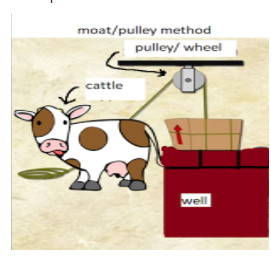
A moat (deep, broad ditch filled with water is dug) has been used in some cases to collect water that was later taken directly to the fields with buckets and water the crops. Moat/pulley is a manual method that requires a wheel (a pulley) and a large well. The wheel is rotated by oxen, buffalo, or cows to get the water out of the well and then spread out over the crops by a human.
Note: There are various other traditional ways of irrigation like a pulley system, chain pump, dhekli, and Rahat. Compared to modern methods like a sprinkler system, drip system, etc. traditional methods are less efficient and cheaper.
Complete step-by-step answer:
The Rahat system of irrigation was found back in the 1970s. Rahat is a bit dissimilar than the other irrigation systems. Water needs to be consistent as crops can’t give a nice yield without it. It was compulsory to form some type of water collection system to have water disperse out over the fields. Sometimes wells are used to keep water contained and utilize it when needed.
In the Rahat system Oxen, buffalo or cow is used to move a lever in a rotating manner. A turbine that has buckets attached picks up water from a stream is connected to the lever through many gears. The water flows into buckets that could then be dumped over the crops. Places like Africa and the Middle East is this kind of technique. Even now it is used by some tribes.
A moat (deep, broad ditch filled with water is dug) has been used in some cases to collect water that was later taken directly to the fields with buckets and water the crops. Moat/pulley is a manual method that requires a wheel (a pulley) and a large well. The wheel is rotated by oxen, buffalo, or cows to get the water out of the well and then spread out over the crops by a human.
Note: There are various other traditional ways of irrigation like a pulley system, chain pump, dhekli, and Rahat. Compared to modern methods like a sprinkler system, drip system, etc. traditional methods are less efficient and cheaper.
Recently Updated Pages
Master Class 11 English: Engaging Questions & Answers for Success

Master Class 11 Social Science: Engaging Questions & Answers for Success
Master Class 11 Maths: Engaging Questions & Answers for Success
Master Class 11 Biology: Engaging Questions & Answers for Success
Master Class 11 Physics: Engaging Questions & Answers for Success
Master Class 11 Chemistry: Engaging Questions & Answers for Success
Trending doubts
One Metric ton is equal to kg A 10000 B 1000 C 100 class 11 physics CBSE
Difference Between Prokaryotic Cells and Eukaryotic Cells
Difference between physical and chemical change class 11 chemistry CBSE
Find the value of the expression given below sin 30circ class 11 maths CBSE
Two of the body parts which do not appear in MRI are class 11 biology CBSE
Draw a diagram of a plant cell and label at least eight class 11 biology CBSE