




Explain the process of roof top rain water harvesting with the help of a suitable diagram.
Answer
 Verified
640.5k+ views
Hint:The roof top rain water harvesting is a method utilized by many people and industries where rainwater is collected and stored in large tanks or discharged in the ground to recharge the groundwater system.
Complete step by step answer:The most applicable method employed to store rain water is roof top rainwater harvesting systems.
The diagram for roof top rain water harvesting is shown below.
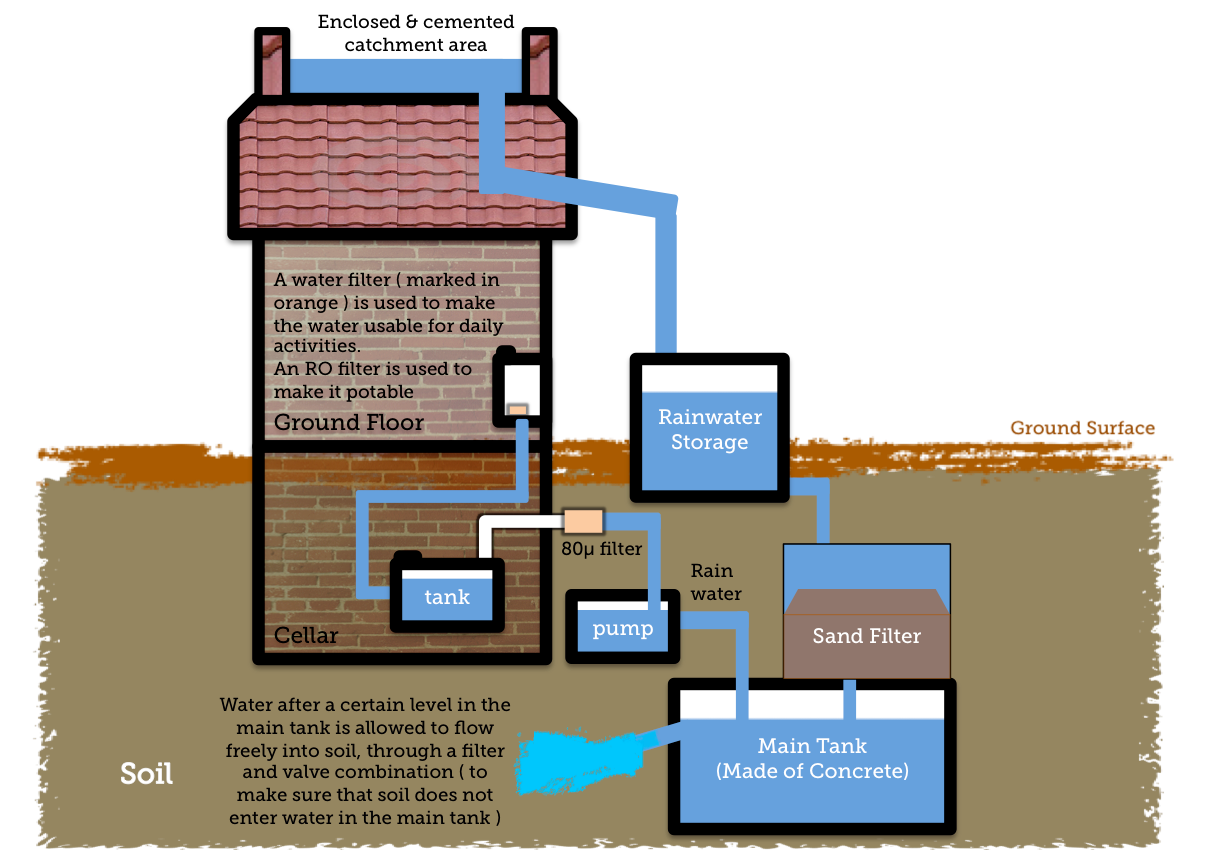
The main components of roof top rain water harvesting are shown below.
1. Catchment: The surface where the rainwater is collected is called the catchment. It can be a terrace, paved or unpaved open ground. The rain water is collected on the terrace which should be flat.
2. Transportation: The water from the roof is transported to the storage system with the help of pipes. The pipes used are made of poly vinyl chloride and are U.V resistant. The water from the terrace is caught through the gutter from which it moves to the pipes.
3. The first flush: The device used to flush the first shower of rain is known as first flush. It is necessary to flush the water to avoid contamination. It also helps in removing the silt present in the surface of the roof.
4. Filters: Filtering of water is done to remove turbidity of the water and other microorganisms. It is necessary to pass the water through filters after the first flush.
After filtration, the water is stored in the storage tank for reuse or discharged to ground which can be recharged by hand pumps.
Note:The filter should be cleaned on a daily basis to avoid clotting, as it prevents the water from moving in the storage tank which will cause overflow. The sand and granules should be removed before it enters the filtering process.
Complete step by step answer:The most applicable method employed to store rain water is roof top rainwater harvesting systems.
The diagram for roof top rain water harvesting is shown below.
The main components of roof top rain water harvesting are shown below.
1. Catchment: The surface where the rainwater is collected is called the catchment. It can be a terrace, paved or unpaved open ground. The rain water is collected on the terrace which should be flat.
2. Transportation: The water from the roof is transported to the storage system with the help of pipes. The pipes used are made of poly vinyl chloride and are U.V resistant. The water from the terrace is caught through the gutter from which it moves to the pipes.
3. The first flush: The device used to flush the first shower of rain is known as first flush. It is necessary to flush the water to avoid contamination. It also helps in removing the silt present in the surface of the roof.
4. Filters: Filtering of water is done to remove turbidity of the water and other microorganisms. It is necessary to pass the water through filters after the first flush.
After filtration, the water is stored in the storage tank for reuse or discharged to ground which can be recharged by hand pumps.
Note:The filter should be cleaned on a daily basis to avoid clotting, as it prevents the water from moving in the storage tank which will cause overflow. The sand and granules should be removed before it enters the filtering process.
Recently Updated Pages
What is BLO What is the full form of BLO class 8 social science CBSE

Explain the Treaty of Vienna of 1815 class 10 social science CBSE
10 examples of friction in our daily life
Draw a diagram of nephron and explain its structur class 11 biology CBSE
Write structures of the following compounds i 2 Chloro3methylpentane class 11 chemistry CBSE
A Paragraph on Pollution in about 100-150 Words
Trending doubts
The normal temperature of the human body on the Kelvin class 9 biology CBSE
Air is a A Homogenous mixture B Heterogeneous mixture class 9 chemistry CBSE
Give 5 examples of refraction of light in daily life
What are merits and demerits of democracy
Write a paragraph on Child labour
Find the value of the expression given below sin 30circ class 11 maths CBSE