




Explain the process of guttation with the help of a diagram.
Answer
 Verified
598.8k+ views
Hint: Guttation is an adaptation for the removal of surplus water. Usually, it takes place from the margins of tips of leaves through stomata like pores, called hydathodes, or 'water stomata'. Exudation sometimes takes place through scars and lenticels of the stem also. By guttation, fully turgid plants remove extra water.
Complete answer:
Guttation is defined as the process of exudation of liquid drops with dissolved inorganic solutes from uninjured xylem endings. So the plant loses water in liquid form. It is common in tropical herbaceous plants, growing under conditions of high atmospheric humidity, high water absorption, and very low transpiration.
Root pressure is the major cause of guttation. Guttation water get outside through hydathodes or water stomata, seen at xylem terminals of leaves. It occurs in some plants like grasses, tomatoes, colocasia, etc.
The amount of the exudate may vary from a few too many drops. Its quality also varies from pure water to a dilute solution of organic and inorganic solutes, such as aspartic acid, asparagine, several sugars, and various inorganic compounds. This is the reason that guttation is a process of water loss in liquid form containing dissolved minerals. Guttation is less important to plants. High humidity and low transpiration increase guttation.
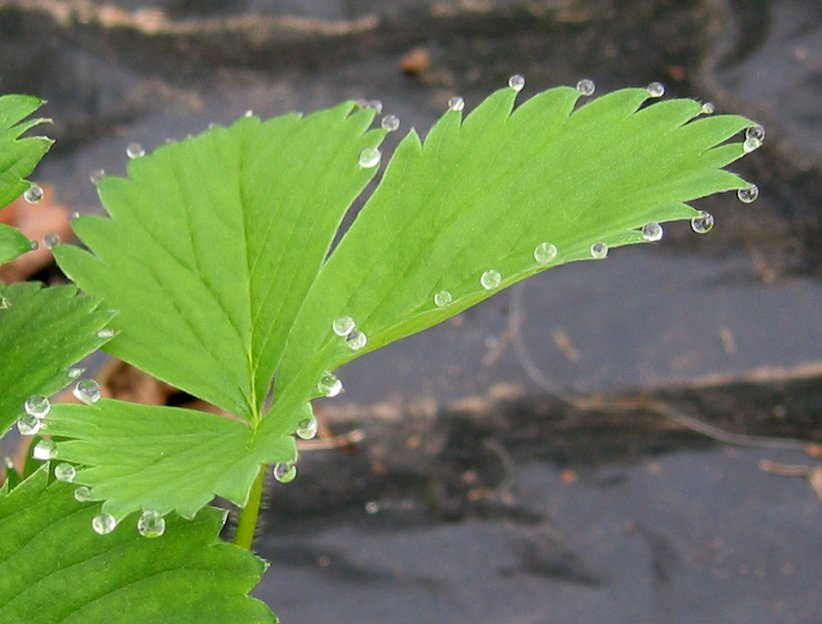
Note: Guttation is a physiological process that takes place in certain plants and occurs through hydathodes present on leaf tips and leaf margins. Dewdrops are formed as a result of condensation of the atmospheric moisture on the cold surface of the leaves at night or in the early morning. Unlike guttation, dewdrops are generally formed on the leaf body and not on the margins, however, they may trickle down to the leaf tips and create confusion.
Complete answer:
Guttation is defined as the process of exudation of liquid drops with dissolved inorganic solutes from uninjured xylem endings. So the plant loses water in liquid form. It is common in tropical herbaceous plants, growing under conditions of high atmospheric humidity, high water absorption, and very low transpiration.
Root pressure is the major cause of guttation. Guttation water get outside through hydathodes or water stomata, seen at xylem terminals of leaves. It occurs in some plants like grasses, tomatoes, colocasia, etc.
The amount of the exudate may vary from a few too many drops. Its quality also varies from pure water to a dilute solution of organic and inorganic solutes, such as aspartic acid, asparagine, several sugars, and various inorganic compounds. This is the reason that guttation is a process of water loss in liquid form containing dissolved minerals. Guttation is less important to plants. High humidity and low transpiration increase guttation.
Note: Guttation is a physiological process that takes place in certain plants and occurs through hydathodes present on leaf tips and leaf margins. Dewdrops are formed as a result of condensation of the atmospheric moisture on the cold surface of the leaves at night or in the early morning. Unlike guttation, dewdrops are generally formed on the leaf body and not on the margins, however, they may trickle down to the leaf tips and create confusion.
Recently Updated Pages
Master Class 12 Economics: Engaging Questions & Answers for Success

Master Class 12 English: Engaging Questions & Answers for Success
Master Class 12 Social Science: Engaging Questions & Answers for Success
Master Class 12 Maths: Engaging Questions & Answers for Success
Master Class 12 Physics: Engaging Questions & Answers for Success
Master Class 9 General Knowledge: Engaging Questions & Answers for Success
Trending doubts
One Metric ton is equal to kg A 10000 B 1000 C 100 class 11 physics CBSE
Difference Between Prokaryotic Cells and Eukaryotic Cells
Find the value of the expression given below sin 30circ class 11 maths CBSE
Two of the body parts which do not appear in MRI are class 11 biology CBSE
Draw a diagram of nephron and explain its structur class 11 biology CBSE
10 examples of friction in our daily life