




Explain the process of cellular respiration.
Answer
 Verified
614.1k+ views
Hint: The cellular respiration is a long process involving three sub-processes, glycolysis, TCA cycle, and oxidative phosphorylation. Each of them has multiple steps involving oxidation, reduction, isomerization, dehydrogenation, and hydrogenation. Each step is facilitated by enzymes.
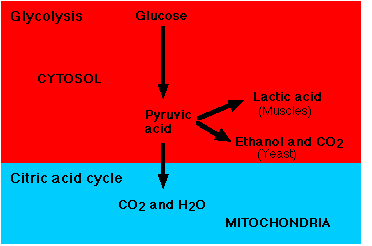
Step by step answer:The cellular respiration takes place in three processes:
1. Glycolysis
2. Kreb’s cycle Or TCA cycle
3. Oxidative phosphorylation
-The process of glycolysis is:
In the very first step of glycolysis, the transfer of phosphate from the ATP to glucose takes place, making the glucose-6-phosphate in the presence of the enzymes hexokinase and glucokinase. In the next step, glucose 6-phosphate is reversibly isomerized to fructose-6-phosphate by the enzyme phosphohexoisomerase. In the next step, fructose-6-phosphate is converted into fructose-1, 6-bisphosphate in the presence of an enzyme called phosphofructokinase. In the next step, the enzyme fructose diphosphate aldolase breaks fructose 1, 6-bisphosphate. This leads to the formation of two glyceraldehyde-3-phosphate and dihydroxyacetone phosphate. In the next step, dihydroxyacetone phosphate isomerizes into glyceraldehyde-3-phosphate in the presence of triose phosphate isomerase. The glyceraldehyde-3-phosphate is transformed into 1, 3-bisphosphoglycerate by the enzyme glyceraldehyde 3-phosphate dehydrogenase. In the next step, the shift of phosphate group from the 1, 3-bisphosphoglycerate to ADP by the enzyme phosphoglycerate kinase occurs, thus producing 2 ATP molecules and a 3-phosphoglycerate molecule. The 3-phosphoglycerate gets transformed into 2-phosphoglycerate due to the shift of phosphoryl group from ${{C}_{3}}$ to ${{C}_{2}}$ carbon which is facilitated by enzyme phosphoglycerate mutase. In the next step, dehydration happens. 2-phosphoglycerate forms in the presence of phosphopyruvate hydratase. In the last step, phosphoenolpyruvate converts into an enol form of pyruvate using the enzyme pyruvate kinase. The enol form of Pyruvate isomerizes quickly to form keto form of pyruvate.
-The process of the TCA cycle is:
The first step of the citric acid cycle is combining the four-carbon compound oxaloacetate to a two-carbon compound acetyl CoA. This results in the formation of a six-carbon compound citric acid, CoA in the presence of the enzyme citrate synthase which is later cleaved to free coenzyme A and to form citrate. In the next step, citrate is converted into isocitrate through the formation of cis-aconitase in the presence of the enzyme aconitase and later cis-aconitase dehydrates into isocitrate. In the next step, isocitrate is oxidatively decarboxylated and converted into a five-carbon compound called α-ketoglutarate facilitated by the enzyme isocitrate dehydrogenase. Next, $\alpha $-ketoglutarate is oxidatively decarboxylated and converted a four-carbon compound, succinyl-CoA, and $C{{O}_{2}}$ in the presence of the enzyme $\alpha $-ketoglutarate dehydrogenase. Further, Succinyl-CoA is cleaved to form succinate in the presence of enzyme succinyl-CoA synthase. In the next step, succinyl-CoA is dehydrogenated to fumarate facilitated by the enzyme succinate dehydrogenase. In the next step, hydration takes place and fumarate is converted to L-malate in the presence of the enzyme fumarate hydratase. In the very last step, L-malate is dehydrogenated to oxaloacetate, facilitated by the enzyme of L-malate dehydrogenase.
-In oxidative phosphorylation ATP is formed. It happens due to the transfer of electrons from NADH to ${{O}_{2}}$ by a series of electron carriers. This is the final step for cellular respiration.
Note: The final steps take place in the mitochondria of an organism. In every cycle of cellular respiration, 36 to 38 molecules of ATP are generated from one glucose molecule.
Step by step answer:The cellular respiration takes place in three processes:
1. Glycolysis
2. Kreb’s cycle Or TCA cycle
3. Oxidative phosphorylation
-The process of glycolysis is:
In the very first step of glycolysis, the transfer of phosphate from the ATP to glucose takes place, making the glucose-6-phosphate in the presence of the enzymes hexokinase and glucokinase. In the next step, glucose 6-phosphate is reversibly isomerized to fructose-6-phosphate by the enzyme phosphohexoisomerase. In the next step, fructose-6-phosphate is converted into fructose-1, 6-bisphosphate in the presence of an enzyme called phosphofructokinase. In the next step, the enzyme fructose diphosphate aldolase breaks fructose 1, 6-bisphosphate. This leads to the formation of two glyceraldehyde-3-phosphate and dihydroxyacetone phosphate. In the next step, dihydroxyacetone phosphate isomerizes into glyceraldehyde-3-phosphate in the presence of triose phosphate isomerase. The glyceraldehyde-3-phosphate is transformed into 1, 3-bisphosphoglycerate by the enzyme glyceraldehyde 3-phosphate dehydrogenase. In the next step, the shift of phosphate group from the 1, 3-bisphosphoglycerate to ADP by the enzyme phosphoglycerate kinase occurs, thus producing 2 ATP molecules and a 3-phosphoglycerate molecule. The 3-phosphoglycerate gets transformed into 2-phosphoglycerate due to the shift of phosphoryl group from ${{C}_{3}}$ to ${{C}_{2}}$ carbon which is facilitated by enzyme phosphoglycerate mutase. In the next step, dehydration happens. 2-phosphoglycerate forms in the presence of phosphopyruvate hydratase. In the last step, phosphoenolpyruvate converts into an enol form of pyruvate using the enzyme pyruvate kinase. The enol form of Pyruvate isomerizes quickly to form keto form of pyruvate.
-The process of the TCA cycle is:
The first step of the citric acid cycle is combining the four-carbon compound oxaloacetate to a two-carbon compound acetyl CoA. This results in the formation of a six-carbon compound citric acid, CoA in the presence of the enzyme citrate synthase which is later cleaved to free coenzyme A and to form citrate. In the next step, citrate is converted into isocitrate through the formation of cis-aconitase in the presence of the enzyme aconitase and later cis-aconitase dehydrates into isocitrate. In the next step, isocitrate is oxidatively decarboxylated and converted into a five-carbon compound called α-ketoglutarate facilitated by the enzyme isocitrate dehydrogenase. Next, $\alpha $-ketoglutarate is oxidatively decarboxylated and converted a four-carbon compound, succinyl-CoA, and $C{{O}_{2}}$ in the presence of the enzyme $\alpha $-ketoglutarate dehydrogenase. Further, Succinyl-CoA is cleaved to form succinate in the presence of enzyme succinyl-CoA synthase. In the next step, succinyl-CoA is dehydrogenated to fumarate facilitated by the enzyme succinate dehydrogenase. In the next step, hydration takes place and fumarate is converted to L-malate in the presence of the enzyme fumarate hydratase. In the very last step, L-malate is dehydrogenated to oxaloacetate, facilitated by the enzyme of L-malate dehydrogenase.
-In oxidative phosphorylation ATP is formed. It happens due to the transfer of electrons from NADH to ${{O}_{2}}$ by a series of electron carriers. This is the final step for cellular respiration.
Note: The final steps take place in the mitochondria of an organism. In every cycle of cellular respiration, 36 to 38 molecules of ATP are generated from one glucose molecule.
Recently Updated Pages
Master Class 9 General Knowledge: Engaging Questions & Answers for Success

Master Class 9 Maths: Engaging Questions & Answers for Success
Master Class 9 Science: Engaging Questions & Answers for Success
Master Class 9 English: Engaging Questions & Answers for Success
Master Class 9 Social Science: Engaging Questions & Answers for Success
Class 9 Question and Answer - Your Ultimate Solutions Guide
Trending doubts
One Metric ton is equal to kg A 10000 B 1000 C 100 class 11 physics CBSE
Difference Between Prokaryotic Cells and Eukaryotic Cells
Two of the body parts which do not appear in MRI are class 11 biology CBSE
1 ton equals to A 100 kg B 1000 kg C 10 kg D 10000 class 11 physics CBSE
10 examples of friction in our daily life
Name the Largest and the Smallest Cell in the Human Body ?