




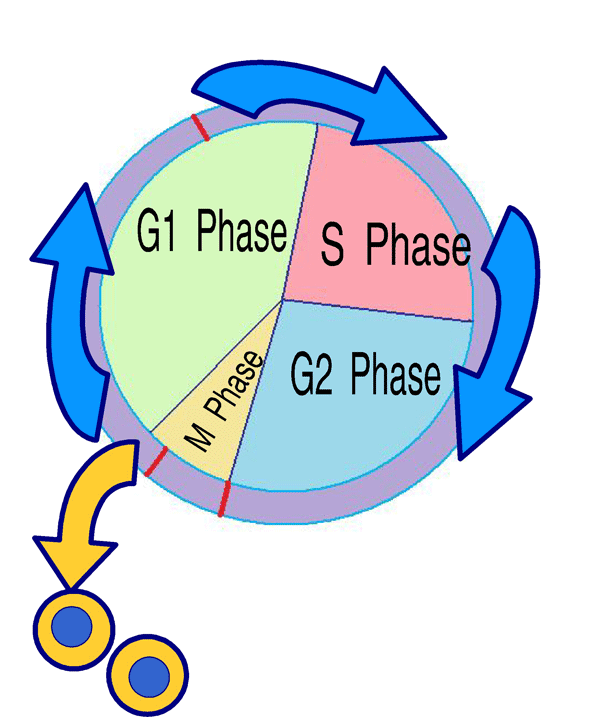
Explain the interphase of the cell cycle with the help of a diagrammatic view.
Answer
 Verified
599.7k+ views
Hint: Cell cycle is the Process in which one cell divides into two daughter cells having the same number of chromosomes as the parent cell. Interphase is the phase where a cell starts its growth and replicates its genome content.
Complete answer:
Cell cycle is a process of sequenced events that occurs in a cell where it undergoes different physical and biological changes and a single cell ultimately results in two daughter cells. Cell cycle consists of four major stages or steps: $G_1$-phase, S-phase, $G_2$-phase and M-phase. Initial three stages, $G_1$-phase, S-phase and $G_2$-phase are combined called as interphase.
Interphase starts with $G_1$ or Gap1 phase and the cell accumulates all the necessary protein and growth factors essential for next stages of cell division. Cells undergo different biosynthetic processes and duration of this phase can vary according to the environmental factors and different organisms and different types of cells within the same organism.
Next step of interphase is the S-phase or Synthesis phase, in which the stage cell replicates its genetic material and duplicates it. Here the amount of genetic material doubles but the number of chromosomes remains the same as the parent cell.
Next step of interphase is the $G_2$ or Gap2 phase. In this stage, cells synthesize all necessary proteins and factors required for the mitotic phase. And after completion of the $G_2$ phase, the cell goes to M-phase. And completion of the cell cycle completes.
Note: Before moving into M-phase from $G_2$ phase, the cell should pass through a checkpoint which is a regulatory system of cells which ensures the smooth regulation and cell division. It is regulated by the p53 gene which is involved in DNA repair if there is any damage in DNA.
Complete answer:
Cell cycle is a process of sequenced events that occurs in a cell where it undergoes different physical and biological changes and a single cell ultimately results in two daughter cells. Cell cycle consists of four major stages or steps: $G_1$-phase, S-phase, $G_2$-phase and M-phase. Initial three stages, $G_1$-phase, S-phase and $G_2$-phase are combined called as interphase.
Interphase starts with $G_1$ or Gap1 phase and the cell accumulates all the necessary protein and growth factors essential for next stages of cell division. Cells undergo different biosynthetic processes and duration of this phase can vary according to the environmental factors and different organisms and different types of cells within the same organism.
Next step of interphase is the S-phase or Synthesis phase, in which the stage cell replicates its genetic material and duplicates it. Here the amount of genetic material doubles but the number of chromosomes remains the same as the parent cell.
Next step of interphase is the $G_2$ or Gap2 phase. In this stage, cells synthesize all necessary proteins and factors required for the mitotic phase. And after completion of the $G_2$ phase, the cell goes to M-phase. And completion of the cell cycle completes.
Note: Before moving into M-phase from $G_2$ phase, the cell should pass through a checkpoint which is a regulatory system of cells which ensures the smooth regulation and cell division. It is regulated by the p53 gene which is involved in DNA repair if there is any damage in DNA.
Recently Updated Pages
Master Class 11 English: Engaging Questions & Answers for Success

Master Class 11 Social Science: Engaging Questions & Answers for Success
Master Class 11 Maths: Engaging Questions & Answers for Success
Master Class 11 Biology: Engaging Questions & Answers for Success
Master Class 11 Physics: Engaging Questions & Answers for Success
Master Class 11 Chemistry: Engaging Questions & Answers for Success
Trending doubts
One Metric ton is equal to kg A 10000 B 1000 C 100 class 11 physics CBSE
Difference Between Prokaryotic Cells and Eukaryotic Cells
Find the value of the expression given below sin 30circ class 11 maths CBSE
Difference between physical and chemical change class 11 chemistry CBSE
Two of the body parts which do not appear in MRI are class 11 biology CBSE
Draw a diagram of a plant cell and label at least eight class 11 biology CBSE