




Explain the formation of the mirage.
Answer
 Verified
618.3k+ views
Hint: We know that the mirage is an optical phenomenon. We need to understand the conditions and other factors, which cause it to happen. The mirage is a daily-life experience of total internal reflection in hot and dry regions around us.
Complete step by step solution:
The total internal reflection is a refraction phenomenon. We know that light rays traveling from one medium to the other undergo refraction. The type of refraction depends on the refractive indices of the two media.
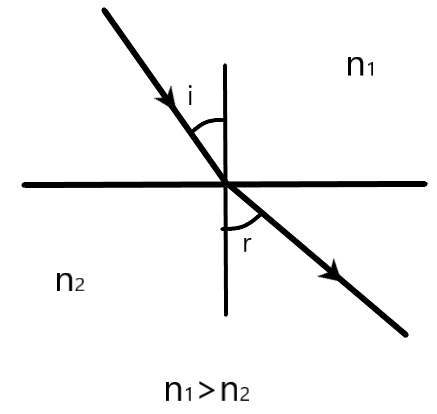
The total internal reflection is an exclusive phenomenon for the refraction of the light rays from a medium of higher refractive to a medium of lower refractive index. The rays tend to move away from the normal in usual cases. As the incident angle increases, there reaches a critical angle after which the light rays will not pass through the second medium, instead get reflected back to the first medium itself. This critical angle is the minimum condition for the total internal reflection.

Now, when we consider the mirage, it is an atmospheric optical phenomenon. We know that the air has different densities at different heights. On a hot day, the atmosphere will clearly form layers of decreasing refractive indices downwards as the hot air rises. The bottom-most layer of the atmosphere close to the ground has a lower refractive index than the other layers.

As a result, the light coming from higher altitudes of higher refractive indices to lower altitudes of lower refractive indices tend to get away from the normal and finally reaches the critical angle where it completely reflects back.
This creates a sensation for human eyes to see a water-like surface on the ground when looked at due to the optical illusion caused by refraction. It is the sky, which is observed as a reflection on the ground. This is the phenomenon of mirage.
Note: The mirages are misleading for desert wanderers who see oasis-like illusions far ahead of them. There is also an opposite phenomenon, known as ‘looming’ in which cold air above the ocean surfaces in misty days makes the illusion of ships at far distances as viewed from ashore.
Complete step by step solution:
The total internal reflection is a refraction phenomenon. We know that light rays traveling from one medium to the other undergo refraction. The type of refraction depends on the refractive indices of the two media.
The total internal reflection is an exclusive phenomenon for the refraction of the light rays from a medium of higher refractive to a medium of lower refractive index. The rays tend to move away from the normal in usual cases. As the incident angle increases, there reaches a critical angle after which the light rays will not pass through the second medium, instead get reflected back to the first medium itself. This critical angle is the minimum condition for the total internal reflection.
Now, when we consider the mirage, it is an atmospheric optical phenomenon. We know that the air has different densities at different heights. On a hot day, the atmosphere will clearly form layers of decreasing refractive indices downwards as the hot air rises. The bottom-most layer of the atmosphere close to the ground has a lower refractive index than the other layers.
As a result, the light coming from higher altitudes of higher refractive indices to lower altitudes of lower refractive indices tend to get away from the normal and finally reaches the critical angle where it completely reflects back.
This creates a sensation for human eyes to see a water-like surface on the ground when looked at due to the optical illusion caused by refraction. It is the sky, which is observed as a reflection on the ground. This is the phenomenon of mirage.
Note: The mirages are misleading for desert wanderers who see oasis-like illusions far ahead of them. There is also an opposite phenomenon, known as ‘looming’ in which cold air above the ocean surfaces in misty days makes the illusion of ships at far distances as viewed from ashore.
Recently Updated Pages
Match columnI with columnII and choose the correct class 12 biology NEET_UG

Match columnI with columnII and choose the correct class 12 biology NEET_UG
Match columnI with columnII and choose the correct class 12 biology NEET_UG
Which plant will lose its economic value if its fruits class 12 biology NEET_UG
Human insulin is being commercially produced from a class 12 biology NEET_UG
Match columnI with columnII and choose the correct class 12 biology NEET_UG
Trending doubts
Which are the Top 10 Largest Countries of the World?
Draw a labelled sketch of the human eye class 12 physics CBSE
Differentiate between homogeneous and heterogeneous class 12 chemistry CBSE
Draw a well labelled diagram of LS of the human ki class 12 biology CBSE
Modern Homo sapiens arose during the ice age between class 12 biology CBSE
Why is the cell called the structural and functional class 12 biology CBSE